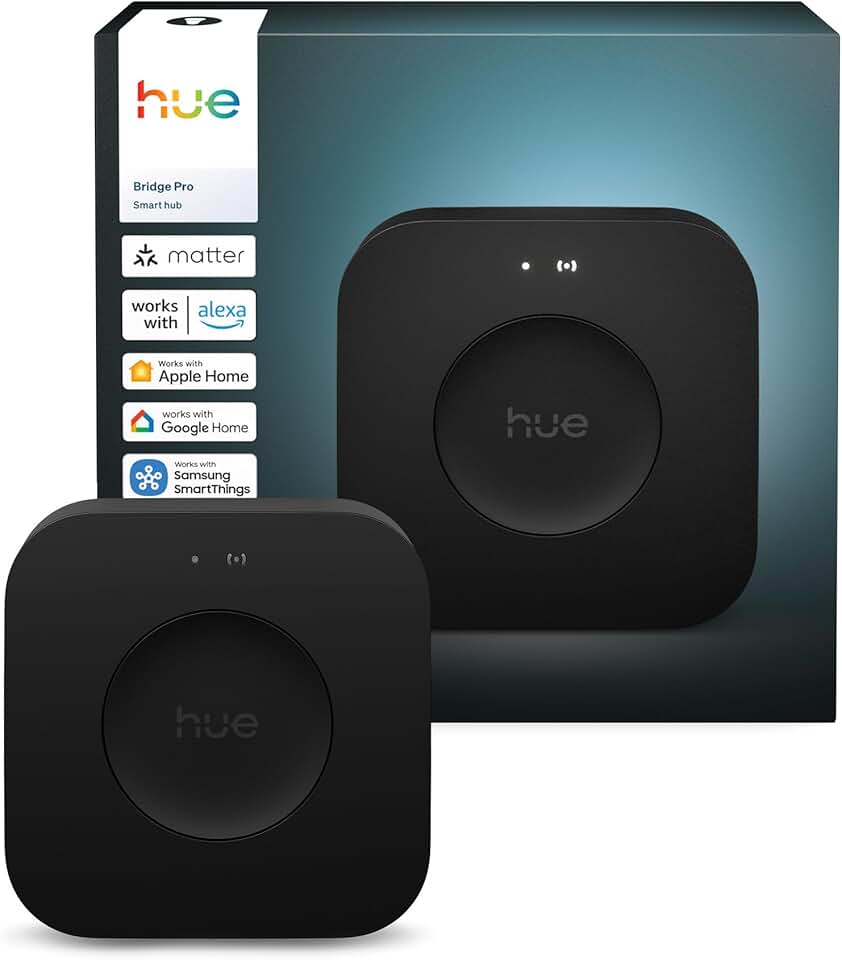
The Philips Hue Bridge Pro stands as the central nervous system for any robust Philips Hue smart lighting system. It is an essential component that unlocks the full potential of your smart bulbs, strips, and fixtures, enabling advanced control, automation, and integration with other smart home platforms.
Quick Summary: Philips Hue Bridge Pro
Rating: 4.2 out of 5 stars
Price: $98.99 USD
Key Pros:
- Unlocks full Hue ecosystem features and advanced automations.
- Supports a vast number of lights and accessories (150+ lights, 50+ accessories).
- Offers robust local control, ensuring reliability even without internet.
Key Cons:
- An additional upfront cost for a smart lighting system.
- Requires an Ethernet connection to your router.
Table of Contents
Philips Hue Bridge Pro Overview
The Philips Hue Bridge Pro is far more than just a simple gadget; it’s the dedicated control hub that orchestrates your entire Philips Hue smart lighting ecosystem. Without it, many of the advanced functionalities that make Hue a premium smart lighting solution would be unavailable. It acts as the translator between your Hue app, voice assistants, and your Zigbee-enabled Hue lights.
This bridge ensures a stable and responsive network for your lights, creating a dedicated Zigbee mesh network that operates independently of your home Wi-Fi. This means that even if your internet goes down, your lights can still be controlled locally through the Hue app, a significant advantage over Wi-Fi-only smart bulbs.
The Pro version of the Hue Bridge builds upon the robust foundation of its predecessors, offering enhanced security features and potentially future-proofing your smart home setup. It’s designed to handle a large number of devices, supporting over 150 lights and more than 50 accessories simultaneously, making it suitable for even the most expansive smart home installations.
Its primary function is to consolidate all your Hue devices under one central control point, allowing for seamless integration and automation. From creating custom scenes and schedules to enabling dynamic light effects and connecting with entertainment systems, the bridge is the cornerstone of these capabilities.
The device itself is compact and unobtrusive, typically connected via an Ethernet cable to your home router. This wired connection provides a stable and reliable link to your home network, which is crucial for consistent performance and quick response times when controlling your lights.
For users looking to expand beyond basic on/off control and embrace the full spectrum of smart lighting possibilities, the Philips Hue Bridge Pro is an indispensable investment. It transforms individual smart bulbs into a cohesive, intelligent lighting system, capable of adapting to your lifestyle and enhancing your home environment.
The bridge also facilitates integration with major smart home platforms such as Apple HomeKit, Amazon Alexa, Google Assistant, and Samsung SmartThings. This broad compatibility allows you to control your Hue lights using your preferred voice assistant or through a centralized smart home app, adding another layer of convenience and automation.
Understanding the role of the Philips Hue Bridge Pro is key to appreciating the value it brings to a smart lighting setup. It’s not just about turning lights on and off; it’s about creating immersive experiences, enhancing security, and simplifying daily routines through intelligent illumination.
Philips Hue Bridge Pro Key Features & Specs
The Philips Hue Bridge Pro is engineered with a suite of features and specifications that cement its position as a leading smart lighting hub. Its core strength lies in its ability to create a dedicated Zigbee network, which is purpose-built for smart home devices, offering superior reliability and responsiveness compared to Wi-Fi-based solutions.
A standout feature is its impressive device capacity. The bridge can simultaneously support over 150 Philips Hue lights and more than 50 accessories, such as dimmer switches, motion sensors, and smart buttons. This high capacity ensures that even large homes with numerous smart lights and controls can operate seamlessly under a single bridge.
Advanced encryption is another critical aspect of the Philips Hue Bridge Pro. With growing concerns about smart home security, Philips has implemented robust encryption protocols to protect your data and prevent unauthorized access to your lighting system. This provides peace of mind, knowing your smart home is secure.
Compatibility is a major advantage, as the bridge works flawlessly with a wide array of smart home ecosystems. It supports Apple HomeKit, allowing for Siri voice control and integration into HomeKit scenes and automations. Similarly, it integrates with Amazon Alexa and Google Assistant, enabling voice commands and routines through Echo and Google Home devices.
Furthermore, the Philips Hue Bridge Pro is compatible with Samsung SmartThings, expanding its reach into broader smart home automation scenarios. This multi-platform support makes it an incredibly versatile hub, regardless of your existing smart home setup.
The bridge utilizes the Zigbee Light Link standard, which is an open global standard for wireless communication between smart devices. This standard is known for its low power consumption and robust mesh networking capabilities, ensuring that signals can hop between devices, extending the range and reliability of your smart lighting network.
Local control is a significant benefit; once configured, many functions of your Hue system can operate without an active internet connection. This means that scheduled automations and local app control will continue to work, maintaining functionality during internet outages.
Physically, the bridge is a small, white square device that connects to your router via an Ethernet cable. It requires a power adapter, which is typically included. Its discreet design allows it to blend easily into most home environments without drawing undue attention.
The companion Philips Hue app, available for iOS and Android, provides an intuitive interface for managing your entire lighting system. From setting up new lights and creating custom scenes to configuring complex automations and integrating with entertainment, the app unlocks the full potential of the Philips Hue Bridge Pro.
Regular firmware updates are also a key specification, ensuring that the bridge remains secure, compatible with new features, and optimized for performance over time. Philips consistently releases updates to enhance functionality and address any potential issues, adding to the long-term value of the product.
Pros & Cons of the Philips Hue Bridge Pro
Evaluating the Philips Hue Bridge Pro involves weighing its numerous benefits against a few minor drawbacks. Understanding these aspects is crucial for potential buyers to determine if it aligns with their smart home aspirations and budget.
Pros:
- Unlocks Full Hue Ecosystem Features: The primary advantage is access to all advanced functionalities of Philips Hue. This includes dynamic scenes, complex automations, Hue Sync for entertainment, and precise color control across multiple lights. Without the bridge, Hue bulbs function as basic smart bulbs via Bluetooth, lacking the robust network and capabilities.
- Superior Reliability and Responsiveness: By creating its own dedicated Zigbee mesh network, the bridge offers a far more stable and responsive lighting system than Wi-Fi-only bulbs. Commands are executed almost instantly, and the network is less prone to interference or slowdowns from other home Wi-Fi traffic.
- High Device Capacity: Supporting over 150 lights and 50+ accessories, the Philips Hue Bridge Pro is designed for scalability. This ensures that even in large homes or commercial settings, you won’t quickly run out of capacity as you expand your smart lighting setup.
- Local Control Functionality: A significant benefit is the ability to control your lights and execute automations even if your internet connection is down. This ensures that essential lighting functions remain operational, providing a crucial layer of dependability.
- Broad Smart Home Integration: The bridge’s compatibility with Apple HomeKit, Amazon Alexa, Google Assistant, and Samsung SmartThings makes it incredibly versatile. Users can integrate their Hue lights into their preferred smart home platform for centralized control and voice commands.
- Enhanced Security Measures: The inclusion of advanced encryption protocols provides a secure environment for your smart lighting data. This focus on security helps protect your home network from potential vulnerabilities associated with connected devices.
- Robust Automation and Scheduling: With the bridge, users can create intricate lighting schedules, set up routines based on presence or time of day, and link lights to motion sensors. This level of automation significantly enhances convenience and energy efficiency.
Cons:
- Additional Upfront Cost: The most notable downside is that the Philips Hue Bridge Pro is an extra purchase required to fully utilize the Hue system. This adds to the overall investment, especially for those just starting their smart lighting journey.
- Requires Ethernet Connection: The bridge needs to be physically connected to your home router via an Ethernet cable. While this ensures stability, it means the bridge must be placed near your router, which might not be ideal for all home layouts or aesthetics. It also occupies a port on your router.
- Potential for Overwhelm for Beginners: While powerful, the extensive features and customization options available through the bridge and Hue app might be a bit overwhelming for users new to smart home technology. The learning curve for complex automations can be steeper than simple Bluetooth-controlled bulbs.
- Dependent on a Single Point of Failure: As the central hub, if the bridge itself malfunctions, the entire Hue system can become inoperable. While rare, this centralized dependency is a consideration, though Philips products are generally known for their reliability.
Overall, the pros of the Philips Hue Bridge Pro heavily outweigh its cons for anyone serious about building a comprehensive and reliable smart lighting system. Its capabilities justify the additional investment for the enhanced experience it provides.
Who Should Buy the Philips Hue Bridge Pro?
Deciding whether the Philips Hue Bridge Pro is the right investment for your home depends largely on your smart lighting aspirations and existing setup. It’s not a universal requirement for all smart bulb users, but it becomes indispensable for specific user profiles and use cases.
Smart Home Enthusiasts and Integrators: If you’re passionate about smart home technology and enjoy building interconnected systems, the Philips Hue Bridge Pro is a must-have. It provides the robust backbone needed to integrate Hue lights with HomeKit, Alexa, Google Home, and SmartThings, allowing for complex routines and cross-platform automation.
Users with Multiple Philips Hue Lights: For those planning to install more than just a couple of Hue bulbs, the bridge is essential. While newer Hue bulbs offer Bluetooth control for up to 10 lights, this is a basic, single-room solution. The bridge supports over 150 lights, enabling whole-home smart lighting with centralized control.
Anyone Desiring Advanced Automations: If you want to create sophisticated lighting scenes, set precise schedules, or link your lights to motion sensors, door sensors, or even external weather conditions, the bridge is non-negotiable. It unlocks the full potential of Hue’s automation capabilities, far beyond what Bluetooth offers.
Individuals Seeking Reliability and Responsiveness: Bluetooth connections can sometimes be inconsistent or slow, especially across multiple rooms. The dedicated Zigbee network created by the Philips Hue Bridge Pro ensures commands are executed instantly and reliably, making your lighting system a joy to use rather than a source of frustration.
Homeowners Who Value Local Control: If you’re concerned about your smart home’s functionality during internet outages, the bridge offers a critical advantage. Many of its core functions and automations continue to work locally, ensuring you’re never left in the dark, literally or figuratively.
Entertainment and Ambiance Seekers: For those who love dynamic lighting effects, such as syncing lights with movies, music, or games via Hue Sync, the bridge is absolutely required. It processes the complex light changes needed for these immersive experiences.
Long-Term Planners for Smart Home Expansion: If you envision your smart home growing over time, starting with the Philips Hue Bridge Pro provides a future-proof foundation. It ensures compatibility and scalability for new Hue products and integrations as they become available.
Those Prioritizing Security: The enhanced encryption and secure communication protocols of the bridge offer a more secure smart lighting environment. If data privacy and network security are paramount to you, the bridge provides a more robust solution than direct Wi-Fi or Bluetooth connections.
In summary, if you’re content with basic on/off and dimming of a few lights in one room, and don’t mind potential internet dependency, you might get by with Bluetooth-only Hue bulbs. However, for a truly smart, reliable, scalable, and feature-rich lighting experience, the Philips Hue Bridge Pro is an indispensable component of your smart home ecosystem.
The decision to invest in the bridge ultimately boils down to how deeply you wish to integrate and leverage smart lighting in your daily life. For casual users, it might seem like an unnecessary expense, but for anyone looking for a comprehensive and reliable smart lighting solution, its value becomes clear.
Consider your current smart home devices and your future plans. If you already have a voice assistant or other smart home hubs, the bridge will enhance their capabilities by integrating a powerful lighting system. For a seamless and advanced smart lighting experience, the Philips Hue Bridge Pro is the definitive choice.
FAQ about the Philips Hue Bridge Pro
Here are some frequently asked questions about the Philips Hue Bridge Pro to help clarify its functionality and importance within the smart home ecosystem.
Q1: Is the Philips Hue Bridge Pro necessary for all Philips Hue lights?
A1: Not strictly for all, but highly recommended for full functionality. Newer Philips Hue bulbs offer Bluetooth control, allowing you to control up to 10 lights in a single room without a bridge. However, this method limits features like multi-room control, advanced automations, remote access, and integration with most smart home platforms. The Philips Hue Bridge Pro unlocks the complete Hue experience.
Q2: What is the main difference between the Philips Hue Bridge Pro and previous versions?
A2: The