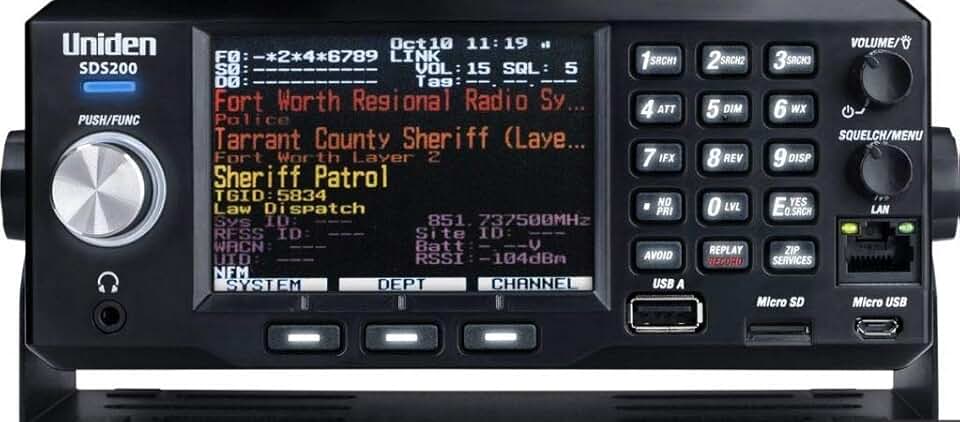
The Uniden SDS200 Scanner stands out as a premier base/mobile digital scanner, offering advanced features for both amateur enthusiasts and professional users. Its True I/Q receiver technology redefines digital signal decoding, providing clarity and reliability in complex radio environments. This review delves into its capabilities, performance, and overall value for serious radio monitoring.
Quick Summary: Uniden SDS200 Scanner
- Rating: 4.5/5 stars (Based on 876 reviews)
- Price: $724.00 USD
- Key Pros:
- Superior digital decode performance with True I/Q technology.
- Advanced TrunkTracker X for seamless trunked system monitoring.
- Customizable color display and user-friendly interface.
- Integrated GPS for location-based scanning.
- Future-proof with support for multiple digital modes (P25 Phase I/II, DMR, NXDN, ProVoice).
- Key Cons:
- High initial price point compared to entry-level scanners.
- Can have a steep learning curve for users new to advanced scanning features.
Table of Contents
Uniden SDS200 Scanner Overview
The Uniden SDS200 Scanner represents a significant leap forward in the world of radio scanning, designed for both fixed-location base use and mobile applications. It builds upon the success of its handheld counterpart, the SDS100, by offering enhanced power, robust construction, and a larger, more comprehensive display. This scanner is engineered to tackle the complexities of modern digital radio systems with unparalleled efficiency.
At its core, the SDS200 utilizes Uniden’s revolutionary True I/Q receiver technology. This advanced processing method significantly improves the ability to capture and decode digital signals, especially in challenging RF environments. Traditional scanners often struggle with signal distortion and simulcast interference, but the SDS200 handles these issues with remarkable precision, leading to clearer audio and more reliable monitoring.
The scanner’s design caters to users who demand constant, high-quality monitoring. Its robust casing and internal components are built for longevity, making it suitable for installation in vehicles or as a permanent fixture in a home or office. The larger display, compared to handheld units, offers better readability and more information at a glance, which is crucial during active monitoring sessions.
Another cornerstone of the Uniden SDS200 Scanner’s performance is its TrunkTracker X technology. This allows the scanner to seamlessly follow conversations on complex trunked radio systems, including P25 Phase I, P25 Phase II, DMR, NXDN, and ProVoice. This wide compatibility ensures that users can monitor a vast array of public safety, commercial, and amateur radio communications.
The SDS200 is not just a receiver; it’s a comprehensive monitoring station. It features an integrated GPS receiver, which enables location-based scanning. This means the scanner can automatically select frequencies and talkgroups relevant to your current geographical position, a highly valuable feature for mobile users or those traveling through different jurisdictions.
Programming the scanner is made easier through Uniden’s Sentinel software, allowing users to manage their favorite lists, update firmware, and customize settings from a computer. While the initial setup can be intricate due to the scanner’s depth of features, the software simplifies the process for those willing to invest the time. Regular firmware updates also ensure the scanner remains compatible with evolving radio technologies.
For enthusiasts and professionals alike, the Uniden SDS200 Scanner is more than just a device; it’s a gateway to understanding the invisible world of radio communications. Its ability to accurately decode signals, manage complex systems, and adapt to varying environments makes it a top-tier choice. The investment reflects its advanced capabilities and the superior listening experience it provides.
Compared to other base/mobile scanners on the market, the SDS200 consistently ranks high in terms of digital decode quality. This is particularly noticeable in areas with simulcast distortion, where competing models often fail to deliver intelligible audio. The True I/Q technology truly sets it apart, offering a distinct advantage in real-world scanning scenarios.
Understanding the intricacies of modern digital radio systems requires a tool that can keep pace, and the Uniden SDS200 Scanner rises to that challenge. Its comprehensive feature set ensures that users are equipped to monitor a broad spectrum of communications, from local police and fire departments to federal agencies and utility services. This makes it an indispensable asset for anyone serious about radio monitoring.
Uniden SDS200 Scanner Key Features & Specs
The Uniden SDS200 Scanner is packed with advanced features that justify its position as a premium base/mobile scanning device. Understanding these capabilities is crucial for appreciating its value and performance. Each specification contributes to its superior digital decode and overall user experience.
True I/Q Receiver Technology
This is arguably the most significant feature of the SDS200. True I/Q processing directly samples the radio frequency spectrum and processes it digitally, which drastically improves the ability to resolve digital signals. It specifically excels in environments with simulcast distortion, a common issue where multiple transmitters broadcast the same signal, often causing audio degradation on conventional scanners. The SDS200 minimizes these artifacts, providing clear, intelligible audio even under challenging conditions. This advanced technology ensures that critical communications are not missed due to signal interference.
TrunkTracker X Technology
The SDS200 is equipped with Uniden’s latest TrunkTracker X system, offering comprehensive support for various trunked radio protocols. This includes APCO P25 Phase I and Phase II, DMR (Digital Mobile Radio), NXDN, and ProVoice. This broad compatibility makes the scanner future-proof and highly versatile, capable of monitoring most contemporary public safety and commercial digital radio systems. Users can effortlessly track conversations across these complex systems without manual frequency adjustments.
Integrated GPS Receiver
A built-in GPS receiver allows the scanner to automatically select channels and systems based on its current location. This is incredibly useful for mobile users, as it eliminates the need to manually change programming when traveling between different areas or jurisdictions. The scanner can dynamically load appropriate frequencies and talkgroups from its database, ensuring you’re always listening to relevant transmissions. This feature significantly enhances usability and convenience, making the SDS200 an ideal mobile companion.
Customizable Color Display
The SDS200 features a large, bright, and customizable color display. Users can personalize the display colors for different types of channels, systems, or alerts, making it easier to identify important information at a glance. The screen provides detailed information about the active transmission, including system type, talkgroup ID, and signal strength. This enhanced visual feedback improves situational awareness during monitoring.
SD Card for Database and Recordings
The scanner uses a MicroSD card to store its extensive database of frequencies, settings, and recorded audio. This allows for vast storage capacity and easy updates via Uniden’s Sentinel software. Users can record interesting transmissions directly to the SD card for later playback, a valuable feature for documentation, analysis, or simply reliving a significant event. The ability to easily update the database ensures the scanner remains current with changing radio landscapes.
Multi-Digital Mode Support
Beyond P25, the SDS200 offers optional paid upgrades for DMR, NXDN, and ProVoice decoding. While some modes may require an additional purchase, this flexibility ensures that the scanner can adapt to virtually any digital radio system encountered. This comprehensive support means users won’t need multiple scanners to cover different digital protocols, streamlining their monitoring setup.
Ethernet Connectivity
Unique for a scanner, the SDS200 includes an Ethernet port, allowing for IP-based remote control and streaming. This enables users to access and control their scanner from a remote location over a network, or stream live audio to a computer or other networked device. This feature is particularly beneficial for fixed installations or for those who wish to share their monitoring capabilities. It provides unparalleled flexibility for advanced users.
Physical Specifications
The Uniden SDS200 Scanner is designed for base or mobile use, featuring a robust chassis. It measures approximately 7.25 inches wide, 5.31 inches deep, and 2.36 inches high, weighing around 2.65 pounds. These dimensions make it suitable for dashboard mounting or desktop placement. Its solid construction ensures durability in various operating environments, from a home shack to a moving vehicle. The front panel controls are intuitive, providing easy access to essential functions.
These key features collectively make the Uniden SDS200 Scanner a powerhouse for radio monitoring. Its combination of advanced digital decoding, extensive system compatibility, and user-friendly enhancements positions it as a leading choice for serious scanning enthusiasts and professionals. The thoughtful inclusion of features like GPS and Ethernet connectivity further extends its utility and adaptability in modern communication landscapes. For more technical details and direct support, you can visit the Uniden official website.
Pros & Cons
Evaluating the Uniden SDS200 Scanner requires a balanced look at its strengths and weaknesses. While it excels in many areas, potential buyers should be aware of both its advantages and any limitations. This comprehensive overview helps in making an informed decision based on individual needs and expectations.
Pros: Superior Digital Decode Performance
The paramount advantage of the SDS200 is its unparalleled digital decode quality, especially for P25 Phase I and II systems. Thanks to its True I/Q technology, it handles simulcast distortion significantly better than most other scanners on the market. This results in clearer, more consistent audio, minimizing the frustration of garbled or dropped transmissions that are common with less advanced receivers. For critical monitoring, this clarity is indispensable.
Pros: Wide Digital Mode Compatibility
With support for APCO P25 Phase I/II, DMR, NXDN, and ProVoice (some via optional upgrades), the SDS200 is exceptionally versatile. This extensive compatibility ensures that users can monitor a vast array of modern digital radio systems used by public safety, businesses, and amateur radio operators. It reduces the need for multiple specialized scanners, consolidating monitoring capabilities into one powerful device. This makes it a highly future-proof investment in a rapidly evolving radio landscape.
Pros: Integrated GPS for Location-Based Scanning
The built-in GPS receiver is a game-changer for mobile users. It automatically adjusts the scanner’s active frequencies and talkgroups based on the device’s geographical location. This eliminates the tedious manual reprogramming often required when traveling across different service areas. The convenience and efficiency gained from this feature are substantial, allowing users to focus on listening rather than managing settings.
Pros: Large, Customizable Color Display
The SDS200’s large, vibrant color display is a significant upgrade, offering excellent readability and detailed information. Users can customize color schemes for different channels or types of alerts, improving visual recognition and operational efficiency. This enhanced display makes monitoring more intuitive and less fatiguing, especially during extended periods of use. It provides critical data at a glance, improving overall user experience.
Pros: Ethernet Connectivity and Remote Control
The inclusion of an Ethernet port allows for advanced networking capabilities, including remote control and audio streaming over IP. This feature is ideal for fixed installations where the scanner might be in a remote location, or for users who want to access their scanner from a computer or mobile device. It adds a layer of flexibility and convenience not typically found in conventional scanners, expanding its utility for professional applications.
Cons: High Price Point
One of the primary drawbacks of the Uniden SDS200 Scanner is its relatively high cost. Priced significantly higher than many other scanners, it represents a substantial investment. This might be a barrier for casual hobbyists or those with limited budgets. While its features justify the price for serious users, it’s a factor to consider for anyone weighing their options.
Cons: Steep Learning Curve
Given its advanced features and extensive customization options, the SDS200 can present a steep learning curve for new users, especially those unfamiliar with digital radio systems or advanced scanning concepts. Programming and optimizing settings can be complex, requiring time and patience to master. While Uniden’s Sentinel software helps, beginners might find the initial setup daunting. Access to comprehensive user manuals and online communities can mitigate this challenge.
Cons: Power Consumption
As a base/mobile unit with a large color display and powerful processing, the SDS200 has higher power consumption compared to smaller, handheld units. While this is less of an issue for permanent installations with continuous power, mobile users need to ensure their vehicle’s power system can adequately support it. This might require dedicated wiring or careful management of vehicle battery drain during extended use. This is a minor consideration, but important for some mobile setups.
In summary, the Uniden SDS200 Scanner offers a premium scanning experience with its cutting-edge technology and extensive feature set. The benefits of superior digital decode, broad compatibility, and advanced networking often outweigh the cons for dedicated users. However, the investment and initial learning required are important considerations for potential buyers. For an in-depth understanding of trunked radio systems, which the SDS200 excels at monitoring, consider exploring resources like Wikipedia’s Trunked Radio System page.
Who Should Buy the Uniden SDS200 Scanner?
The Uniden SDS200 Scanner is not an entry-level device; it’s a sophisticated tool designed for specific types of users who require advanced capabilities and reliable performance. Understanding the target audience for this scanner helps determine if it’s the right investment for your needs. It caters to individuals and organizations with serious radio monitoring requirements.
Advanced Scanning Hobbyists
For individuals deeply immersed in the hobby of radio scanning, the SDS200 offers an unparalleled experience. These users often seek out the latest technologies, desire the clearest audio from complex digital systems, and enjoy the process of programming and optimizing their equipment. The SDS200’s True I/Q and TrunkTracker X technologies deliver the performance and versatility that advanced hobbyists demand, making it a top-tier choice for their passion.
Public Safety Monitors and Spotters
Individuals who monitor police, fire, EMS, and other public safety communications for news, emergency preparedness, or general awareness will find the SDS200 invaluable. Its superior digital decode performance ensures that critical transmissions are heard clearly, even in challenging RF environments. The ability to reliably monitor P25 Phase I/II systems is essential for staying informed about local emergencies and public events. This scanner provides the reliability needed for critical information gathering.
Emergency Management Personnel
For volunteer or professional emergency management teams, having reliable access to diverse communication channels is paramount. The SDS200’s multi-mode compatibility (P25, DMR, NXDN) allows these teams to monitor various agencies and organizations, ensuring comprehensive situational awareness during incidents. Its robust build and mobile capabilities make it suitable for deployment in command centers or field vehicles, providing crucial intelligence.
Media Professionals and Journalists
News reporters and journalists often rely on scanner traffic to stay ahead of breaking stories, especially those involving public safety. The SDS200 provides the clarity and reliability needed to capture real-time information from emergency services. Its recording capabilities are also beneficial for archiving important transmissions for later review or inclusion in reports, making it a valuable tool for field reporting.
Railfans and Aviation Enthusiasts
Hobbyists interested in monitoring railroad operations or aviation communications will appreciate the SDS200’s capabilities. With support for various conventional and digital modes, it can effectively track train dispatchers, rail yard operations, and air traffic control frequencies. The integrated GPS can also help in identifying relevant channels based on the user’s proximity to railway lines or airports, enhancing the monitoring experience.
Professional Radio Technicians and Developers
For those involved in radio system development, maintenance, or spectrum analysis, the SDS200 serves as an excellent diagnostic and monitoring tool. Its raw I/Q output capabilities (though requiring external software) can be leveraged for advanced signal analysis. The ability to precisely decode various digital formats makes it useful for verifying system performance and troubleshooting. It provides a robust platform for detailed radio observation.
The SDS200 is an investment, and it’s best suited for those who will fully utilize its advanced features. If you are a casual listener only interested in analog police calls, a less expensive scanner might suffice. However, if you demand the absolute best in digital decode performance, broad compatibility, and advanced functionalities like GPS and remote access, then the Uniden SDS200 Scanner is an exceptional choice. It’s designed for those who need to hear everything, clearly and reliably, in the complex world of modern radio communications.
Ultimately, the decision to purchase the Uniden SDS200 Scanner should be based on your specific monitoring goals and budget. If your current scanner struggles with digital signals or you’re looking to upgrade to a device that offers cutting-edge performance and future-proofing, the SDS200 is a standout option. Its capabilities far exceed those of conventional scanners, offering a professional-grade experience to a wide range of users. It effectively bridges the gap between casual listening and serious, in-depth radio monitoring, providing clarity where other devices simply cannot.
FAQ about Uniden SDS200 Scanner
Here are some frequently asked questions about the Uniden SDS200 Scanner, providing further clarity on its features, operation, and common concerns. These answers aim to address typical inquiries from both prospective buyers and existing users.
Q1: What is True I/Q and how does it benefit the SDS200?
True I/Q is Uniden’s proprietary receiver technology that directly samples the radio frequency spectrum. This digital processing method significantly improves the scanner’s ability to accurately decode digital signals, especially in challenging environments. Its primary benefit is superior performance in simulcast interference, where multiple transmitters broadcast the same signal, often causing audio issues for other scanners. With True I/Q, the SDS200 delivers clearer, more consistent digital audio, reducing garbled transmissions and missed communications.
Q2: Does the Uniden SDS200 Scanner support DMR and other digital modes?
Yes, the Uniden SDS200 Scanner supports a wide range of digital modes. Out of the box, it handles APCO P25 Phase I and Phase II. For DMR (Digital Mobile Radio), NXDN, and ProVoice, these modes are available as optional paid upgrades. Once purchased and activated, the scanner can seamlessly decode these protocols, making it one of the most versatile scanners on the market for modern digital communications. This ensures broad compatibility with various public safety and commercial systems.
Q3: How do I program the Uniden SDS200 Scanner?
The primary method for programming the Uniden SDS200 Scanner is through Uniden’s free Sentinel software, which is compatible with Windows computers. Users can connect the scanner to their PC via a USB cable, then use Sentinel to update the nationwide radio database, create and manage Favorite Lists, and customize various settings. While manual programming via the scanner’s keypad is possible, Sentinel simplifies the process significantly, especially for complex systems. Uniden provides detailed instructions and tutorials for using the software effectively.
Q4: Is the SDS200 a portable scanner like the SDS100?
No, the Uniden SDS200 Scanner is designed as a base/mobile unit, meaning it is intended for fixed installations in a home or office, or for permanent mounting in a vehicle. While it shares many advanced features with its handheld counterpart, the SDS100, the SDS200 is larger, heavier, and requires an external power source. It does not contain an internal battery for portable operation. Its robust build and larger display are optimized for stationary or in-vehicle use.
Q5: What is the difference between the SDS100 and the Uniden SDS200 Scanner?
Both the SDS100 and the Uniden SDS200 Scanner utilize the same core True I/Q and TrunkTracker X technologies, offering superior digital decode performance. The key difference lies in their form factor and intended use. The SDS100 is a compact, handheld portable scanner with an internal battery. The SDS200 is a larger base/mobile unit, designed for fixed installations, offering a larger display, more robust physical controls, and an integrated Ethernet port for remote access. The SDS200 also benefits from better heat dissipation due to its larger chassis.
Q6: Can I record audio with the Uniden SDS200 Scanner?
Yes, the SDS200 has built-in recording capabilities. It uses a MicroSD card to store recorded audio, allowing users to capture and save interesting or important transmissions for later playback. The scanner can record continuously or be set to record only when specific channels or talkgroups are active. This feature is highly valuable for documentation, analysis, or simply reviewing missed communications. The size of the SD card determines the total recording capacity.
Q7: What kind of antenna do I need for the SDS200?
The Uniden SDS200 Scanner comes with a basic telescopic antenna, which is suitable for initial testing. However, to maximize its performance, especially for distant signals or specific frequency ranges, an external antenna is highly recommended. The type of antenna depends on what you primarily want to monitor (e.g., a wideband discone for general coverage, a specific Yagi for UHF, or a mobile antenna for vehicle use). Connect it to the scanner’s BNC antenna port. Investing in a good quality antenna will significantly enhance your scanning experience and range.
Q8: Does the SDS200 require internet access to function?
The Uniden SDS200 Scanner does not require constant internet access to function as a scanner. It operates entirely independently once programmed. However, an internet connection is necessary for updating the scanner’s database via the Sentinel software and for utilizing its advanced Ethernet features like remote control and audio streaming. For basic scanning, once programmed, it can be used offline indefinitely. Internet access enhances its capabilities but is not fundamental for its core scanning function.
Final Verdict
The Uniden SDS200 Scanner is an outstanding piece of engineering that delivers on its promise of superior digital decode performance. For anyone serious about radio monitoring, from dedicated hobbyists to public safety professionals, this scanner offers a level of clarity and reliability that is hard to match. Its True I/Q receiver technology is a genuine game-changer, especially in areas plagued by simulcast interference.
While the initial investment is significant, the SDS200 justifies its price tag through its comprehensive feature set, wide digital mode compatibility, and robust build quality. Features like integrated GPS, a customizable color display, and Ethernet connectivity elevate it beyond a mere receiver into a sophisticated monitoring station. It’s designed to be a long-term asset, capable of adapting to evolving radio systems.
The learning curve can be steep for newcomers, but the rewards of mastering this device are immense. The ability to clearly hear communications that are often garbled on lesser scanners provides invaluable insight and satisfaction. Its performance in challenging RF environments alone makes it a worthwhile upgrade for many existing scanner owners.
For those who demand the best possible digital decode, desire extensive compatibility with modern trunked systems, and appreciate advanced features like remote access and location-based scanning, the Uniden SDS200 Scanner is an excellent choice. It is a premium product for a discerning user, offering an unparalleled window into the world of radio communications. This scanner truly represents the ultimate in base/mobile digital scanning technology, providing exceptional value for its performance.