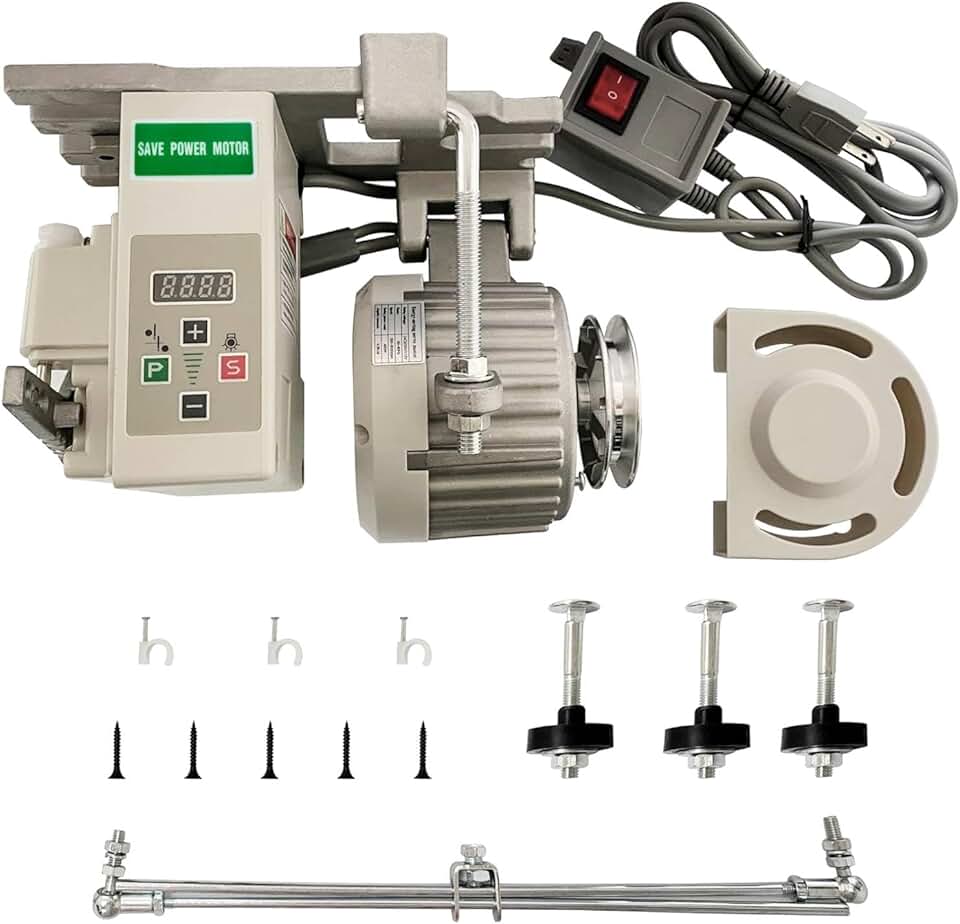
Upgrading your industrial sewing machine can dramatically improve your productivity and the quality of your work. The Sewing Machine Servo Motor is a prime example of a component that can transform an older, noisy machine into a modern, efficient workhorse. This AC110V industrial brushless servo motor, complete with a controller and foot switch, promises precise speed control and quiet operation, making it an invaluable addition for any serious sewer or business.
Quick Summary
Rating: 4.7 out of 5 stars
Price: $66.99 USD
Key Pros:
- Precise Speed Control: Offers unparalleled stitching accuracy, especially for intricate tasks.
- Whisper-Quiet Operation: Significantly reduces noise compared to traditional clutch motors, improving the work environment.
- Energy Efficient: Brushless design consumes less power, leading to long-term savings.
Key Cons:
- Initial Setup Learning Curve: May require some time to get used to the controller settings.
- Compatibility Check: While generally universal, always verify fit with specific machine models.
Table of Contents
Sewing Machine Servo Motor Overview
The Sewing Machine Servo Motor represents a significant leap forward in industrial sewing technology, moving beyond the limitations of traditional clutch motors. Unlike older models that run continuously at full speed, creating constant noise and consuming excessive electricity, a servo motor operates only when the foot pedal is pressed. This fundamental difference leads to a much quieter workspace and substantial energy savings over time.
This particular model is designed for industrial applications, meaning it’s built to withstand heavy-duty use and provide consistent performance for extended periods. Its 750W power output ensures it can handle a wide range of fabrics, from delicate silks to multiple layers of denim or leather, without bogging down. The integration of a controller and foot switch offers the user granular control over stitching speed.
The brushless design is a key highlight, contributing to both the motor’s efficiency and longevity. Brushless motors have fewer wearing parts, reducing the need for maintenance and extending the operational life of the unit. This makes the investment in a brushless Sewing Machine Servo Motor particularly appealing for busy workshops and production environments where downtime is costly.
For those unfamiliar with servo motors, they are a type of motor that allows for precise control of angular or linear position, velocity, and acceleration. This precision is invaluable in sewing, where consistent stitch length and speed are crucial for professional results. You can learn more about the general principles of servomotors on Wikipedia.
The included foot switch is not just an on/off mechanism; it often provides proportional control, allowing the user to vary the speed of the motor by how much pressure is applied. This intuitive control is a massive advantage over clutch motors, which typically offer less fine-tuned speed adjustment, often resulting in an all-or-nothing power delivery that can be challenging for beginners or intricate work.
Furthermore, the reversible functionality of this Sewing Machine Servo Motor adds another layer of versatility. This feature is essential for tasks like back-tacking, reinforcing seams, or correcting stitching errors without manually turning the fabric. It simplifies complex operations and enhances the overall efficiency of the sewing process.
The AC110V power requirement makes it suitable for standard electrical outlets in North America, ensuring easy integration into existing setups. Its compact size and relatively straightforward installation process mean that most users can upgrade their machines without extensive professional help, though basic mechanical aptitude is certainly beneficial for a smooth transition.
Overall, this Sewing Machine Servo Motor is positioned as an economical yet powerful solution for anyone looking to modernize their industrial sewing machine. It promises to deliver a more pleasant and productive sewing experience, whether you’re a professional tailor, a small business owner, or a dedicated hobbyist seeking professional-grade results from your equipment.
Sewing Machine Servo Motor Key Features & Specs
Understanding the core specifications and features of this Sewing Machine Servo Motor is crucial for appreciating its capabilities and how it can benefit your sewing projects. This model boasts several key attributes that set it apart from older motor technologies, focusing on power, control, and efficiency.
Firstly, the motor operates at AC110V, making it compatible with standard North American power outlets. This eliminates the need for voltage converters or special wiring, simplifying the installation process for most users. Its broad compatibility is a significant advantage for home-based businesses and small workshops.
The heart of its performance lies in its 750W power output. This wattage is robust enough for a wide array of industrial sewing tasks, from handling heavy upholstery fabrics and multiple layers of denim to working with leather and canvas. Such power ensures that the needle penetrates tough materials effortlessly, preventing skipped stitches and maintaining consistent speed under load.
A standout feature is its brushless servo motor design. Brushless motors are renowned for their efficiency, quiet operation, and extended lifespan compared to brushed motors. They generate less heat, require virtually no maintenance (as there are no carbon brushes to replace), and offer superior torque at lower RPMs, which translates to better control for the user.
The inclusion of a dedicated controller is another critical component. This electronic control unit allows for precise speed adjustment, often with digital displays for accurate settings. Users can set maximum speeds, control needle up/down positioning (if their machine supports it), and fine-tune acceleration and deceleration, providing an unprecedented level of control over the sewing process.
Accompanying the motor and controller is a high-quality foot switch. This isn’t a simple on/off pedal; it’s designed to offer sensitive, proportional speed control. The harder you press, the faster the machine stitches, allowing for seamless transitions from very slow, precise stitching to high-speed production, all managed intuitively by foot pressure.
The reversible functionality is a practical feature that greatly enhances usability. This allows the motor to drive the sewing machine in both forward and reverse directions, which is indispensable for locking stitches at the beginning and end of seams, creating reinforced areas, or performing intricate design elements that require back-and-forth movement without repositioning the fabric.
In terms of physical dimensions, while specific measurements aren’t always provided for generic motors, industrial servo motors are typically designed to fit standard mounting brackets on industrial sewing machine tables. This ensures that replacing an old clutch motor with this servo unit is a relatively straightforward mechanical task, assuming basic tools and a bit of mechanical know-how.
The overall construction is typically robust, featuring durable metal casings and high-quality internal components designed for continuous industrial operation. This focus on durability means the motor can withstand the rigors of a busy workshop, providing reliable service for many years with minimal intervention. Investing in a motor with these specifications means investing in enhanced productivity and a more comfortable work environment.
Pros & Cons of this Industrial Sewing Machine Servo Motor
Every product has its strengths and weaknesses, and the Sewing Machine Servo Motor is no exception. A balanced review requires a thorough examination of both the advantages it offers and any potential drawbacks users might encounter. Understanding these points helps in making an informed purchasing decision.
Pros:
- Precise Speed Control: This is arguably the most significant advantage. Unlike clutch motors that are either on or off at full speed, the servo motor offers variable speed control, from a single stitch at a time to maximum velocity. This precision is invaluable for intricate tasks, starting seams perfectly, and navigating curves or corners with confidence. It allows both beginners and experienced sewers to achieve superior stitch quality.
- Whisper-Quiet Operation: Traditional clutch motors are notoriously loud, often creating a constant, irritating hum that can be fatiguing over long periods. The brushless Sewing Machine Servo Motor, by contrast, is remarkably quiet. It only makes noise when the machine is actively sewing, drastically improving the work environment and reducing noise pollution in shared spaces or home studios.
- Energy Efficient: Servo motors only draw power when they are actively driving the machine. Clutch motors, however, spin continuously, consuming electricity even when the machine is idle. This