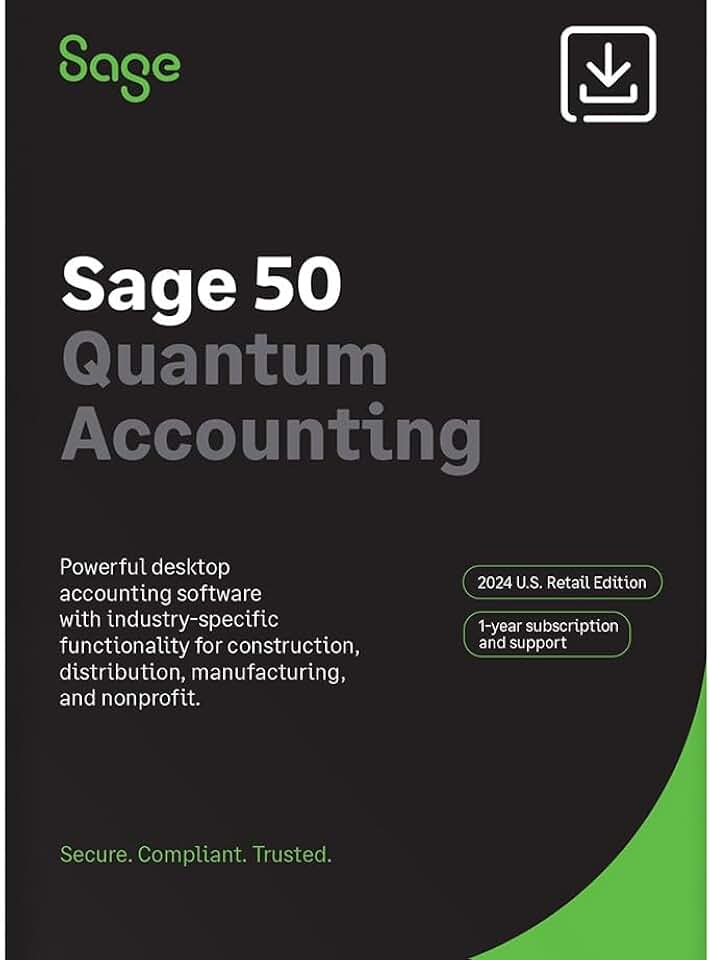
The Sage 50 Quantum Accounting software stands out as a powerful solution designed for small to mid-sized businesses requiring comprehensive financial management. This 2024 U.S. 3-User 1-Year Subscription offers a robust suite of tools, from general ledger and accounts payable to advanced inventory and job costing capabilities.
In this detailed review, we will delve into the intricacies of Sage 50 Quantum Accounting, exploring its features, benefits, and potential drawbacks. We aim to provide an honest assessment to help you determine if this accounting software is the ideal investment for your business operations.
Quick Summary: Sage 50 Quantum Accounting
Rating: N/A (Based on 0 customer reviews)
Price: $2599.99 USD
Key Pros:
- Robust Feature Set: Offers advanced inventory, job costing, and financial management suitable for complex business needs.
- Scalable User Access: Supports up to 40 users, making it ideal for growing small to mid-sized businesses.
- Industry-Specific Functionality: Provides specialized tools for construction, manufacturing, and distribution sectors.
Key Cons:
- High Cost: The annual subscription price is a significant investment, especially for very small businesses.
- PC Download Only: Requires local installation on Windows PCs, limiting cross-platform flexibility and requiring local IT management.
Table of Contents
Sage 50 Quantum Accounting Overview
Sage 50 Quantum Accounting represents the pinnacle of Sage’s desktop accounting software line for small and growing businesses in the U.S. This 2024 edition is designed to handle more complex financial operations than its Pro or Premium counterparts, catering specifically to businesses with higher transaction volumes, advanced inventory needs, or intricate job costing requirements.
Historically known as Peachtree Accounting, Sage 50 has evolved significantly over the years, maintaining its strong foundation in desktop reliability while integrating modern features. The “Quantum” designation signifies its enhanced capacity, supporting up to 40 named users simultaneously, which is a substantial leap from the lower tiers.
The core functionality of Sage 50 Quantum Accounting encompasses a full suite of accounting modules. This includes general ledger management, accounts payable and receivable, invoicing, banking reconciliation, and comprehensive financial reporting. It provides the essential tools for managing daily financial transactions with precision and control.
Beyond the basics, Quantum distinguishes itself with advanced capabilities crucial for specific industries. Businesses involved in manufacturing, construction, or distribution will find tailored features that address their unique operational challenges. This specialized functionality helps streamline workflows and improve accuracy in complex business environments.
The product is offered as a PC download, meaning it is installed directly onto your local computer systems. This provides a level of control and data security that some businesses prefer over purely cloud-based solutions. While it’s a desktop application, Sage does offer cloud-connected services that can enhance its accessibility and collaboration features, bridging the gap between traditional desktop software and modern cloud platforms.
The 1-year subscription model ensures that users always have access to the latest software version, including updates, security patches, and often, enhanced features. This also typically includes access to customer support, which is vital for complex accounting solutions. The 3-user license included in this package is a strong starting point for many growing teams, allowing multiple employees to access and work within the system concurrently.
Understanding the architecture of Sage 50 Quantum Accounting is key to appreciating its value. It’s built for performance and stability, handling large datasets efficiently. For businesses that have outgrown entry-level accounting software but aren’t ready for a full-fledged ERP system, Quantum offers a powerful middle-ground solution, balancing robust features with a more manageable implementation.
The software’s emphasis on detailed reporting and analytics provides businesses with actionable insights into their financial health. Customization options for reports allow users to extract specific data tailored to their decision-making processes. This level of detail is invaluable for strategic planning and operational improvements.
Furthermore, Sage 50 Quantum Accounting is designed with compliance in mind, helping businesses adhere to accounting standards and tax regulations. Its audit trail capabilities track all transactions and user activities, providing transparency and accountability. This is particularly important for businesses subject to rigorous audits or internal controls.
Key Features & Specs of Sage 50 Quantum Accounting
The feature set of Sage 50 Quantum Accounting is extensive, catering to a wide array of demanding business functions. Understanding these capabilities is crucial for evaluating its suitability for your operations. The 2024 U.S. 3-User 1-Year Subscription includes several advanced tools that differentiate it from standard accounting software.
One of the most significant features is its multi-user access. This specific package supports three concurrent users, but the Quantum edition itself can scale up to 40 licensed users. This capability is vital for larger teams where multiple departments or individuals need to access and update financial data simultaneously without conflicts or slowdowns.
Advanced Inventory Management is another cornerstone of Sage 50 Quantum Accounting. It moves beyond basic tracking to offer serialized and lot tracking, which is essential for businesses dealing with high-value items, regulated products, or goods with expiration dates. Multiple warehouse management allows for precise tracking of stock across different locations, optimizing inventory levels and reducing carrying costs. The software also supports various costing methods like FIFO (First-In, First-Out) and LIFO (Last-In, First-Out), providing flexibility for accurate cost accounting.
For project-based businesses, Job Costing in Quantum is exceptionally robust. It enables detailed tracking of costs and revenues by project, phase, and even individual tasks. Users can manage budgets, track progress, and perform progress billing, ensuring projects stay on track and profitable. This feature is particularly beneficial for contractors, service firms, and manufacturers who need granular control over project finances.
The Financial Management suite covers all traditional accounting bases with depth. The General Ledger is highly customizable, allowing for detailed chart of accounts structures. Accounts Payable and Receivable modules simplify vendor payments, customer invoicing, and cash flow management. Bank reconciliation tools help maintain accuracy between bank statements and internal records, minimizing discrepancies.
Customizable Reporting is a powerful asset, allowing businesses to generate a vast array of financial statements, sales reports, and inventory analyses. Users can tailor reports to display specific metrics, compare periods, and gain deeper insights into business performance. The ability to export reports to Excel or PDF further enhances data sharing and analysis capabilities.
While often an add-on service, integration with Payroll is typically seamless with Sage 50 Quantum Accounting, providing a comprehensive solution for managing employee compensation, taxes, and benefits. This integration streamlines payroll processing and ensures accurate financial records across all departments.
Security and Controls are paramount in financial software, and Quantum delivers with robust features. User permissions can be set at a granular level, restricting access to sensitive data and functions based on roles. A comprehensive audit trail logs all transactions and user activities, providing an unalterable record for compliance and accountability. This helps prevent fraud and ensures data integrity.
The software also often includes Industry-Specific Editions or specialized modules tailored for manufacturing, construction, and distribution. These provide unique functionalities such as bill of materials (BOM) for manufacturing, retainage tracking for construction, and advanced pricing levels for distribution, directly addressing the pain points of these sectors.
Being a PC Download, the software requires installation on Windows operating systems. This means businesses need to manage their own IT infrastructure for hosting the software, including backups and server maintenance if used in a multi-user network environment. While this can be a commitment, it also offers greater control over data and system configurations compared to purely cloud-based alternatives. Regular updates are delivered through the subscription, ensuring compatibility and security.
Pros & Cons
Evaluating Sage 50 Quantum Accounting involves weighing its significant advantages against its potential drawbacks. This balance is crucial for businesses deciding whether this powerful software aligns with their operational needs and budget. Here, we outline the key pros and cons to help inform your decision.
Pros:
- Robust Feature Set for Growing Businesses: Sage 50 Quantum Accounting offers an exceptionally comprehensive array of tools that go far beyond basic bookkeeping. It includes advanced inventory management with serialized and lot tracking, detailed job costing, and robust financial reporting. These features are critical for businesses that have outgrown simpler software and require sophisticated controls over their operations. The depth of functionality supports complex workflows across various departments.
- Strong Job Costing and Inventory Management: For industries like construction, manufacturing, and wholesale distribution, the specialized job costing and inventory modules are standout benefits. Businesses can meticulously track project profitability, manage multiple warehouses, and utilize various inventory valuation methods. This level of detail helps in accurate budgeting, cost control, and efficient supply chain management, directly impacting the bottom line.
- Desktop Reliability with Optional Cloud Access: While primarily a desktop application, Sage 50 Quantum Accounting offers the stability and performance associated with locally installed software. This can be reassuring for businesses concerned about internet dependency or data security in the cloud. Additionally, Sage provides options for cloud integration, offering the best of both worlds by enabling remote access and collaboration while maintaining a robust desktop core.
- Industry-Specific Functionality: Quantum is designed with specific industry verticals in mind, offering features tailored to the unique requirements of manufacturing, construction, and distribution. This means businesses in these sectors can leverage tools that are precisely engineered for their operations, such as bill of materials, progress billing with retainage, and advanced pricing structures. This specialization reduces the need for extensive customization or multiple disparate systems.
- Scalability for Up to 40 Users: The ability to support up to 40 named users concurrently is a significant advantage for expanding small to mid-sized businesses. This scalability ensures that as your team grows, your accounting software can keep pace without requiring a complete system overhaul. Multiple users can work simultaneously, improving efficiency and collaboration across financial, sales, and operational teams, making it a sustainable solution for growth.
Cons:
- High Upfront Cost (Subscription): The annual subscription price of $2599.99 for the 3-user license is a substantial investment. For very small businesses or startups with limited budgets, this cost can be prohibitive, especially when compared to more entry-level cloud-based solutions. While the features justify the price for some, it requires careful financial planning and a clear return on investment justification.
- Steep Learning Curve for New Users: Due to its extensive feature set and powerful capabilities, Sage 50 Quantum Accounting can present a steep learning curve for individuals or businesses new to advanced accounting software. Users might require dedicated training or a significant time investment to become proficient. This can lead to slower adoption rates and initial frustration if not properly managed, potentially requiring professional assistance for setup and ongoing support.
- Requires Local Installation (PC Download): As a PC download, the software needs to be installed on Windows operating systems, limiting its flexibility for users on other platforms like macOS or Linux. Furthermore, local installation implies the need for internal IT resources to manage server setup (for multi-user environments), backups, and system maintenance. This can add to operational overhead and complexity, especially for businesses without dedicated IT staff.
- Potential for Complex Setup and Customization: While customization is a strength, it can also be a challenge. Setting up Sage 50 Quantum Accounting to perfectly align with specific business processes, especially for complex inventory or job costing scenarios, can be intricate and time-consuming. Businesses might need to engage consultants or spend significant internal resources to configure the software optimally, which can add to the total cost of ownership beyond the subscription fee.
- Limited macOS Compatibility: The software is designed for PC (Windows) environments, meaning native macOS support is non-existent. Mac users would need to run Windows via virtualization software (like Parallels or VMware Fusion) or Boot Camp, which adds another layer of complexity, cost, and potential performance issues. This can be a significant drawback for businesses operating exclusively on Apple hardware or those seeking cross-platform flexibility.
Who Should Buy Sage 50 Quantum Accounting?
Deciding if Sage 50 Quantum Accounting is the right fit for your business requires a careful assessment of your current and future needs. This software is not a one-size-fits-all solution; it excels in specific environments and for particular types of businesses. Understanding its ideal user profile can prevent costly missteps.
Firstly, small to mid-sized businesses with complex accounting needs are the primary target audience. If your business has moved beyond basic invoicing and expense tracking and now requires sophisticated inventory management, detailed job costing, or advanced departmental reporting, Quantum could be an excellent upgrade. It provides the depth of functionality that simpler accounting packages simply cannot match.
Companies requiring detailed job costing, such as contractors, construction firms, service providers, or custom manufacturers, will find immense value in Quantum. Its ability to track costs, revenues, and profitability at a granular project level is unparalleled in its class. This allows for precise bidding, progress monitoring, and accurate financial reporting for each client engagement.
Similarly, businesses with extensive inventory management requirements, including wholesalers, distributors, and manufacturers, will benefit from Quantum’s advanced features. Serialized and lot tracking, multi-warehouse support, and various costing methods are critical for managing complex stock, ensuring compliance, and optimizing supply chains. If inventory accuracy is paramount to your operations, Quantum provides the tools to achieve it.
For firms with multiple users needing simultaneous access to financial data, the 3-user license (expandable to 40) is a significant advantage. This supports collaborative environments where sales, purchasing, accounting, and project management teams all need real-time access to financial information. It reduces bottlenecks and improves inter-departmental communication, leading to greater efficiency.
Businesses that are familiar with desktop accounting software and prefer a perpetual license (or annual subscription for a desktop product) over purely cloud-based solutions will appreciate Sage 50 Quantum Accounting. It offers the robust performance and local data control that many long-time desktop software users value, while still providing some cloud-connected capabilities for flexibility.
It is also an excellent choice for businesses that have been using lower-tier Sage 50 products (like Pro or Premium) and have reached their functional or user limit. Quantum provides a natural upgrade path, allowing them to leverage their existing data and familiarity with the Sage ecosystem while gaining significant new capabilities without migrating to an entirely new platform.
Conversely, if you are a very small business, a freelancer, or a startup with simple accounting needs, Sage 50 Quantum Accounting might be overkill and too expensive. For such entities, simpler, more affordable cloud-based solutions might be a better fit. Similarly, businesses that operate exclusively on macOS or prefer a 100% web-based solution without any local installation requirements should look elsewhere.
In essence, if your business is growing, has complex operational requirements, and requires a powerful, reliable desktop-based accounting solution with multi-user capabilities, Sage 50 Quantum Accounting offers a compelling package. It’s an investment in a robust system that can support your financial operations for years to come, provided you have the resources to manage its implementation and ongoing use.
FAQ about Sage 50 Quantum Accounting
Here are some frequently asked questions about Sage 50 Quantum Accounting to provide further clarity on its features, usage, and suitability for various businesses. These answers address common concerns and help potential users make informed decisions.
Q1: What is the difference between Sage 50 Pro, Premium, and Quantum?
A1: The main differences lie in scalability, advanced features, and user capacity. Sage 50 Pro Accounting is the most basic version, typically for a single user with fundamental accounting needs. Sage 50 Premium Accounting offers more features like departmental accounting, serialized inventory (limited), and supports up to 5 users. Sage 50 Quantum Accounting is the top-tier desktop product, supporting up to 40 users and providing the most extensive feature set, including advanced job costing, multi-warehouse inventory, and industry-specific editions. Quantum is designed for businesses with complex operations and higher user counts.
Q2: Is Sage 50 Quantum cloud-based?
A2: Sage 50 Quantum Accounting is primarily a desktop application, meaning it is installed locally on your Windows PC or server. It is not a purely cloud-based software like Sage Business Cloud Accounting. However, Sage does offer cloud-connected services, such as Sage Remote Data Access, which allows users to access their desktop data remotely over the internet. This provides flexibility while retaining the robust performance and local control of a desktop solution. Data is stored locally, with options for cloud backup and remote access features.
Q3: Can I upgrade from a lower Sage 50 version to Quantum?
A3: Yes, you can typically upgrade from Sage 50 Pro or Premium Accounting to Sage 50 Quantum Accounting. Sage provides a straightforward upgrade path that allows you to migrate your existing company data to the Quantum version. This ensures continuity and leverages your previous investment in the Sage ecosystem. It’s advisable to consult with Sage support or a certified Sage partner during the upgrade process to ensure a smooth transition and proper configuration of new features.
Q4: What are the system requirements for Sage 50 Quantum Accounting?
A4: As a PC download, Sage 50 Quantum Accounting requires a Windows operating system (e.g., Windows 10, Windows 11, or compatible Windows Server for multi-user environments). Specific requirements include a certain processor speed, minimum RAM (typically 8GB or more for optimal performance), and available hard disk space. A stable internet connection is needed for activation, updates, and cloud-connected services. It’s always best to check the official Sage website for the most current and detailed system requirements to ensure compatibility and smooth operation. Visit Sage’s official website for detailed product information.
Q5: Does Sage 50 Quantum include payroll?
A5: While Sage 50 Quantum Accounting manages general ledger entries related to payroll, the core payroll processing functionality (e.g., calculating taxes, printing checks, filing forms) is typically an add-on service. You can integrate Sage 50 Quantum with Sage Payroll Services or other compatible third-party payroll providers. This integration ensures that payroll data flows seamlessly into your accounting records, providing a comprehensive financial picture. The subscription usually includes the framework for payroll but not the service itself.
Q6: How does the 3-user license work?
A6: The 3-user license for Sage 50 Quantum Accounting means that up to three named individuals can access and work within the software concurrently. These users can be working from different workstations connected to a central server or shared data location. Each user account has specific permissions that can be configured by the administrator, ensuring data security and control. If your business needs more than three users, you would need to purchase additional user licenses, up to the Quantum edition’s maximum capacity of 40 users.
Q7: Is technical support included with the subscription?
A7: Yes, typically, a 1-year subscription for Sage 50 Quantum Accounting includes access to technical support and product updates. This ensures that you receive assistance with any software issues, get access to the latest features, and stay compliant with tax and accounting regulations. The level of support (e.g., phone, chat, online resources) may vary, so it’s important to review the specific terms of your subscription. This ongoing support is a key benefit of the subscription model.
Q8: How does Sage 50 Quantum compare to QuickBooks Enterprise?
A8: Both Sage 50 Quantum Accounting and QuickBooks Enterprise are robust accounting solutions targeting growing small to mid-sized businesses with complex needs. They both offer advanced inventory, job costing, and multi-user capabilities. Key differences often include their user interfaces, specific industry-focused features, and pricing models. Sage 50 Quantum is often preferred for its strong desktop performance and specific industry modules, while QuickBooks Enterprise is known for its user-friendly interface and extensive third-party integrations. The choice often comes down to specific feature requirements, user preference, and existing familiarity with either ecosystem.
Final Verdict
After a thorough review of its capabilities, Sage 50 Quantum Accounting emerges as a highly capable and robust accounting software solution, particularly for small to mid-sized businesses with intricate financial and operational requirements. Its comprehensive feature set, encompassing advanced inventory, detailed job costing, and extensive financial management, positions it as a significant upgrade for companies that have outgrown simpler accounting platforms.
The 2024 U.S. 3-User 1-Year Subscription offers a powerful combination of multi-user access and industry-specific tools that can streamline complex workflows in sectors like construction, manufacturing, and distribution. The desktop reliability, coupled with optional cloud connectivity, provides a secure and high-performance environment for managing critical financial data. This blend of traditional stability and modern flexibility is a key differentiator.
However, the software is not without its considerations. The substantial annual subscription cost and a potentially steep learning curve mean that it represents a significant investment in both capital and training. Its PC-only download nature also requires businesses to have the necessary Windows infrastructure and potentially internal IT support for setup and maintenance. Businesses operating exclusively on macOS or those seeking a purely web-based, zero-installation solution may find these aspects challenging.
For whom is Sage 50 Quantum Accounting truly worth it? It is an exceptional choice for established small to mid-sized businesses that demand powerful, granular control over their finances, inventory, and projects. If your business relies heavily on accurate job costing, manages complex inventory across multiple locations, or requires robust multi-user access with strong security controls, then Quantum provides the depth and scalability you need. It’s ideal for those seeking an upgrade from entry-level software without transitioning to a full-scale enterprise resource planning (ERP) system.
Ultimately, Sage 50 Quantum Accounting is a powerful tool designed to support growth and efficiency in complex business environments. While its price point and desktop-centric nature require careful consideration, its comprehensive features and proven track record make it an impressive contender for businesses ready to invest in a sophisticated accounting solution. If your business needs the advanced capabilities it offers, the investment is likely to yield substantial returns in efficiency, accuracy, and informed decision-making.