The NeoLucida XL is a remarkable drawing tool designed to help artists of all skill levels improve their observational drawing and master perspective with greater ease. This modern interpretation of the classic camera lucida offers a unique way to superimpose a scene or object onto your drawing surface, allowing for accurate tracing and proportion. It bridges the gap between traditional drawing methods and a clever optical trick, making complex subjects more approachable for detailed rendition.
Artists often struggle with accurately capturing proportions and perspective, a challenge that the NeoLucida XL aims to simplify significantly. By projecting a ghostly image of your subject directly onto your paper, it enables precise placement of lines and forms. This review will delve into the functionality, features, and overall value of this innovative device, helping you decide if it’s the right addition to your artistic toolkit.
Quick Summary: NeoLucida XL
- Rating: 3.8 out of 5 stars (733 reviews)
- Price: $99.0 (USD)
- Key Pros:
- Excellent for learning proportion and perspective.
- Highly portable and easy to set up for on-the-go sketching.
- Aids in accurately tracing complex subjects.
- Key Cons:
- Requires a learning curve to master the ghost image.
- Performance can be sensitive to lighting conditions.
Table of Contents
NeoLucida XL Overview
The NeoLucida XL revives a fascinating historical drawing aid, the camera lucida, making it accessible to contemporary artists. Invented in 1806 by William Hyde Wollaston, the original camera lucida allowed artists to trace what they saw by superimposing a virtual image of the subject onto their drawing surface. This ingenious optical device was favored by artists and scientists alike for its ability to render accurate depictions of landscapes, portraits, and specimens.
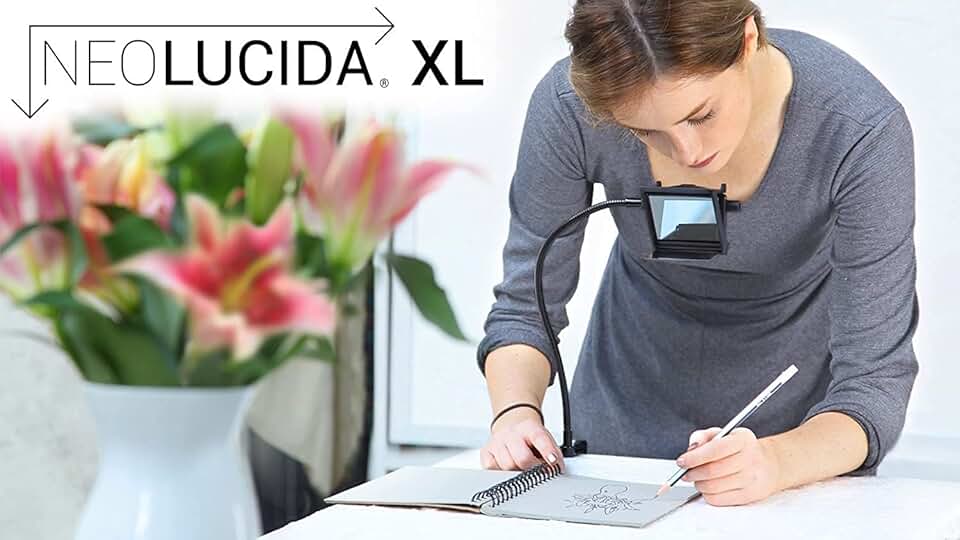
The NeoLucida XL modernizes this concept, offering a compact and user-friendly version that doesn’t require electricity or complex setup. It works on the principle of optical superimposition, using a prism or beam splitter to reflect the scene in front of you onto your drawing paper. When you look through the viewing aperture, you see both your subject and your hand on the paper simultaneously, creating a ‘ghost image’ that you can trace.
This tool is particularly valuable for developing a keen eye for proportion and perspective, skills that are fundamental to realistic drawing. By providing a direct visual guide, it helps artists understand how objects relate to each other in space and how to translate three-dimensional forms onto a two-dimensional plane. It’s not just a tracing device; it’s a learning tool that trains your brain to see more accurately.
The ‘XL’ in its name signifies an enhanced version, typically offering a larger viewing area compared to its predecessors or smaller camera lucida models. This expanded field of view provides a more comfortable and comprehensive visual experience, especially when working with larger subjects or broader landscapes. It allows for greater freedom of movement for your drawing hand and less need to constantly reposition the device.
The creators of the NeoLucida XL, artists Pablo Garcia and Golan Levin, launched the original NeoLucida through a Kickstarter campaign, aiming to democratize access to this historical tool. Their mission was to make the camera lucida affordable and available to anyone interested in art and drawing. The XL version builds upon this success, offering refinements that improve usability and optical performance, addressing feedback from the artistic community.
Understanding the historical context of the camera lucida enriches the experience of using the NeoLucida XL. Many master artists and illustrators from the 19th century, including figures like John Ruskin and Charles Darwin, are believed to have utilized similar devices for their detailed studies and illustrations. The NeoLucida XL allows modern artists to tap into this rich legacy and explore drawing methods that stood the test of time, proving their effectiveness for observational accuracy.
While it simplifies the act of achieving accurate outlines, the NeoLucida XL still requires practice and patience to master. The ‘ghost image’ can be elusive, and optimal lighting conditions are crucial for a clear projection. However, the reward is a significantly accelerated learning process for visual accuracy and a deeper understanding of spatial relationships in drawing. It serves as an excellent complement to traditional freehand drawing practice, rather than a replacement.
For more historical context on the camera lucida and its impact on art and science, you can refer to the Wikipedia page on Camera Lucida. This background helps in appreciating the ingenuity behind such a simple yet powerful optical device and how the NeoLucida XL carries that tradition forward.
NeoLucida XL Key Features & Specs
The NeoLucida XL boasts several key features and design specifications that contribute to its functionality and appeal for artists. Understanding these elements helps users maximize the potential of this unique drawing tool. Its design focuses on simplicity, portability, and effective optical projection, making it a powerful aid for observational drawing.
At its core, the device utilizes a specialized optical prism or beam splitter. This component is crucial as it creates the semi-transparent overlay of your subject onto the drawing surface. The quality of this optical element directly impacts the clarity and visibility of the ‘ghost image,’ which is paramount for accurate tracing. The NeoLucida XL is engineered to provide a bright and clear projection, minimizing distortion.
One of the most significant advantages of the NeoLucida XL is its adjustable clamp mechanism. This robust clamp allows the device to be securely attached to a variety of surfaces, including drawing boards, tables, and even sketchbooks. Its versatility means artists can use it in their studio, at home, or out in the field for plein air sketching. The stability provided by the clamp is essential for maintaining a consistent image while you draw.
The ‘XL’ designation primarily refers to its enlarged viewing area. This larger field of view is a substantial upgrade, offering a more expansive and comfortable perspective of your subject. It reduces the need for constant adjustments and allows artists to capture broader scenes or larger objects without feeling restricted. This feature is particularly beneficial for landscape artists or those working on bigger canvases.
The portability and lightweight design of the NeoLucida XL make it an ideal companion for artists who frequently work outdoors or travel. It can be easily disassembled and packed into a small bag, ensuring that you can take your observational drawing practice wherever inspiration strikes. The lack of electronic components means no batteries or power sources are needed, adding to its convenience and reliability in diverse environments.
While specific magnification lenses are not explicitly detailed for the NeoLucida XL, the device inherently offers a direct one-to-one projection of your subject. This means what you see is exactly the size you will draw, which is excellent for maintaining accurate proportions. Some camera lucida models might include reduction lenses, but the XL focuses on clear, true-to-life representation.
The overall build quality emphasizes durability without being overly heavy. Typically constructed from robust plastics and metal components for the clamp and arm, the NeoLucida XL is designed to withstand regular use. This ensures longevity and consistent performance, even with frequent setup and breakdown. The materials are chosen to provide a balance between sturdiness and portability.
Setting up the NeoLucida XL is straightforward, involving attaching the clamp to your drawing surface and positioning the optical element. The design prioritizes ease of use, allowing artists to quickly transition from setup to drawing. The arm usually features adjustable segments, enabling users to fine-tune the angle and height of the prism for optimal viewing, catering to different drawing postures and paper sizes.
The device is also designed to be ambidextrous, meaning it can be comfortably used by both right-handed and left-handed artists. This universal design consideration makes it accessible to a wider range of users, ensuring that everyone can benefit from its unique drawing assistance. The flexible arm and adjustable viewing angle contribute to this adaptability.
In essence, the NeoLucida XL is a thoughtfully designed tool that distills the essence of a historical optical instrument into a modern, practical, and portable device. Its key features are all geared towards enhancing the artist’s ability to see, understand, and accurately render the world around them, making complex visual tasks significantly more manageable. For more detailed product information and potential updates, artists can often find resources on the official NeoLucida website.
Pros & Cons
Understanding the advantages and disadvantages of the NeoLucida XL is crucial for any artist considering this tool. Like any specialized device, it excels in certain areas while presenting challenges in others. A balanced perspective helps set realistic expectations and ensures it aligns with your artistic goals.
Pros of the NeoLucida XL:
- Exceptional Aid for Proportion and Perspective: The primary strength of the NeoLucida XL lies in its ability to directly superimpose your subject onto your drawing surface. This optical trick makes it incredibly easy to capture accurate proportions and master complex perspective, which are often significant hurdles for artists, especially beginners. It provides an immediate visual reference that dramatically speeds up the learning curve for these fundamental skills.
- Highly Portable and Easy to Set Up: Designed with artists on the go in mind, the NeoLucida XL is lightweight and compact. Its simple clamp-on design allows for quick setup on virtually any stable surface, from a café table to a plein air easel. This portability encourages artists to draw more frequently in diverse environments, fostering a deeper connection with their surroundings.
- Facilitates Accurate Tracing of Complex Subjects: For intricate subjects like architectural details, complex still lifes, or detailed portraits, the NeoLucida XL shines. It allows artists to trace outlines with remarkable precision, saving time and reducing frustration. This accuracy is invaluable for technical illustrations or when replicating specific forms without relying solely on freehand estimation.
- Enhances Observational Drawing Skills: While it provides a tracing guide, the NeoLucida XL also trains your eye to see more acutely. By focusing on the ‘ghost image,’ artists become more aware of the subtle curves, angles, and relationships between elements in a scene. It encourages a structured approach to observation, which ultimately translates to improved freehand drawing over time.
- Cost-Effective Compared to Digital Alternatives: For artists seeking a tool to aid accuracy, the NeoLucida XL offers an affordable alternative to digital projectors or high-end tracing light boxes. It provides similar benefits in terms of visual guidance without the expense, maintenance, or power requirements of electronic devices, making it a budget-friendly option for many.
- Engaging Historical Experience: Using the NeoLucida XL connects artists to a rich history of optical drawing aids. It offers a tangible experience of how artists and scientists observed and recorded the world centuries ago. This historical connection can be inspiring and add a unique dimension to one’s artistic practice, fostering a deeper appreciation for traditional methods.
Cons of the NeoLucida XL:
- Significant Learning Curve for the ‘Ghost Image’: The most common challenge for new users is getting accustomed to seeing and effectively tracing the faint ‘ghost image.’ It requires practice to train your eyes to focus simultaneously on the projected image and your drawing hand. Initial attempts can be frustrating, as the image might appear elusive or difficult to discern, leading some users to give up prematurely.
- Sensitivity to Lighting Conditions: The performance of the NeoLucida XL is highly dependent on ambient lighting. Optimal use requires specific lighting scenarios where the subject is well-lit, and the drawing surface is relatively dim. Bright environments can wash out the projected image, making it nearly impossible to see. Conversely, excessively dark conditions can make it hard to see your paper and pencil. This sensitivity limits its usability in certain settings.
- Image Can Appear Faint or Difficult to See: Even in ideal lighting, some users find the projected image to be too faint or blurry, leading to eye strain. This can be exacerbated by individual eyesight differences or the specific contrast of the subject. While the ‘XL’ version improves the viewing area, the fundamental optical nature of the camera lucida means the image will always be semi-transparent and require focused attention.
- Not a Substitute for Fundamental Drawing Practice: While excellent for accuracy, the NeoLucida XL does not teach fundamental drawing skills like shading, line quality, understanding form, or artistic interpretation. It’s a tool for observation and proportion, not a complete drawing instructor. Over-reliance on it without concurrent freehand practice can hinder the development of core artistic abilities.
- Requires a Stable Surface for Best Results: For the best and most consistent results, the NeoLucida XL needs to be clamped onto a perfectly stable and level surface. Any wobbling or movement of the device or the drawing surface can cause the projected image to shift, leading to inaccuracies. This can be a limitation for artists who prefer to draw in less structured environments or on unstable portable surfaces.
In summary, the NeoLucida XL is a powerful and historically rich tool that can significantly enhance an artist’s ability to capture accurate proportions and perspective. Its portability and ease of use are major draws. However, users must be prepared for a learning curve and be mindful of lighting conditions to fully harness its potential. When used thoughtfully, it can be an invaluable addition to any artist’s toolkit, complementing and accelerating traditional drawing practice.
Who Should Buy the NeoLucida XL?
The NeoLucida XL is a versatile tool, but it’s not for everyone. Identifying your artistic needs and goals will help determine if this unique optical drawing aid is a worthwhile investment for you. Its particular strengths cater to specific types of artists and learning objectives.
Beginner Artists Struggling with Proportion and Perspective: If you’re new to drawing and find it challenging to accurately represent what you see, the NeoLucida XL can be a game-changer. It provides immediate visual feedback, allowing you to trace the correct outlines and relationships between objects. This direct guidance can build confidence and accelerate your understanding of fundamental observational skills, making the initial stages of learning less daunting.
Experienced Artists Seeking a New Tool or Quick Studies: Even seasoned artists can benefit from the NeoLucida XL. It can serve as a rapid sketching tool for capturing complex scenes or subjects quickly and accurately, especially when time is limited. For artists exploring new techniques or looking for a fresh approach to their observational work, it offers a unique perspective and can spark creativity by simplifying the initial structural phase of a drawing.
Plein Air Painters and Sketchers: The portability and quick setup of the NeoLucida XL make it an excellent companion for outdoor artists. Whether you’re sketching landscapes, cityscapes, or natural elements, it helps you quickly establish accurate compositions and proportions on location. This allows more time to focus on color, light, and atmosphere, rather than wrestling with foundational drawing challenges.
Architectural Illustrators and Technical Artists: For those who require precise representations of buildings, structures, or technical designs, the NeoLucida XL can be incredibly useful. It ensures that architectural details, vanishing points, and structural integrity are accurately translated onto paper. This precision is vital for professional work where exactitude is paramount.
Art Educators and Students: Art instructors can use the NeoLucida XL as a teaching aid to demonstrate principles of perspective, proportion, and composition. Students can utilize it to grasp these concepts more quickly and to verify their freehand drawing accuracy. It offers a tangible and interactive way to understand complex visual relationships, complementing traditional classroom instruction.
Hobbyists Interested in Copying Images Accurately: If your passion lies in replicating existing images, photographs, or even historical artworks, the NeoLucida XL provides an effective method for achieving high fidelity. It’s a non-digital way to trace with precision, allowing you to focus on developing your line work and shading skills within an accurately laid-out framework. It’s also a fantastic tool for artists who enjoy creating highly detailed and realistic pieces.
Individuals Interested in Historical Art Tools and Techniques: For those fascinated by the history of art and the ingenious methods employed by past masters, the NeoLucida XL offers a direct connection. It allows you to experience firsthand how optical aids shaped artistic production centuries ago. This cultural and historical aspect adds another layer of appreciation and enjoyment to the drawing process, making it more than just a functional device.
Consider your working environment: if you primarily draw in well-controlled lighting conditions and on stable surfaces, you will likely have a more positive experience with the NeoLucida XL. Its performance is optimized when these factors are consistent. Artists who frequently work in dimly lit spaces or on highly unstable surfaces might find its limitations frustrating.
Ultimately, the NeoLucida XL is best suited for artists who value accuracy, seek to improve their observational skills, and are open to integrating a unique optical tool into their practice. It’s for those who understand that it’s an aid to learning and precision, rather than a magical shortcut that bypasses the need for practice. If you are willing to invest a little time in learning how to use it effectively, the rewards in terms of improved drawing accuracy and confidence can be substantial, making it a valuable addition to your artistic arsenal.
FAQ about NeoLucida XL
Here are some frequently asked questions about the NeoLucida XL, providing detailed answers to common inquiries from artists and potential users.
Q1: What exactly is a camera lucida and how does the NeoLucida XL work?
A camera lucida is an optical device that uses a prism or beam splitter to superimpose a virtual image of an object onto a drawing surface. The NeoLucida XL employs this principle by reflecting the scene in front of you onto your paper. When you look through the viewing aperture, you see a faint, ‘ghostly’ image of your subject directly over your drawing paper, allowing you to trace its outlines and proportions accurately. It essentially blends your view of the subject with your view of the paper.
Q2: Is the NeoLucida XL difficult to use for beginners?
While the concept is simple, there is a learning curve associated with using the NeoLucida XL, especially for beginners. The main challenge is training your eyes to simultaneously focus on the faint projected image and your drawing hand. This takes practice and patience. However, once mastered, it becomes an incredibly powerful tool for understanding proportion and perspective, often accelerating a beginner’s progress in observational drawing.
Q3: Can I use the NeoLucida XL for tracing photos or 3D objects?
Yes, the NeoLucida XL is designed to work with both 3D objects and 2D images like photographs. When tracing a 3D object, you simply position the object in front of the device. For photographs or other 2D images, you can place the image upright (e.g., taped to a wall or stand) in front of the NeoLucida XL, and it will project onto your paper just like a real-world scene. The key is ensuring your subject is stable and well-lit.
Q4: What are the best lighting conditions for using this tool?
Optimal lighting is crucial for the best performance of the NeoLucida XL. Ideally, your subject should be brightly lit, while your drawing surface should be slightly dimmer. This contrast helps the projected ‘ghost image’ stand out more clearly against your paper. Avoid direct sunlight or very bright ambient light on your drawing surface, as this can wash out the image. Working indoors near a window with indirect light, or using a directional lamp on your subject, often yields good results.
Q5: How does the NeoLucida XL differ from the original NeoLucida?
The NeoLucida XL is an enhanced version of the original NeoLucida. The primary difference lies in the ‘XL’ designation, which indicates a significantly larger viewing area. This expanded field of view provides a more comfortable and less restrictive drawing experience, allowing artists to capture broader scenes or larger subjects with greater ease. It generally offers improved optics and a more robust build, addressing feedback from users of the initial model for a more refined tool.
Q6: Is the NeoLucida XL suitable for left-handed artists?
Absolutely. The NeoLucida XL is designed to be ambidextrous, meaning it can be comfortably used by both left-handed and right-handed artists. Its adjustable arm and clamp system allow for flexible positioning of the optical prism, ensuring that artists can set it up to suit their dominant hand and preferred drawing angle without obstruction. This universal design makes it accessible to a wide range of users.
Q7: Can the NeoLucida XL help me draw portraits more accurately?
Yes, the NeoLucida XL can be a valuable aid for drawing portraits. It helps you accurately capture the proportions of facial features, the angle of the head, and the overall structure of the face. By tracing the main outlines and key landmarks, you can establish a strong foundation before adding details, shading, and personal interpretation. It’s particularly useful for getting the initial likeness correct, reducing the common struggle with facial symmetry and proportion.
Q8: Does it require any batteries or power?
No, the NeoLucida XL is a purely optical device and does not require any batteries, electricity, or digital components. It operates solely on the principles of light reflection and refraction through its prism. This makes it incredibly portable, reliable, and environmentally friendly, as you can use it anywhere without worrying about power sources or charging.
Final Verdict
The NeoLucida XL stands out as an impressive and highly effective drawing tool for anyone serious about improving their observational skills and achieving greater accuracy in their artwork. It successfully revives a historical optical device, making it relevant and accessible for contemporary artists. Despite a slight learning curve, the benefits it offers in mastering proportion, perspective, and detail are substantial.
Its portability, ease of setup, and lack of reliance on power make it an ideal companion for artists working in various environments, from the studio to the great outdoors. The enlarged viewing area of the XL model significantly enhances the user experience, providing a more comfortable and expansive field of vision for diverse subjects. While it won’t teach you how to draw from scratch, it acts as a powerful guide, training your eye and hand to work in harmony.
For beginners, it offers a supportive framework to overcome initial hurdles in accurate representation, building confidence and fostering a deeper understanding of visual mechanics. For experienced artists, it serves as a rapid sketching tool, a precision aid for complex subjects, or a unique way to reconnect with historical drawing methods. It’s a tool that complements, rather than replaces, traditional freehand practice.
Considering its innovative approach, historical significance, and practical benefits for improving drawing accuracy, the NeoLucida XL is indeed Worth It for artists who are committed to observational drawing. It’s an investment in a unique learning experience that can profoundly impact your artistic journey. If you’re willing to dedicate a little time to master its use, the rewards in terms of improved visual perception and drawing precision will be immense.