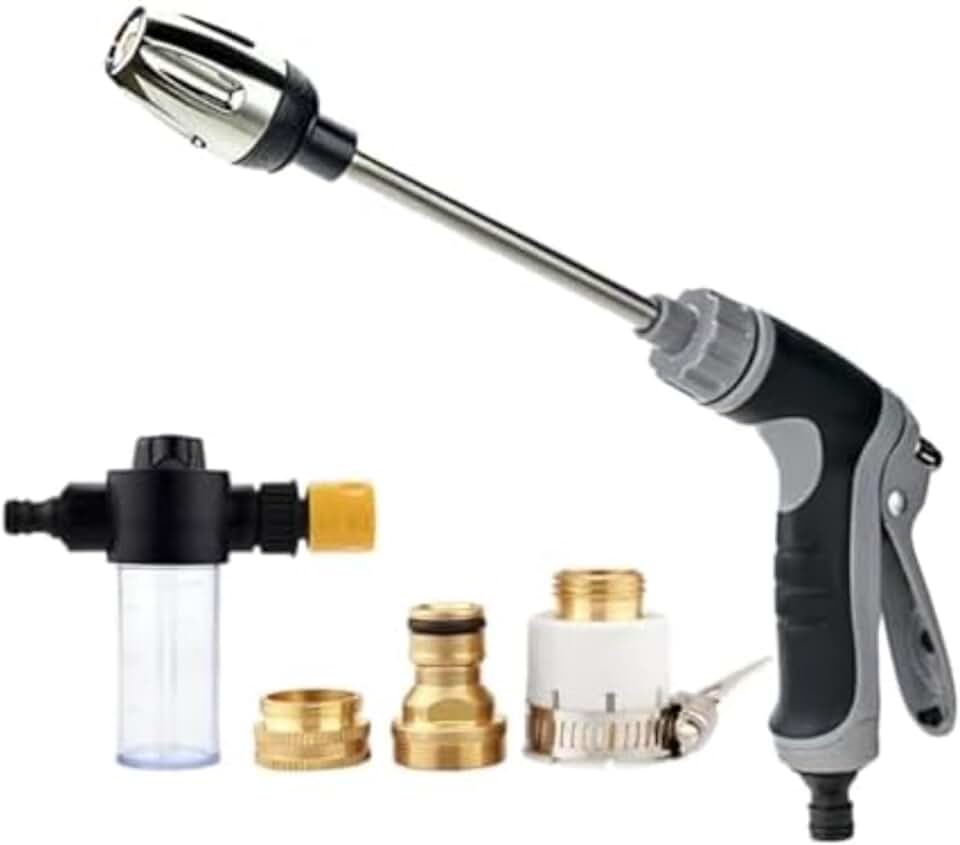
The Hose Hawk Pressure Washer promises effortless dirt and stain removal with its universal design and three spray modes. However, in the world of home improvement and outdoor cleaning, the term “pressure washer” implies a certain level of power and efficacy that this particular device struggles to deliver.

Quick Summary: Hose Hawk Pressure Washer
- Rating: 2.0/5.0
- Price: $69.95
- Key Pros:
- Easy and quick to install with standard garden hoses.
- Compact and lightweight design for convenient storage.
- Offers basic water jet functionality for light rinsing.
- Key Cons:
- Delivers insufficient pressure for true “pressure washing” tasks.
- Questionable durability and build quality for long-term use.
- Poor value for money, essentially a glorified nozzle.
Table of Contents
Hose Hawk Pressure Washer Overview
The Hose Hawk Pressure Washer positions itself as a convenient solution for household cleaning tasks, aiming to simplify the process of removing dirt and grime. It’s marketed with claims of being universal and easy to install, suggesting a plug-and-play experience for users.
However, a critical examination reveals that this device operates more like a high-pressure garden hose nozzle rather than a true pressure washer. Traditional pressure washers utilize a pump to significantly amplify water pressure, often reaching hundreds or even thousands of PSI (pounds per square inch). This product, conversely, appears to rely primarily on the existing water pressure from your garden hose.
This fundamental difference in operation dictates its capabilities and limitations. While it might offer a more focused and slightly more forceful stream than a standard garden nozzle, it falls far short of the power required for tasks typically associated with pressure washing, such as deep cleaning driveways, removing stubborn mold from siding, or stripping paint.
The appeal of its simplicity and lower price point is understandable, especially for those seeking a quick fix for minor cleaning. However, prospective buyers should temper their expectations regarding its performance against actual pressure washers. The product’s title mentions “effortless dirt & stain removal,” a claim that, given its nature, warrants significant skepticism for anything beyond superficial debris.
Its design is likely compact and lightweight, making it easy to store and maneuver, which can be seen as a positive for users with limited space or those who find traditional pressure washers cumbersome. Yet, this convenience comes at the cost of genuine cleaning power, leading to frustration when faced with more demanding cleaning challenges.
The target demographic for such a product would ideally be individuals needing only the absolute lightest of cleaning tasks, perhaps rinsing off patio furniture or quickly washing a car surface that’s not heavily soiled. Anyone expecting to tackle serious grime, mildew, or caked-on mud will likely be left thoroughly disappointed by its output.
Understanding the distinction between a garden hose attachment and a dedicated pressure washing machine is crucial before investing in the Hose Hawk. Its 2.0-star rating from limited reviews strongly suggests that many users have found its performance to be underwhelming compared to their expectations of a device bearing the “pressure washer” moniker.
The device’s perceived value is also a significant concern. At $69.95, it sits in a price bracket where one might expect a noticeable improvement over a basic spray nozzle. Unfortunately, for many, the marginal increase in performance may not justify the cost, pushing it into the category of an overpriced novelty rather than a functional home improvement tool.
Hose Hawk Pressure Washer Key Features & Specs
When evaluating the Hose Hawk Pressure Washer, its advertised features are the primary points of discussion, especially since detailed specifications like PSI or GPM are notably absent. The product description highlights three main aspects: three spray modes, universal and easy installation, and the promise of effortless dirt & stain removal.
Let’s delve into these claims. The mention of three spray modes suggests versatility in application. Typically, these modes might include a focused jet stream for concentrated cleaning, a fan spray for broader coverage, and perhaps a gentle rinse setting. While having different patterns is generally useful, their effectiveness is entirely dependent on the underlying water pressure delivered by the device.
Without a robust internal pump to generate high pressure, these spray modes will merely be variations of a garden hose stream. A jet mode might offer a slightly more concentrated blast, but it’s unlikely to achieve the impact needed to dislodge deeply embedded dirt or grime. Similarly, a fan spray will cover an area, but its cleaning power will be superficial at best, suitable only for dusting off surfaces.
The claim of being universal and easy to install is one of the more credible features. This typically means the device connects directly to a standard garden hose connection, requiring no special adapters or tools. This aspect does indeed contribute to user convenience, allowing for quick setup and immediate use without much fuss. For many, this simplicity is a major draw, especially compared to the more involved setup of electric or gas-powered pressure washers.
However, this ease of installation is also a strong indicator that the device lacks the complex pumping mechanisms of a true pressure washer. It implies that the pressure output will be limited to whatever your household water supply can provide, which is typically between 40-60 PSI. This is a far cry from the 1500-3000 PSI delivered by entry-level electric pressure washers.
Finally, the promise of effortless dirt & stain removal is the most ambitious and, based on user feedback and general product understanding, the most misleading claim. True effortless cleaning for tough dirt and stains requires significant hydraulic force. Without that force, “effortless” quickly turns into “tedious” and ultimately “ineffective.” Users attempting to remove mildew, oil stains, or deeply ingrained dirt will likely find themselves scrubbing manually after using this device, negating any perceived ease.
The absence of specific technical data, such as PSI (pounds per square inch) or GPM (gallons per minute), is a red flag. These metrics are standard for any legitimate pressure washer and are crucial for understanding its capabilities. Their omission suggests that the numbers would likely be too low to impress or accurately categorize it as a pressure washer.
In terms of construction, given the price point and general category, it’s reasonable to infer that the Hose Hawk Pressure Washer likely uses lightweight plastics and basic metals. While this keeps the unit light, it raises concerns about long-term durability, especially with repeated use or exposure to outdoor elements. A robust build is often necessary for tools subjected to water pressure and outdoor conditions, a quality that might be compromised here.
Overall, while the convenience of installation and the presence of multiple spray patterns offer some utility, these features are severely limited by the device’s fundamental lack of actual pressure-generating capability. It’s crucial for consumers to understand that these features do not translate into the performance expected from a genuine pressure washer.
Pros & Cons
Understanding the strengths and weaknesses of any product is crucial for making an informed purchase decision. The Hose Hawk Pressure Washer, despite its name, presents a mixed bag of very limited advantages and significant drawbacks, particularly when measured against the performance standards of actual pressure washing equipment.
Pros:
- Extremely Easy and Quick to Install: One of the most significant advantages of this device is its straightforward setup. It connects directly to a standard garden hose without the need for complex plumbing, specialized tools, or power outlets (if it’s purely hose-powered). This makes it accessible for anyone to use almost immediately upon unboxing, saving time and effort often associated with more powerful machines.
- Compact and Lightweight Design: The Hose Hawk is undeniably portable and easy to handle. Its small footprint ensures it won’t take up much storage space in a garage, shed, or utility closet. This characteristic also makes it less cumbersome to maneuver during use, which can be a relief for individuals who find bulkier equipment challenging to operate.
- Basic Water Jet Functionality for Light Rinsing: While it doesn’t deliver true pressure, the device does offer a more focused and slightly stronger stream than a typical garden hose nozzle. This can be marginally effective for very light tasks such as rinsing off loose dust from patio furniture, washing superficial dirt from a bicycle, or giving a quick rinse to garden tools after use. It serves as an incremental step up from a basic hose spray.
- No Electricity or Gas Required (if hose-powered): If the device is indeed purely hose-powered, it eliminates the need for electrical outlets or fuel, which simplifies operation and reduces potential points of failure or maintenance. This can be a convenience for outdoor areas where power sources are not readily available.
Cons:
- Inadequate Pressure for True Pressure Washing: This is the most critical drawback. The Hose Hawk simply does not generate the high PSI required to remove stubborn dirt, grime, mold, mildew, or oil stains effectively. Users expecting to clean driveways, concrete patios, or heavily soiled siding will find its performance severely lacking, resulting in frustration and wasted effort. It functions more as a high-pressure nozzle than a pressure washer.
- Questionable Durability and Build Quality: Given its price point and the general characteristics of similar products, the Hose Hawk likely employs less robust materials in its construction. This can lead to concerns about its longevity, with potential issues like leaks, cracks, or component failures arising after limited use. A lack of sturdy construction diminishes its overall value and reliability.
- Poor Value for Money: At nearly $70, the Hose Hawk is priced similarly to some entry-level electric pressure washers or significantly higher than advanced garden hose nozzles that offer comparable performance. Its limited capabilities make it an expensive proposition for what it delivers, leading many users to feel that they have overpaid for a product that doesn’t meet its advertised potential.
- Misleading Marketing Claims: The product’s assertion of “effortless dirt & stain removal” is highly misleading. Real-world application suggests that significant effort, if not additional cleaning agents and scrubbing, will still be required for most cleaning tasks. This discrepancy between marketing and performance sets unrealistic expectations for consumers.
- Limited Applications and Effectiveness: The range of tasks the Hose Hawk can genuinely perform effectively is extremely narrow. It struggles with anything beyond the most superficial cleaning. This severely limits its utility as a versatile home improvement tool, making it unsuitable for the majority of jobs typically assigned to a pressure washer.
- Lack of Transparent Specifications: The absence of key performance metrics like PSI and GPM is a significant concern. Reputable pressure washer manufacturers always provide these details. Their omission from the Hose Hawk’s description makes it difficult for consumers to objectively assess its capabilities before purchase and reinforces the suspicion of low performance.
In summary, while the Hose Hawk offers unparalleled ease of use and portability, these benefits are overshadowed by its fundamental inability to perform as a true pressure washer. Its low rating and the nature of its design strongly suggest that its cons far outweigh its limited pros for anyone seeking genuine cleaning power.
Who Should Buy the Hose Hawk Pressure Washer?
Given the significant limitations and the general underperformance of the Hose Hawk Pressure Washer, the list of individuals who would genuinely benefit from this purchase is quite narrow. It’s crucial for potential buyers to align their expectations with the product’s actual capabilities, rather than its ambitious marketing claims.
You might consider the Hose Hawk if:
- You only need the absolute lightest of rinsing tasks: If your primary goal is to simply rinse off loose dust from outdoor furniture, gently wash a child’s toy, or give a very light spray to your garden tools after use, and you have no expectation of removing any caked-on dirt or stains, then the Hose Hawk might suffice. Its concentrated stream could be slightly more effective than a thumb over a hose.
- You have extremely limited storage space: For apartment dwellers or those with very small sheds where even a compact electric pressure washer is too bulky, the Hose Hawk’s minimalist design might be appealing. It’s essentially a small attachment that can be easily tucked away.
- You are looking for extreme simplicity: If you are intimidated by power tools, motors, or complex setups, and prefer a device that literally just screws onto a hose, the Hose Hawk offers that level of straightforwardness. There are no engines to start, no power cords to manage, and no detergents to mix (unless you add a separate attachment).
- You are on a very tight budget for a spray device, but not for a pressure washer: While $69.95 is overpriced for what it is, it’s still less than a proper entry-level pressure washer. If your budget absolutely cannot stretch further, and you understand its severe limitations, it might be a last resort for a slightly more powerful hose stream.
Who absolutely should NOT buy the Hose Hawk Pressure Washer:
- Anyone expecting to perform actual pressure washing tasks: This includes cleaning driveways, concrete patios, brick walls, vinyl siding with mildew, decks, or heavily soiled vehicles. The Hose Hawk lacks the power to tackle these jobs effectively, leading to immense disappointment and wasted money. For these tasks, you need a machine that delivers hundreds or thousands of PSI.
- Individuals seeking good value for money: At $69.95, you can find much more effective tools. A high-quality multi-pattern garden hose nozzle might cost $20-30 and offer similar or better performance for basic rinsing. Entry-level electric pressure washers, which provide genuine cleaning power, can often be found for $100-$150 on sale.
- Those looking for durability and long-term reliability: The construction quality of such devices is often suspect, with reports of leaks or failures. If you need a tool that will last for multiple seasons and withstand regular use, the Hose Hawk is unlikely to meet those expectations.
- DIY enthusiasts or homeowners with moderate to significant cleaning needs: If you pride yourself on maintaining your home and property, you will quickly outgrow the capabilities of the Hose Hawk. Investing in a proper pressure washer, even a small electric model, will save you time, effort, and frustration in the long run.
In essence, the Hose Hawk Pressure Washer is a product that suffers from an identity crisis. It’s marketed as a solution for tasks it cannot genuinely perform, leading to a significant mismatch between consumer expectations and real-world results. For the vast majority of homeowners and DIYers, investing in a proper electric or gas pressure washer, even if it means a higher upfront cost, will provide far greater satisfaction and utility. For those who need to understand how actual pressure washers function and what to look for, resources like Wikipedia’s page on Pressure Washers can be incredibly informative.
Consider your cleaning needs carefully. If you require anything more than a glorified garden hose nozzle for rinsing, it would be wise to explore other options in the market that are designed to deliver genuine pressure washing performance. This will prevent disappointment and ensure your investment goes towards a tool that truly meets your home improvement demands.
FAQ about Hose Hawk Pressure Washer
Here are some frequently asked questions about the Hose Hawk Pressure Washer, addressing common concerns and clarifying its capabilities.
Q1: Is the Hose Hawk a true pressure washer, like those used for cleaning driveways?
A1: No, the Hose Hawk is not a true pressure washer in the conventional sense. It does not contain an internal pump to significantly amplify water pressure. Instead, it relies on your existing garden hose’s water pressure, functioning more like a specialized high-pressure nozzle or spray wand. It will not deliver the hundreds or thousands of PSI needed for heavy-duty cleaning tasks like stripping paint or deep cleaning concrete.
Q2: What is the PSI (pounds per square inch) of the Hose Hawk Pressure Washer?
A2: The manufacturer does not specify the PSI for the Hose Hawk. This omission is a significant red flag, as PSI is a fundamental metric for any genuine pressure washer. Based on its design and function, its output pressure would be limited to your household water pressure, typically around 40-60 PSI, which is far below that of even entry-level electric pressure washers (1500-2000 PSI).
Q3: What kind of cleaning tasks can the Hose Hawk effectively handle?
A3: The Hose Hawk is best suited for extremely light cleaning and rinsing tasks. This includes washing off loose dust from vehicles, patio furniture, or garage floors, and giving a superficial rinse to garden tools. It may offer a slightly more focused stream than a standard garden hose, but it struggles with any dirt or stains that are even moderately caked on or ingrained.
Q4: How does the Hose Hawk compare to a regular garden hose nozzle?
A4: The Hose Hawk offers a more directed and potentially slightly more forceful stream than a basic garden hose nozzle, especially with its jet spray mode. However, the difference in actual cleaning power for removing stubborn grime is often marginal. For many tasks, a high-quality multi-pattern garden hose nozzle might offer similar practical utility at a lower cost.
Q5: Is the Hose Hawk durable and built to last?
A5: User reviews and the product’s price point suggest that durability may be a concern. The construction likely involves lightweight materials that might not withstand prolonged or heavy use, or exposure to harsh outdoor conditions. Issues such as leaks or component failures are not uncommon for products in this category, leading to a limited lifespan.
Q6: Can this device remove stubborn mildew, oil stains, or deep-seated dirt?
A6: It is highly unlikely that the Hose Hawk Pressure Washer can effectively remove stubborn mildew, oil stains, or deep-seated dirt. These types of cleaning challenges require significant water pressure and often specialized detergents, which this device simply cannot provide. Attempting these tasks with the Hose Hawk will likely result in frustration and unsatisfactory results.
Q7: Is the Hose Hawk easy to install and use for anyone?
A7: Yes, its ease of installation and use is one of its few genuine advantages. It is designed to connect quickly and easily to any standard garden hose, requiring no complex assembly or technical know-how. This makes it accessible even for individuals who are not accustomed to using power tools or complex machinery.
Q8: Is the Hose Hawk a good value for its price?
A8: Generally, no. At $69.95, many consumers find the Hose Hawk to be overpriced for its limited capabilities. While it’s cheaper than a true pressure washer, its performance is often only marginally better than a much less expensive high-quality garden hose nozzle. For a slightly higher investment, one could purchase an entry-level electric pressure washer that offers significantly more power and versatility. For more information on what constitutes good value in pressure washing, consider consulting resources like Better Homes & Gardens’ Pressure Washing Basics.
Final Verdict
After a thorough review, the Hose Hawk Pressure Washer emerges as a product that largely fails to live up to its name and marketing promises. While it offers undeniable convenience in terms of installation and compact storage, these benefits are severely overshadowed by its fundamental lack of genuine pressure washing capability. It operates more as a high-pressure garden hose nozzle than a true pressure washer, relying solely on your household water pressure rather than an internal pump.
The claims of “effortless dirt & stain removal” are, for most practical purposes, misleading. Users seeking to tackle common home cleaning challenges like stubborn mildew, ingrained dirt on concrete, or caked-on mud will find the Hose Hawk utterly inadequate. Its performance is limited to the lightest of rinsing tasks, where a standard garden hose might achieve similar results with a good nozzle.
Priced at $69.95, the Hose Hawk presents a poor value proposition. For a slightly higher investment, consumers can access entry-level electric pressure washers that deliver hundreds or thousands of PSI, offering genuine cleaning power and versatility. The absence of specific performance metrics like PSI or GPM further reinforces the impression that its capabilities are intentionally obscured due to their low figures.
Durability is another significant concern, with the lightweight construction suggesting a limited lifespan. For homeowners and DIY enthusiasts who require a reliable tool for their cleaning needs, the Hose Hawk is likely to disappoint and prove to be a short-term, inefficient solution.
In conclusion, our recommendation for the Hose Hawk Pressure Washer is to approach it with extremely low expectations. If your needs are strictly limited to very light rinsing and you prioritize ultimate simplicity over actual cleaning power, it might serve a niche purpose. However, for anyone seeking a tool that can effectively remove dirt, grime, and stains, investing in a proper electric or gas pressure washer is a far more sensible and cost-effective decision in the long run. The Hose Hawk, despite its appealing name, is unfortunately a disappointing reality for those expecting true pressure washing performance.