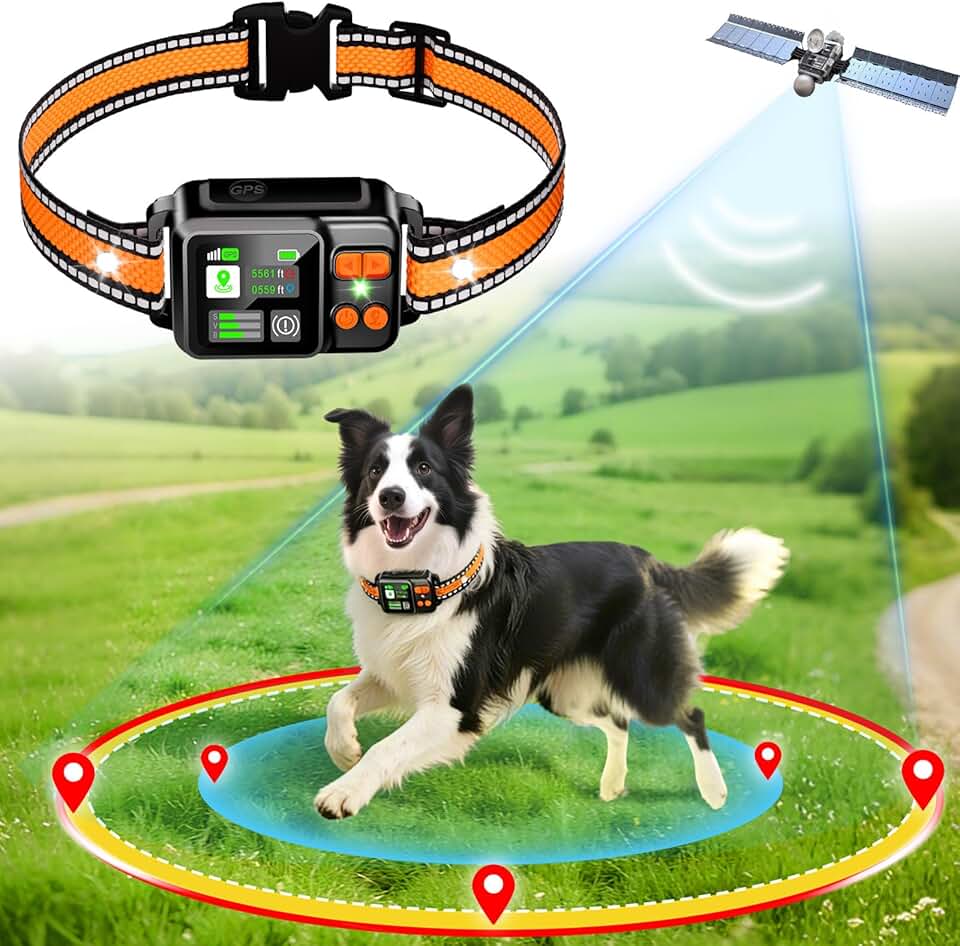
The GPS Wireless Dog Fence system represents a significant leap forward in pet containment technology, offering a wire-free solution for keeping your canine companion safely within designated boundaries. Unlike traditional systems that require burying wires or setting up physical transmitters, this innovative fence utilizes GPS satellite technology to establish virtual perimeters.

This review will delve deep into the features, performance, and overall value of this particular GPS Wireless Dog Fence, helping you determine if it’s the right choice for your home and your beloved pet. We’ll examine its accuracy, durability, ease of use, and suitability for various property types.
Quick Summary: GPS Wireless Dog Fence
- Rating: 4.4/5.0
- Price: $109.99
- Key Pros:
- No wires to bury, offering hassle-free setup and portability.
- Utilizes GPS for large, customizable boundary areas.
- IPX7 waterproof design ensures durability in all weather conditions.
- Key Cons:
- GPS accuracy can vary with environmental factors like dense tree cover.
- Initial training period is crucial and requires consistent effort.
Table of Contents
GPS Wireless Dog Fence Overview
The concept of an invisible dog fence has revolutionized pet containment, offering freedom for pets while providing peace of mind for owners. The GPS Wireless Dog Fence system takes this a step further by eliminating the need for any physical wires or boundary flags, relying instead on global positioning system (GPS) satellites to define the containment area.
This particular system is designed for ease of use and adaptability, making it an attractive option for homeowners with varying property sizes and layouts. It removes the labor-intensive process of burying wires, which is often a deterrent for many potential users of traditional in-ground fences.
At its core, the system consists of a single collar unit that receives GPS signals to determine its location relative to a pre-set boundary. When the dog approaches this virtual boundary, the collar emits a series of warnings—typically sound, vibration, and then static correction—to encourage the dog to return to the safe zone.
The primary advantage of a GPS-based system like this GPS Wireless Dog Fence is its unparalleled flexibility. Users can define boundaries in minutes, whether a simple circular perimeter or a more complex free-form shape tailored to their property’s unique contours. This makes it ideal for large rural properties, vacation homes, or even for use on camping trips where temporary containment is needed.
However, it’s important to understand that GPS technology, while highly advanced, has its limitations. Factors like dense tree cover, tall buildings, or severe weather can sometimes affect signal accuracy. These considerations are crucial when evaluating if a GPS-based fence is the right fit for your specific environment.
The system’s IPX7 waterproof rating ensures that the collar can withstand exposure to rain, puddles, and even a quick dip, making it suitable for active dogs who love to explore regardless of the weather. The rechargeable design adds to its convenience, eliminating the need for frequent battery replacements.
Understanding the fundamental operation of this technology is key to successful implementation. The collar continuously monitors its position, and the system is calibrated to provide consistent feedback to the dog as it approaches the boundary. This consistent training is vital for the dog to learn and respect the new limits.
Compared to radio-frequency wireless fences, which typically create a circular boundary around a central transmitter, the GPS Wireless Dog Fence offers far greater range and customization. This makes it a superior choice for properties exceeding a few acres where traditional wireless systems fall short.
For more detailed information on how GPS technology works, you can visit Wikipedia’s page on GPS. This background knowledge can help users better understand the capabilities and potential limitations of satellite-based pet containment.
GPS Wireless Dog Fence Key Features and Specifications
This GPS Wireless Dog Fence system comes packed with features designed to provide effective and convenient pet containment. Understanding these specifications is crucial for evaluating its performance and suitability for your needs.
GPS Electric Satellite Technology
The core of this system is its reliance on GPS for boundary definition. This allows for a completely wireless setup, eliminating the need for burying wires or installing a stationary transmitter. The system uses satellite signals to pinpoint the dog’s location, providing real-time tracking relative to the established virtual fence.
This technology enables the creation of large containment zones, often covering areas from half an acre up to several hundred acres, depending on the model and signal strength. The precision of GPS allows for dynamic boundary adjustments, which is a significant advantage over fixed-radius wireless systems.
Users can typically set the boundary radius in increments, allowing for fine-tuning of the safe zone. The system constantly recalculates the dog’s position, ensuring that the correction sequence is triggered accurately when the pet approaches the boundary.
IPX7 Waterproof Rechargeable Design
Durability is paramount for outdoor pet equipment, and the IPX7 rating addresses this directly. An IPX7 rating means the collar can be submerged in up to 1 meter of water for 30 minutes without damage, making it resistant to rain, snow, sprinklers, and even accidental dips in a pond or pool.
The rechargeable battery eliminates the ongoing cost and inconvenience of replacing disposable batteries. Most units offer several days to a week of use on a single charge, depending on usage frequency and GPS signal acquisition time. A USB charging cable is typically included for easy power replenishment.
The convenience of a rechargeable design also contributes to the system’s overall eco-friendliness, reducing waste from discarded batteries. Users should establish a regular charging routine to ensure the collar is always ready for use.
Two Modes: Circular and Free-Form Fence
This dual-mode functionality provides exceptional versatility. The circular mode is ideal for quick setup in open areas, creating a perfectly round boundary around a central point. This is particularly useful for temporary setups, such as during camping or visits to new locations.
The free-form mode allows users to customize the boundary to match the exact shape of their property, avoiding areas like gardens, driveways, or swimming pools. This mode typically involves walking the perimeter with the collar to map out the desired safe zone, offering a tailored containment solution.
Switching between these modes is usually straightforward, allowing owners to adapt the fence to different environments or changing needs. The ability to define complex shapes makes this GPS Wireless Dog Fence a powerful tool for diverse property types.
Adjustable Correction Levels
Most advanced GPS dog fences, including this one, offer multiple levels of static correction, vibration, and sound warnings. This allows owners to customize the deterrents to their dog’s temperament and training progress, starting with milder warnings and progressing if necessary.
The progressive correction sequence usually begins with an audible tone, followed by vibration, and then a static correction if the dog continues to approach or crosses the boundary. This tiered approach helps the dog understand the warning signals before receiving a stronger stimulus.
Proper adjustment of these levels is crucial for humane and effective training. Owners should always start at the lowest effective level and observe their dog’s reaction, ensuring the correction is noticeable but not overly distressing.
Collar Design and Comfort
The collar itself is designed to be lightweight and comfortable for prolonged wear, typically made from durable nylon or similar material. It should be adjustable to fit a wide range of dog sizes, from small to large breeds, ensuring a snug but not restrictive fit.
The GPS receiver and correction unit are integrated into the collar, making it a self-contained system. The weight and bulk of the unit are important considerations, especially for smaller dogs, to ensure it does not cause discomfort or impede their movement.
Regular inspection of the collar and contact points is recommended to prevent skin irritation and ensure proper function. Choosing the correct length of contact points (short for short-haired dogs, long for long-haired dogs) is also vital for effective correction delivery.
Wide Coverage Area
One of the most significant advantages of a GPS-based system is its ability to cover vast areas that would be impractical or impossible with wired or traditional RF wireless fences. This system can typically define boundaries for properties ranging from 0.5 acres up to several hundred acres, making it ideal for rural settings or large estates.
The maximum range is determined by the quality of the GPS signal and the system’s internal algorithms for boundary calculation. This wide coverage provides immense freedom for dogs on large properties, allowing them to roam safely within a much larger space than traditional systems permit.
Pros and Cons of the GPS Wireless Dog Fence
Evaluating any pet containment system requires a balanced look at its advantages and disadvantages. The GPS Wireless Dog Fence offers numerous benefits but also comes with certain limitations that potential buyers should be aware of.
Pros:
- No Wires to Bury: This is arguably the biggest advantage. The elimination of wire trenching or laying saves significant time, effort, and expense. Installation is dramatically simpler and quicker, often taking minutes instead of hours or days. This also means no damage to your landscaping.
- Exceptional Portability and Flexibility: Because there’s no fixed base station or buried wires, the system is highly portable. You can easily take it with you to a new home, on vacation, or even to a friend’s property. The ability to set up new boundaries quickly is a game-changer for those with dynamic lifestyles.
- Large Coverage Area: GPS technology allows for containment zones that span many acres, far exceeding the capabilities of traditional radio-frequency wireless fences. This is perfect for large rural properties, farms, or estates where a wide roaming area is desired for your dog.
- Customizable Boundaries (Circular & Free-Form): The option to choose between a simple circular boundary or a complex free-form shape provides immense control. This allows owners to tailor the safe zone precisely to their property, avoiding obstacles or specific areas like pools or sensitive gardens.
- IPX7 Waterproof Design: The collar’s robust waterproof rating ensures it can withstand various weather conditions, from heavy rain to snow, and even accidental submersion. This means your dog can play and explore without you worrying about the device failing due to moisture.
- Rechargeable Battery: The built-in rechargeable battery offers convenience and cost savings over time. It eliminates the need to constantly purchase and replace disposable batteries, contributing to a more sustainable and user-friendly experience.
- Progressive Correction Levels: With multiple levels of sound, vibration, and static correction, the system allows for humane and effective training. Owners can start with gentle warnings and adjust as needed, ensuring the dog learns without undue stress.
Cons:
- GPS Accuracy Variations: While generally reliable, GPS accuracy can be affected by environmental factors. Dense tree cover, tall buildings, steep terrain, or even heavy cloud cover can sometimes lead to slight shifts in the boundary or temporary signal loss, which might cause inconsistent corrections.
- Initial Learning Curve for Dogs: While easy for humans to set up, dogs require consistent training to understand the new, invisible boundaries. Some dogs may take longer to adapt, and a dedicated training period with boundary flags is essential for success.
- Battery Life Considerations: Although rechargeable, the continuous use of GPS can drain the battery faster than simpler electronic collars. Depending on the model and usage, daily or every-other-day charging might be necessary, which requires routine management.
- Not Ideal for Small Urban Yards: For very small properties or urban environments with many obstructions, GPS accuracy might not be precise enough to create very tight, small boundaries. Traditional wired fences might offer more consistent containment in such scenarios.
- Cost: While often competitive with high-end wired systems, GPS fences can be more expensive than basic wired or radio-frequency wireless options. The initial investment should be weighed against the convenience and features offered.
- Potential for Signal Dropout: In areas with poor satellite visibility or interference, there’s a risk of temporary signal loss. While systems often have fail-safes, this could theoretically lead to a dog crossing a boundary without correction or receiving a false correction.
Who Should Buy the GPS Wireless Dog Fence?
Deciding if the GPS Wireless Dog Fence is the right solution for your pet containment needs depends heavily on your specific circumstances, property characteristics, and your dog’s temperament. This system shines in particular situations where traditional fences fall short.
Owners with Large Properties
If you own a sprawling property, perhaps several acres or more, this GPS fence is an ideal choice. The ability to create large, expansive boundaries without burying miles of wire is incredibly beneficial. Rural homeowners, those with large plots of land, or hobby farmers will find this system particularly advantageous for giving their dogs ample space to roam safely.
Traditional wireless fences typically have a limited range, usually no more than an acre or two, making them unsuitable for vast estates. The GPS system overcomes this limitation, providing freedom for your pet across significant landscapes.
Those Seeking Portability and Flexibility
For individuals who frequently move, travel with their dog, or visit different locations (like vacation homes or campsites), the portability of a GPS Wireless Dog Fence is unmatched. You can set up a new boundary in minutes, wherever you are, without any permanent installation.
This flexibility extends to adapting the boundary on your own property. If you re-landscape or add a new feature, you can easily redefine the fence line without digging up and re-burying wires. This makes it a dynamic solution for evolving needs.
Homeowners Who Dislike Burying Wires
The thought of digging trenches across your yard, damaging landscaping, or dealing with the complexities of wire breaks is a major deterrent for many. This GPS system completely eliminates that arduous task, offering a clean, wire-free installation.
It’s also a great option for properties with difficult terrain, such as rocky ground, dense roots, or areas where digging is simply impractical. The virtual nature of the fence makes these physical barriers irrelevant.
Dogs Needing Training and Containment
While the system provides containment, it also acts as a training tool. Dogs that respond well to consistent, gentle correction can be effectively trained to understand and respect the boundaries. It’s especially useful for dogs prone to wandering or those who need a reminder to stay within certain limits.
The progressive correction levels allow for a tailored training approach, ensuring that the dog learns effectively without experiencing undue stress. This makes it suitable for a wide range of dog personalities, provided the owner commits to the training process.
Who Might Find It Less Suitable:
- Owners of Small Urban Yards: For very small properties (under half an acre) or in densely built urban areas, the slight inaccuracies inherent in GPS technology might make it difficult to set a precise, small boundary. Traditional wired systems might offer better precision in such confined spaces.
- Properties with Heavy Tree Cover or Tall Buildings: Areas with significant overhead obstructions can interfere with GPS signal reception, leading to inconsistent boundary detection. This could result in false corrections or a lack of correction when needed.
- Very Sensitive or Stubborn Dogs: While adjustable, some highly sensitive dogs might find any form of static correction distressing, while extremely stubborn dogs might require a more robust solution or more intensive training.
- Those with Budget Constraints: While the convenience is high, the initial cost can be higher than basic wired systems. If budget is the primary concern and a simple, fixed boundary is sufficient, other options might be more economical.
Ultimately, the GPS Wireless Dog Fence is an excellent investment for owners prioritizing flexibility, large coverage areas, and a wire-free setup, particularly for dogs on larger, more open properties. It provides a modern, convenient solution to pet containment challenges.
FAQ about GPS Wireless Dog Fence
Many common questions arise when considering a high-tech pet containment solution like the GPS Wireless Dog Fence. Here are answers to some of the most frequently asked questions to help clarify how this system works and its practical implications.
Q1: How accurate is the GPS Wireless Dog Fence system?
A1: The accuracy of a GPS Wireless Dog Fence can vary, typically ranging from 10 to 30 feet (3 to 9 meters). Factors like the number of visible satellites, environmental obstructions (dense trees, tall buildings), and weather conditions can influence precision. For large properties, this level of accuracy is generally sufficient, but it might be less ideal for very small, confined areas where pinpoint precision is critical.
Most systems are designed with a correction zone that accounts for these minor variations, ensuring the dog receives warnings before truly crossing the intended boundary. Consistent training helps the dog understand this buffer zone.
Q2: What happens if the GPS signal is lost?
A2: Most modern GPS Wireless Dog Fence systems are designed with fail-safe mechanisms for signal loss. If the collar loses GPS signal, it typically enters a safe mode where it will either stop providing corrections to prevent false alarms or issue a continuous warning tone until the signal is re-established. Some advanced models might store the last known boundary or have a temporary ‘home’ zone.
It’s crucial to check the specific product’s manual for its behavior during signal loss. Regular monitoring of the collar’s status is also advisable, especially during initial training periods or in areas with known signal challenges.
Q3: How long does the battery last on a single charge?
A3: Battery life for a GPS Wireless Dog Fence collar typically ranges from 1 to 3 days of active use, depending on factors such as how frequently the GPS is acquiring signals, the dog’s activity level, and the specific model. Constant signal acquisition and boundary alerts will consume more power.
It is generally recommended to charge the collar daily or every other day to ensure continuous operation. Establishing a routine, such as charging it overnight, can help maintain consistent functionality and prevent unexpected power depletion.
Q4: Is the GPS Wireless Dog Fence suitable for all dog sizes and temperaments?
A4: Most GPS Wireless Dog Fence systems are designed to accommodate a wide range of dog sizes, usually from about 10-15 pounds up to large breeds. The collar should fit snugly but comfortably, and the contact points must make proper skin contact.
For temperaments, the system offers adjustable correction levels (sound, vibration, static shock). This allows owners to tailor the intensity to their dog’s sensitivity. Highly sensitive dogs might do better with just sound and vibration, while more stubborn dogs might require a higher static correction level. However, very anxious or aggressive dogs might require alternative training methods.
Q5: Can I use one GPS Wireless Dog Fence system for multiple dogs?
A5: Yes, generally, you can use one GPS Wireless Dog Fence system for multiple dogs. Each dog would need its own compatible collar, which is purchased separately. The system’s central programming (the defined boundary) is communicated to all paired collars simultaneously.
This allows all dogs wearing a collar to be contained within the same virtual fence. However, ensure that each collar is properly fitted and that each dog undergoes individual training to understand the boundaries.
Q6: How do I train my dog to the GPS Wireless Dog Fence?
A6: Training is crucial for any invisible fence. Start by introducing the collar and letting your dog get used to wearing it. Then, set up the boundary and mark it with visible training flags, typically placed every 10-15 feet.
Walk your dog on a leash towards the flags. When the collar emits a warning tone, gently pull your dog back into the safe zone, praising them. Repeat this process, gradually introducing vibration and static correction as needed. This training usually takes 1-2 weeks of consistent, short sessions. For more comprehensive training tips, you can refer to resources like The Humane Society’s guide on invisible fences.
Q7: What is the difference between circular and free-form fence modes?
A7: The circular fence mode creates a perfectly round containment area around a central point where you set the boundary. This is quick and easy to set up, ideal for open spaces or temporary containment.
The free-form fence mode allows you to walk the perimeter of your desired safe zone, mapping out a custom shape that can accommodate irregular property lines, avoid obstacles, or exclude specific areas like gardens. This offers much greater flexibility and customization for complex properties.
Q8: Is the static correction safe and humane for my dog?
A8: When used correctly and at appropriate levels, the static correction from a GPS Wireless Dog Fence is generally considered safe and humane. The goal is to provide a mild, startling sensation that interrupts unwanted behavior, not to cause pain. It’s akin to a static shock from touching a doorknob.
Always start with the lowest effective correction level and use positive reinforcement when your dog responds correctly. Consult with your veterinarian or a professional dog trainer if you have concerns about using static correction with your specific dog.
Final Verdict
The GPS Wireless Dog Fence system offers a compelling and innovative solution for pet containment, particularly for owners with larger properties or those who prioritize flexibility and portability. Its wire-free setup, extensive coverage area, and customizable boundary options make it a standout choice in the invisible fence market.
While the inherent variability of GPS accuracy and the need for consistent training are factors to consider, the benefits often outweigh these minor drawbacks for the right user. The IPX7 waterproof rating and rechargeable design further enhance its practicality and user-friendliness.
If you’re tired of burying wires, need a containment solution that can adapt to different locations, and have a property where traditional systems fall short, this GPS Wireless Dog Fence is an excellent investment. It provides your dog with the freedom to explore safely within defined limits, offering peace of mind for you.
For urban dwellers with very small yards or properties with heavy signal obstructions, a traditional wired fence might offer more consistent precision. However, for most other scenarios, especially large, open properties, this GPS system proves to be a highly effective and convenient tool for responsible pet ownership.
Ultimately, the GPS Wireless Dog Fence is a powerful and efficient tool for managing your dog’s roaming habits, providing a modern answer to an age-old challenge. Its advanced features and ease of use make it a worthwhile consideration for any dog owner seeking a reliable and flexible containment solution.