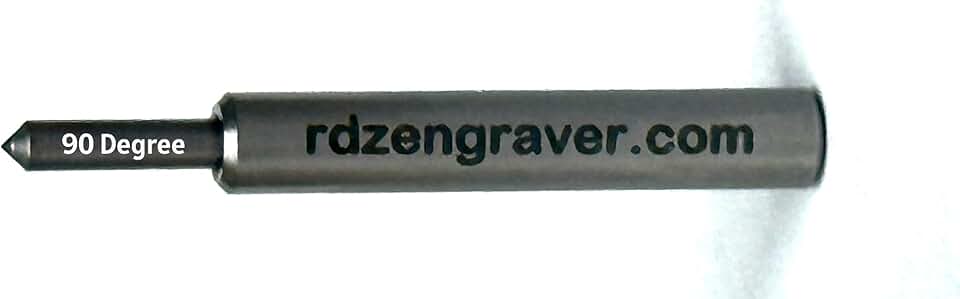
The RDZ Diamond Engraver is a specialized tool designed to elevate the capabilities of your CNC machine, allowing for precise and detailed engraving on a wide array of materials. This spring-loaded drag engraving tool offers a unique approach to marking and personalization, bypassing the need for a high-speed spindle commonly found in rotary engraving setups.

Quick Summary
Rating: 4.6 out of 5 stars (337 reviews)
Price: $69.99 USD
Key Pros:
- Exceptional precision for fine details on various materials.
- Spring-loaded design compensates for uneven surfaces, ensuring consistent depth.
- No spindle required, resulting in quieter operation and less dust.
Key Cons:
- Limited to surface marking; not suitable for deep material removal.
- Diamond tip can wear over time, requiring eventual replacement.
Table of Contents
RDZ Diamond Engraver Overview
The RDZ Diamond Engraver is a highly specialized tool engineered for precision surface marking using CNC machines. Unlike traditional rotary engraving tools that spin at high speeds to cut into material, this device utilizes a diamond-tipped stylus that is dragged across the surface, creating precise lines and designs.
This method, known as drag engraving or scratch engraving, relies on the exceptional hardness of the diamond tip to score or abrade the material. It’s particularly effective on materials that might be difficult to cut with conventional rotary tools or where a very fine, clean line is desired without material removal.
A key distinguishing feature of the RDZ Engraver is its spring-loaded mechanism. This innovative design allows the diamond tip to float vertically, compensating for slight inconsistencies or unevenness in the material surface. This ensures a remarkably consistent engraving depth and pressure, leading to uniform results across the entire workpiece.
The 90-degree tip included with the tool is a versatile choice, suitable for a broad range of applications from fine text to more intricate graphics. This angle influences the width and depth of the engraved line, providing a good balance for general-purpose engraving tasks.
The RDZ Diamond Engraver opens up new possibilities for CNC users, enabling them to engrave on a variety of hard and soft materials including metals like aluminum, brass, and stainless steel, as well as plastics, acrylics, glass, ceramics, and even some stones. This broad material compatibility makes it an invaluable addition to any workshop.
For hobbyists, artists, and small businesses, the ability to add permanent, high-quality markings to products is a significant advantage. Whether it’s for part numbering, decorative flourishes, custom jewelry, or personalized gifts, the precision offered by this diamond drag engraver is impressive.
One of the often-overlooked benefits of drag engraving is the minimal mess it creates. Since there’s no high-speed cutting action, there’s significantly less dust, chips, or debris generated compared to rotary engraving or milling. This contributes to a cleaner work environment and less cleanup time.
Furthermore, the absence of a spinning spindle means quieter operation, which can be a considerable advantage in home workshops or shared spaces. The RDZ Diamond Engraver simply uses the CNC machine’s motion to guide the tip, making it a straightforward and efficient engraving solution.
The tool is designed for easy integration into existing CNC setups. Its standard shank size ensures compatibility with most common collets and tool holders, simplifying the installation process. This means users can quickly switch between milling operations and engraving tasks without extensive reconfigurations.
Understanding the nuances of drag engraving is crucial for maximizing the potential of the RDZ Diamond Engraver. It excels at creating crisp, clean lines and shallow depressions, ideal for aesthetic marking rather than deep material removal. This distinction helps users set appropriate expectations and choose the right tool for their specific project needs.
The robust construction of the engraver ensures durability and longevity, even with regular use. Its simple yet effective design means fewer moving parts that can fail, contributing to its reliability in various working conditions. This makes it a reliable investment for anyone serious about expanding their CNC capabilities.
RDZ Diamond Engraver Key Features & Specs
The RDZ Diamond Engraver stands out due to its thoughtful design and specific features tailored for high-quality drag engraving. Understanding these elements is key to appreciating its value and capabilities in a CNC environment.
Diamond-Tipped Stylus
At the core of this tool is its industrial-grade diamond tip. Diamonds are the hardest known natural material, making them ideal for scoring and marking a vast range of materials without dulling quickly. This exceptional hardness ensures longevity and consistent performance.
The diamond tip allows for incredibly fine lines and sharp details, surpassing what many traditional rotary bits can achieve on hard surfaces. Its resistance to wear means fewer tip replacements and more consistent engraving quality over time, making it a cost-effective solution in the long run.
Spring-Loaded Mechanism
This is arguably the most critical feature of the RDZ Diamond Engraver. The internal spring mechanism provides a controlled, consistent downward pressure on the diamond tip, regardless of minor variations in the workpiece height or surface flatness.
When the CNC machine moves across an uneven surface, the spring allows the tip to retract or extend slightly, maintaining contact and uniform engraving pressure. This eliminates the need for perfectly flat stock or precise Z-axis calibration for every job, significantly simplifying setup and improving engraving consistency.
The spring tension is often adjustable or designed to provide optimal pressure for general engraving tasks. This adaptability makes it suitable for a wider range of materials and surface conditions compared to rigid engraving tools that require exact Z-axis control.
90-Degree Engraving Tip
The included 90-degree diamond tip is a versatile choice for most engraving applications. The angle of the tip influences the width and depth of the line created, with a 90-degree angle offering a good balance between fine detail and noticeable marking.
This angle is excellent for general text, logos, and intricate patterns. While other angles exist for different effects, the 90-degree tip is a robust starting point, providing clear and legible results on a variety of substrates. It creates a V-shaped groove that catches light beautifully.
Universal Shank Diameter
The RDZ Diamond Engraver is designed with a standard shank diameter (e.g., 1/4 inch or 6mm, depending on the specific model variation) to ensure broad compatibility with most CNC routers and milling machines. This universal fit means it can be easily clamped into standard collets and tool holders.
Ease of installation is a significant advantage, allowing users to quickly swap out other tools for engraving operations. This reduces downtime and enhances the versatility of an existing CNC setup without requiring specialized adapters or modifications.
Robust Construction
The body of the engraver is typically constructed from high-quality, durable materials such as anodized aluminum or hardened steel. This robust construction ensures that the tool can withstand the rigors of a workshop environment and maintain its precision over extended periods of use.
The internal components, including the spring and guiding mechanisms, are engineered for smooth operation and longevity. This attention to build quality contributes to the overall reliability and performance of the RDZ Diamond Engraver, making it a dependable tool for consistent results.
Material Versatility
This engraver excels at marking a wide array of materials. It performs exceptionally well on various metals, including aluminum, brass, copper, stainless steel, and even harder alloys, leaving clear, permanent marks. The diamond tip’s hardness is key here.
Beyond metals, it’s highly effective on plastics such as acrylic, polycarbonate, and ABS, creating crisp lines without melting or smearing that can occur with laser engravers or high-speed rotary tools. It can also engrave glass, ceramics, stone, and certain hardwoods, offering extensive creative freedom.
No Spindle Required
A significant advantage of the RDZ Diamond Engraver is that it does not require the CNC spindle to be active. It relies solely on the machine’s X, Y, and Z-axis movements. This simplifies operation, reduces power consumption, and eliminates the noise associated with a spinning spindle.
The lack of a spinning component also means no heat generation from friction, which is crucial when working with heat-sensitive materials. It also minimizes dust and debris, contributing to a cleaner and safer working environment.
Pros & Cons
Evaluating the strengths and weaknesses of the RDZ Diamond Engraver provides a balanced perspective for potential users. This tool offers distinct advantages for specific applications, but also has inherent limitations.
Pros of the RDZ Diamond Engraver:
- Exceptional Precision and Detail: The diamond tip allows for incredibly fine lines and sharp, crisp details, making it ideal for intricate designs, small text, and highly defined logos. This precision is difficult to match with many rotary tools.
- Versatile Material Compatibility: It effectively engraves a wide range of materials, including various metals (aluminum, brass, stainless steel), plastics (acrylic, ABS), glass, ceramics, and even some stone and wood. This broad utility expands the capabilities of your CNC machine significantly.
- Spring-Loaded Compensation: The integrated spring mechanism is a game-changer for achieving consistent engraving depth on uneven or slightly warped surfaces. It automatically adjusts to surface variations, eliminating the need for perfectly flat material or constant Z-axis adjustments.
- No Spindle Required & Quiet Operation: Unlike rotary engravers, this tool does not need a spinning spindle. This results in significantly quieter operation, making it suitable for home workshops or environments where noise is a concern. It also reduces power consumption.
- Minimal Dust and Debris: Since it scores rather than cuts, the RDZ Diamond Engraver produces very little dust or material chips. This leads to a much cleaner working environment and reduces cleanup time, which is a major benefit for sensitive materials or cleanroom settings.
- Easy Integration: With a standard shank size, the engraver easily fits into most common CNC collets and tool holders. This plug-and-play compatibility means quick setup and seamless switching between different tooling operations.
- Permanent Marking: The marks created by the diamond tip are permanent and resistant to fading, scratching, or rubbing off, making it ideal for industrial part marking, serialization, and durable decorative applications.
- Cost-Effective for Specific Tasks: For surface marking and decorative engraving on hard materials, the initial investment and ongoing operational costs can be lower than specialized laser engravers or high-end rotary systems.
- No Heat Generation: As it’s a cold process, there’s no heat generated at the engraving point, which is crucial when working with heat-sensitive materials like certain plastics or tempered glass that could crack or deform with heat.
Cons of the RDZ Diamond Engraver:
- Limited to Surface Marking: The primary limitation is that it’s designed for surface scoring, not deep material removal. It cannot create deep pockets, cut through materials, or perform traditional milling operations.
- Diamond Tip Wear: While diamonds are extremely hard, the tip will eventually wear down, especially when used extensively on very abrasive materials. This necessitates occasional tip replacement, incurring a minor ongoing cost.
- Requires Flat Material for Best Results: While the spring-loaded mechanism compensates for minor unevenness, extremely curved or highly irregular surfaces will still pose a challenge for consistent engraving quality. It performs best on generally flat or slightly contoured surfaces.
- Speed Limitations: Drag engraving is often slower than high-speed rotary engraving or laser marking for large areas, especially when covering broad sections with fine parallel lines. The feed rate needs to be carefully controlled for optimal results.
- Not Ideal for Soft, Gummy Materials: Very soft or gummy materials might not engrave cleanly, as the diamond tip can drag or tear the material rather than scoring it precisely. Experimentation is often needed for such materials.
Who Should Buy the RDZ Diamond Engraver?
The RDZ Diamond Engraver is a valuable addition for a specific set of users and applications, particularly those looking to expand their CNC machine’s capabilities beyond traditional milling or routing. Understanding its strengths helps identify the ideal buyer.
CNC Hobbyists and Enthusiasts
For hobbyists who already own a CNC router, the RDZ Diamond Engraver offers an affordable and easy way to add engraving capabilities without investing in a separate, specialized machine. It allows them to personalize projects, create custom gifts, or add professional-looking markings to their creations.
The simplicity of installation and operation makes it highly accessible for those new to engraving. It provides a clean, precise method for adding intricate details to various materials, enhancing the overall finish of their DIY projects.
Small Businesses and Artisans
Businesses specializing in custom products, such as personalized jewelry, engraved gifts, awards, or custom signage, will find this tool incredibly useful. The precision and versatility of the diamond engraver allow for high-quality, repeatable results on a diverse range of materials.
Jewelers can use it for engraving names, dates, or small designs on metal pieces. Artisans working with acrylic, glass, or specialty metals can create unique, high-value items with intricate detailing that stands out in the market.
Manufacturers Requiring Part Marking or Serialization
For small-scale manufacturing or prototyping operations that need to add permanent identification marks, serial numbers, or branding to components, the RDZ Diamond Engraver is an excellent choice. It creates durable marks that are resistant to wear and environmental factors.
The ability to engrave directly onto various metals, including stainless steel, makes it suitable for industrial applications where traceability and permanent identification are critical. It’s a cost-effective alternative to laser marking for certain types of permanent part identification.
Users Working with Delicate or Heat-Sensitive Materials
If you frequently engrave materials that are prone to cracking with heat (like certain types of glass or ceramics) or melting/deforming (like specific plastics), the cold process of diamond drag engraving is a significant advantage. It allows for precise marking without thermal stress.
This makes it a safer and more reliable option for materials that might otherwise be challenging to engrave with laser or high-speed rotary tools. It preserves the integrity and appearance of sensitive substrates.
Those Seeking Quiet Operation and Minimal Mess
Workshops located in residential areas or shared spaces will greatly benefit from the quiet operation of the RDZ Diamond Engraver. Without a spinning spindle, the noise levels are dramatically reduced compared to traditional CNC milling.
Additionally, the minimal production of dust and chips is a major plus for maintaining a clean workspace. This is particularly important for users who want to avoid airborne particulates or who are working with materials that generate fine, irritating dust.
Educators and Training Facilities
Schools, colleges, and vocational training centers can use the RDZ Diamond Engraver as an effective teaching tool to demonstrate engraving principles and techniques. Its ease of use and safety features (no high-speed cutter) make it suitable for educational environments.
It provides students with hands-on experience in precision marking and personalization, expanding their skill set in CNC operation and material manipulation. The visible results are also very rewarding for learners.
Ultimately, if you’re looking to add high-precision surface marking capabilities to your existing CNC machine, especially on a variety of hard materials, and prioritize clean, quiet operation, the RDZ Diamond Engraver is a highly recommended and cost-effective solution. It bridges the gap between basic CNC functionality and specialized engraving needs.
FAQ about RDZ Diamond Engraver
Here are some frequently asked questions about the RDZ Diamond Engraver to help users better understand its functionality, compatibility, and best practices.
Q1: What materials can the RDZ Diamond Engraver engrave effectively?
The RDZ Diamond Engraver is highly versatile and can engrave a wide range of materials. This includes various metals such as aluminum, brass, copper, stainless steel, and even some harder alloys. Its diamond tip is exceptionally effective at scoring these surfaces.
It also performs excellently on plastics like acrylic, polycarbonate, and ABS, creating crisp lines without the melting or smearing issues that can sometimes occur with heat-based methods. Furthermore, it’s suitable for engraving glass, ceramics, stone (like marble or granite), and certain hardwoods, expanding its application possibilities significantly.
Q2: How does the spring-loaded mechanism of the RDZ Diamond Engraver work, and what are its benefits?
The spring-loaded mechanism is a crucial feature that allows the diamond tip to move vertically within the tool body. As the CNC machine guides the engraver across a workpiece, the spring applies a consistent downward pressure on the diamond tip.
This design enables the tip to automatically adjust for minor variations in the material’s surface height or flatness. The primary benefit is achieving uniform engraving depth and consistent line quality across the entire design, even on materials that aren’t perfectly level. It reduces the need for extremely precise Z-axis calibration and compensates for slight material warpage, simplifying the engraving process and improving results.
Q3: What is the main difference between diamond drag engraving and rotary engraving?
The main difference lies in how they interact with the material. Rotary engraving uses a spinning cutter (end mill or engraving bit) to physically remove material, creating a cut or groove. This requires a high-speed spindle and generates chips and dust.
Diamond drag engraving, on the other hand, uses a non-rotating, static diamond tip that is dragged across the material’s surface. It relies on the diamond’s hardness to score or scratch the material, creating a shallow, clean line without removing significant material. It does not require a spindle and produces minimal dust, making it quieter and cleaner.
Q4: Is the RDZ Diamond Engraver compatible with all CNC machines?
The RDZ Diamond Engraver is designed with a standard shank diameter (commonly 1/4 inch or 6mm), which makes it compatible with most CNC routers, milling machines, and even some 3D printers that have appropriate collets or tool holders. It essentially functions as a passive tool, relying on the CNC machine’s motion for guidance.
Users should verify their machine’s collet size to ensure a proper fit. Since it doesn’t require spindle power, its compatibility is largely determined by the ability of your CNC machine to hold the tool and execute G-code for X, Y, and Z movements. General-purpose CNC software can typically generate the necessary toolpaths.
Q5: How long does the diamond tip typically last, and can it be replaced?
The lifespan of the diamond tip varies significantly based on the materials being engraved and the frequency of use. When used on softer materials like plastics or aluminum, the tip can last for a very long time, often hundreds of hours of engraving.
However, when regularly used on harder or more abrasive materials such as stainless steel, glass, or stone, the tip will experience more wear and eventually require replacement. Yes, the diamond tips are typically replaceable, and replacement tips are usually available from the manufacturer or third-party suppliers. Regular inspection of the tip for chips or dullness is recommended to maintain engraving quality.
Q6: Can the RDZ Diamond Engraver engrave curved surfaces?
While the spring-loaded mechanism helps compensate for minor unevenness on generally flat surfaces, the RDZ Diamond Engraver is primarily designed for 2D engraving on flat or slightly contoured surfaces. Engraving on significantly curved or spherical surfaces can be challenging.
For truly curved surfaces, the Z-axis would need to constantly adjust to maintain the correct engraving depth and angle, which requires complex 3D toolpaths and a CNC machine capable of true 3D contouring. For best results, use it on surfaces that are largely flat or have gentle, consistent curves that the spring mechanism can effectively manage.
Q7: What software settings are recommended for using the RDZ Diamond Engraver?
When setting up your CAM software for the RDZ Diamond Engraver, you typically need to define a toolpath that consists of X and Y movements, with a minimal Z-axis plunge. Since it’s a drag engraver, you won’t set a spindle speed.
Key settings include: Feed Rate (how fast the tool moves horizontally) – typically slower for harder materials and finer details. Plunge Depth – a very shallow plunge (e.g., 0.005 to 0.020 inches or 0.1 to 0.5 mm) is usually sufficient to engage the spring and ensure consistent contact. Experimentation with these settings on scrap material is highly recommended to achieve optimal results for different materials.
Q8: How do I clean and maintain the RDZ Diamond Engraver?
Maintenance for the RDZ Diamond Engraver is relatively simple. After use, especially on materials that produce fine dust (like some plastics or soft metals), it’s a good practice to gently clean the tool. You can use compressed air to blow away any debris that might accumulate around the diamond tip or within the spring mechanism.
Avoid harsh chemicals. Periodically, inspect the diamond tip for any signs of wear, chips, or damage. If the engraving quality degrades, it might be time to replace the tip. Keeping the tool clean and stored in a protective case when not in use will help prolong its lifespan and maintain its precision.
Final Verdict
The RDZ Diamond Engraver is an outstanding tool that significantly enhances the capabilities of any CNC machine by offering precise, clean, and versatile engraving. Its innovative spring-loaded design is a standout feature, simplifying the engraving process and ensuring consistent results even on slightly imperfect surfaces.
For CNC hobbyists, small businesses, or anyone needing to add permanent, high-quality markings to a wide range of materials, this engraver presents an excellent value. It eliminates the need for a noisy spindle, produces minimal mess, and delivers exceptional detail on challenging materials like metals, glass, and hard plastics.
While it is primarily for surface marking and not deep material removal, its strengths in precision, material compatibility, and ease of use make it a highly recommended addition to any workshop. The ability to integrate it seamlessly into an existing CNC setup further adds to its appeal, making it a smart and efficient investment for expanding creative and production possibilities.
The RDZ Diamond Engraver truly shines for those who prioritize fine detail, clean operation, and the ability to mark a diverse array of hard materials without complex setups. It’s a tool that pays for itself through its versatility and the professional quality of its output.