The Drawing Projector Tracing tool presents an innovative solution for artists, crafters, and hobbyists seeking to enhance their creative process. This device simplifies the complex task of transferring images onto various surfaces, making intricate designs accessible to everyone. Our comprehensive review delves into its capabilities, ideal use cases, and overall value.
Quick Summary: Drawing Projector Tracing
Rating: Not yet rated (0.0/5.0)
Price: $69.99 USD
Key Pros:
- Exceptional versatility for various creative projects.
- Significantly aids in improving drawing and tracing accuracy.
- Compact and portable design enhances usability for different setups.
Key Cons:
- Requires a smartphone or tablet for image projection.
- Performance may vary in brightly lit environments.
Table of Contents
Drawing Projector Tracing Overview
The Drawing Projector Tracing device represents a modern advancement in art and craft tools, designed to simplify and democratize the art of tracing and sketching. At its core, it leverages optical reflection technology to project an image from a smartphone or tablet onto a drawing surface. This allows users to accurately trace complex pictures, text, or patterns with ease, regardless of their artistic skill level.
Unlike traditional opaque or overhead projectors, this smart sketcher is compact and highly portable. It uses a series of mirrors or a reflective lens to display a ghost image of your chosen reference material directly onto your canvas, paper, cookie, or cake. This innovative method eliminates the need for light boxes or carbon paper for many applications, streamlining the creative workflow.
The primary benefit of a Drawing Projector Tracing tool is its ability to provide a visual guide for precise replication. For those struggling with freehand drawing or proportion, it acts as an invaluable assistant, allowing them to focus on line quality and shading rather than initial accuracy. This makes it an excellent learning tool for aspiring artists and a time-saver for professionals.
Beyond traditional art, its applications extend significantly into various crafting domains. Cake decorators can use it to transfer intricate fondant designs, while cookie artists can perfectly outline edible masterpieces. It’s also gaining popularity among tattoo artists for creating precise stencils and among DIY enthusiasts for painting signs or custom furniture. The versatility is truly one of its standout characteristics.
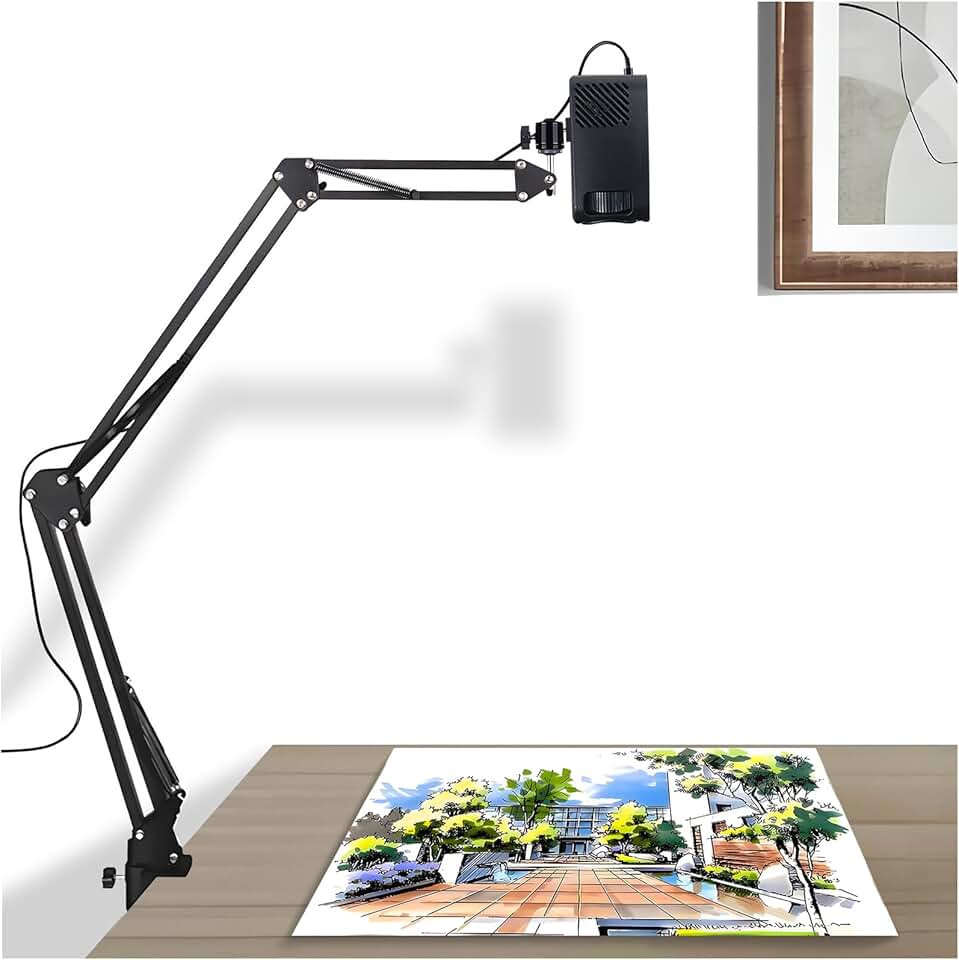
Understanding the underlying principle of the Drawing Projector Tracing mechanism is straightforward. You place your smartphone or tablet on a designated stand, position the device over your chosen surface, and the projector’s optics do the rest. The image appears as a faint, transparent overlay, ready for you to trace with your preferred medium. This intuitive design makes it accessible even for those new to such tools.
This type of art projector is particularly beneficial for projects requiring exact duplication or scaling. Whether it’s enlarging a small sketch to fit a large canvas or reducing a detailed photograph for a miniature painting, the projector provides a consistent and accurate reference. This capability opens up new possibilities for creative expression that might otherwise be too challenging or time-consuming.
Moreover, the modern iterations often come with adjustable stands and sometimes even dimmable light features. These enhancements allow users to optimize the projection clarity and brightness based on ambient lighting conditions and the specific material they are working on. Such flexibility ensures a comfortable and effective tracing experience across diverse environments and projects.
In essence, the Drawing Projector Tracing is more than just a gadget; it’s a creative enabler. It bridges the gap between artistic vision and execution, providing a reliable and easy-to-use method for transferring images. Its rise in popularity reflects a growing desire for tools that support creative endeavors without requiring years of specialized training, making art more accessible to a broader audience.
Drawing Projector Tracing Key Features & Specs
While specific technical specifications can vary between models, the general design and functional features of a Drawing Projector Tracing tool are quite consistent. Understanding these core attributes is crucial for appreciating its utility and performance. This section will detail the typical features and specifications you can expect from such a device, ensuring you know what makes it effective.
Smart Device Compatibility
The most fundamental feature is its reliance on a smartphone or tablet as the image source. This means the projector itself doesn’t have internal storage or a screen; it simply projects what’s displayed on your mobile device. This approach offers immense flexibility, allowing users to project any image they can access on their phone, from personal photos to digital art and online templates. It also keeps the device itself lightweight and affordable.
Adjustable Stand and Holder
A robust and adjustable stand is critical for proper functionality. This stand typically holds both the projection mirror/lens and your smart device securely. It allows for height and angle adjustments, which are essential for controlling the size and position of the projected image on your surface. Stability is key here, as any wobble can distort your tracing. Some models feature a multi-jointed arm, offering even greater flexibility.
Optical Reflection Technology
The core of the Drawing Projector Tracing is its optical system, often comprising a high-quality acrylic lens or a series of mirrors. This system reflects the image from your phone screen onto your working surface. The quality of this optical component directly impacts the clarity and sharpness of the projected image, which is vital for accurate tracing. Advanced models might use specialized coatings to reduce glare and improve light transmission.
Portable and Lightweight Design
These projectors are designed with portability in mind, often featuring a collapsible or easily disassembled structure. Made from lightweight materials like ABS plastic, they are easy to transport and store. This makes them ideal for artists who work in different locations, attend workshops, or simply need to clear their workspace quickly. The compact footprint ensures it doesn’t take up much room on a desk.
Ease of Setup and Use
One of the significant advantages is the straightforward setup process. Typically, it involves assembling the stand, placing your phone, and positioning the projector. There are usually no complex electronic configurations or software installations required. This plug-and-play simplicity makes it accessible to users of all technical proficiencies, allowing them to focus immediately on their creative tasks.
Image Brightness and Clarity
While not a traditional projector with a dedicated light source, the clarity of the projected image is paramount. This depends on both the brightness of your smartphone screen and the ambient lighting. Some projectors include a small LED light to enhance visibility, especially in slightly brighter rooms. For optimal results, working in a moderately dim environment is usually recommended to ensure the projected lines are clearly visible for tracing.
Versatile Application Surfaces
The design of the Drawing Projector Tracing allows it to be used on a wide array of surfaces. This includes paper, canvas, wood, fabric, and even three-dimensional objects like cakes or cookies. The ability to project onto non-flat or irregular surfaces significantly expands its utility beyond conventional drawing, catering to a diverse range of artistic and crafting needs. This adaptability is a major selling point for many users.
In summary, the key features of a Drawing Projector Tracing tool revolve around its smart device integration, a stable and adjustable projection system, and a lightweight, user-friendly design. These elements combine to create an effective and accessible tool for anyone looking to simplify their image transfer and tracing processes. The lack of complex electronics contributes to its reliability and ease of maintenance, making it a low-hassle addition to any creative toolkit.
Pros & Cons
Evaluating any tool requires a balanced look at its strengths and weaknesses. The Drawing Projector Tracing device, while highly innovative and useful, is no exception. Understanding its advantages and limitations will help potential users determine if it’s the right fit for their specific creative needs and workflow.
Pros of the Drawing Projector Tracing
Enhances Drawing Accuracy and Proportion
One of the most significant benefits is the ability to achieve precise accuracy in drawing. For artists who struggle with proportions, perspective, or replicating complex images, this projector provides an undeniable advantage. It projects a perfect outline, allowing the user to focus solely on their line work and artistic interpretation rather than struggling with the initial sketch. This can dramatically improve the quality of finished pieces.
Boosts Learning and Skill Development
For beginners or those looking to improve their drawing skills, the projector acts as an excellent learning aid. By tracing, individuals can develop muscle memory, understand how lines form shapes, and internalize compositional principles. It allows them to tackle more ambitious projects earlier in their artistic journey, fostering confidence and encouraging continuous practice. It’s a stepping stone to freehand mastery.
Exceptional Versatility Across Mediums and Projects
The adaptability of this tool is truly impressive. It’s not just for paper; it can be used for canvas painting, mural design, wood burning, embroidery patterns, tattoo stencils, and even culinary arts like cake and cookie decorating. This broad application spectrum makes it a valuable asset for a wide range of crafters and artists, maximizing its utility in a diverse creative toolkit. Imagine transferring an intricate pattern onto a wooden box or a delicate design onto a personalized mug.
Saves Time and Reduces Frustration
Manually transferring complex images can be incredibly time-consuming and often frustrating, especially for detailed work. The projector streamlines this process, cutting down hours of sketching into minutes of tracing. This efficiency allows artists to complete more projects, focus on the more enjoyable aspects of their craft, and avoid the common pitfalls of initial setup errors. It’s a productivity booster for any creative.
Portable and Easy to Store
Most Drawing Projector Tracing models are designed to be lightweight and compact. They are often collapsible or easily disassembled, making them perfect for artists who have limited workspace or need to work on the go. Their small footprint also means they don’t take up much storage space, a significant advantage in smaller studios or homes. This portability allows for creative expression anywhere.
Cons of the Drawing Projector Tracing
Reliance on External Smart Device
A primary drawback is its dependence on a smartphone or tablet. If your device battery dies, or if you don’t have a compatible device, the projector becomes unusable. This adds an extra layer of equipment management and potential points of failure that traditional projectors might not have. It also means your phone is tied up during the tracing process, which can be inconvenient if you need it for other tasks.
Performance in Bright Environments
The clarity and visibility of the projected image are highly dependent on ambient lighting conditions. In a brightly lit room, the projected lines can be very faint, making tracing difficult or impossible. While some models include small LEDs, optimal performance usually requires a moderately dim environment. This limitation can restrict where and when you can effectively use the projector, posing a challenge for those who prefer working in well-lit spaces.
Learning Curve for Optimal Setup
While generally easy to use, achieving the perfect projection size, focus, and alignment can sometimes require a bit of practice. Adjusting the phone position, projector height, and angle to get the desired result might take some trial and error. This initial learning curve, though minor, can be a source of temporary frustration for new users who expect immediate perfection straight out of the box. Mastering the setup is key to leveraging its full potential.
Potential for Image Distortion at Extreme Angles
When the projector or the surface is not perfectly aligned, or when attempting to project onto highly irregular surfaces, some image distortion can occur. The projected image might appear stretched or skewed, requiring manual correction during tracing. While often manageable, this can detract from the precision that the projector is designed to provide, especially for very detailed or architecturally sensitive work. Understanding these limitations helps manage expectations.
In conclusion, the Drawing Projector Tracing offers significant advantages in terms of accuracy, versatility, and time-saving for a wide array of creative endeavors. However, its reliance on a smart device and sensitivity to ambient light are factors to consider. For many, the benefits far outweigh these minor inconveniences, making it a worthy investment for their artistic toolkit.
Who Should Buy the Drawing Projector Tracing?
The Drawing Projector Tracing tool is not a one-size-fits-all solution, but it caters to a surprisingly broad audience due to its versatility and ease of use. Identifying who stands to benefit most from this innovative device involves looking at various creative fields and skill levels. Understanding these target demographics will help you decide if this projector is the missing piece in your artistic arsenal.
Aspiring Artists and Beginners
For individuals just starting their artistic journey, or those who feel intimidated by freehand drawing, this projector is a game-changer. It removes the initial hurdle of accurately sketching an image, allowing beginners to focus on developing their fine motor skills, understanding pressure control, and learning about line quality. It provides a crucial confidence boost, enabling them to create impressive pieces from the outset. This foundational support can be invaluable.
Hobbyists and Casual Crafters
Weekend warriors, DIY enthusiasts, and anyone who enjoys crafting as a hobby will find immense value in the Drawing Projector Tracing. Whether it’s customizing a T-shirt, personalizing a gift, creating unique greeting cards, or decorating home items, the projector ensures that designs are transferred perfectly. It takes the guesswork out of intricate designs, making crafting more enjoyable and less prone to errors. This tool elevates casual projects to a professional-looking finish.
Professional Artists and Illustrators
Even seasoned professionals can benefit from this tool, particularly for certain tasks. When needing to quickly transfer a complex design from a digital sketch to a physical canvas, or for scaling designs without losing fidelity, the projector significantly speeds up the process. It’s an excellent aid for mural artists, sign painters, and illustrators who require precise replication of their work at varying scales. It allows them to dedicate more time to the creative nuances rather than the initial setup.
Cake and Cookie Decorators
This is a rapidly growing niche where the projector shines. Intricate designs, personalized messages, and even photorealistic images can be projected directly onto cakes, cookies, and other edible surfaces. This allows decorators to achieve stunning, detailed results that would be incredibly challenging, if not impossible, to freehand. It transforms confectionery into edible art, opening up new possibilities for custom orders and creative expression. The precision it offers is unparalleled for edible artistry.
Tattoo Artists
For tattoo artists, precision is paramount. The projector can be used to create highly accurate stencils directly on the skin, ensuring that the client’s desired design is perfectly replicated before the needle even touches the skin. This reduces redraws, improves client satisfaction, and ensures the final tattoo matches the initial concept with impeccable accuracy. It’s a modern upgrade to traditional stencil methods.
Educators and Art Teachers
Art instructors can use the Drawing Projector Tracing in classrooms to demonstrate techniques, provide tracing exercises, or help students with challenging projects. It can simplify complex lessons on proportion and perspective, making them more accessible and engaging for students. It’s a versatile teaching aid that supports various learning styles and helps foster a more inclusive creative environment. For example, projecting an anatomy drawing for students to trace can greatly aid in understanding form.
Anyone Seeking Creative Exploration
Ultimately, if you have a creative idea but lack the confidence or skill to bring it to life through drawing, this projector can be your bridge. It lowers the barrier to entry for many artistic pursuits, encouraging experimentation and personal expression. It allows individuals to explore new mediums and techniques without the frustration of initial sketching roadblocks. It’s about making art more accessible and enjoyable for everyone.
However, those who prefer pure freehand artistry or find satisfaction solely in manual sketching might not see the immediate appeal. It’s a tool for assistance and precision, not a replacement for fundamental drawing skills. If your primary goal is to improve freehand drawing without any external aids, then this projector might serve more as a complementary tool rather than a central one. Yet, for many, it significantly broadens creative horizons.
In conclusion, the Drawing Projector Tracing is an excellent investment for anyone who desires accuracy, versatility, and efficiency in their creative projects. From novice artists to professional decorators, its ability to simplify image transfer and enhance precision makes it a valuable addition to a wide array of creative endeavors. It empowers users to achieve professional-looking results with greater ease and confidence, ultimately fostering more creative output. For more insights into optical drawing, you can visit Wikipedia’s page on Camera Lucida, which shares similar optical principles.
FAQ about Drawing Projector Tracing
Many potential users have questions about how a Drawing Projector Tracing tool works, its limitations, and best practices. This FAQ section aims to address common inquiries, providing clear and concise answers to help you make an informed decision and get the most out of your projector.
Q1: How does the Drawing Projector Tracing actually work?
The projector works on the principle of optical reflection. You place your smartphone or tablet on a designated holder, and the image displayed on your device screen is reflected through a special optical lens or mirror system. This reflection creates a ghost image that appears superimposed on your drawing surface below. You then simply trace over these projected lines to replicate the image.
It’s essentially a modern take on devices like the camera lucida, using your phone as the light source and image provider. There are no internal electronics or batteries in the projector itself; it merely acts as an optical conduit. This simplicity makes it very robust and user-friendly, relying on the power and display of your existing smart device.
Q2: What kind of images can I project?
You can project any image that can be displayed on your smartphone or tablet screen. This includes photographs, digital artwork, downloaded templates, text, logos, and even real-time camera feeds. The versatility is limited only by what your mobile device can show. This broad capability allows for endless creative possibilities, from complex portraits to simple lettering.
Artists often use it for reference photos, while crafters might use it for intricate patterns found online. Cake decorators can project custom messages or cartoon characters. The key is that the image needs to be clear and bright on your device screen for optimal projection clarity. Experimenting with different image types will help you discover its full potential.
Q3: Do I need any special apps for the Drawing Projector Tracing?
While some manufacturers might recommend or offer proprietary apps, most Drawing Projector Tracing tools do not require specific apps to function. You can simply use your phone’s native photo gallery, web browser, or any drawing app that displays the image you want to trace. Some apps can help with mirroring or adjusting image properties, but they are not strictly necessary for basic operation.
However, using a dedicated app can sometimes enhance the experience by providing features like screen locking (to prevent accidental touches), brightness control, or grid overlays. These features can make tracing even more precise and convenient. For the most part, if your phone can display an image, you can project it.
Q4: Can I adjust the size of the projected image?
Yes, the size of the projected image is typically adjustable. This is primarily achieved by changing the distance between the projector’s lens/mirror and your drawing surface. Raising the projector higher will enlarge the image, while lowering it will reduce the size. Additionally, you can zoom in or out on the image on your smartphone screen to fine-tune the scale.
Some models also offer adjustable angles on their stands, providing further control over the image’s placement and slight size modifications. Mastering these adjustments will allow you to perfectly scale any image to fit your canvas or working area. Practice with different distances to understand the range of size adjustments possible.
Q5: Is it suitable for left-handed people?
Absolutely. The design of most Drawing Projector Tracing tools is ambidextrous, meaning it can be comfortably used by both left-handed and right-handed individuals. The projection appears directly on the surface, allowing you to trace from any angle that feels natural. There are no specific controls or features that favor one hand over the other.
The key is to set up your workspace in a way that is comfortable for you, ensuring good lighting and a stable surface. The projector itself does not impose any handedness restrictions, making it a universally accessible tool for all artists and crafters. Its open design allows for flexible hand placement during tracing.
Q6: How clear is the projected image, especially in bright rooms?
The clarity of the projected image is generally good in moderately dim to dark environments. The brighter your phone screen and the darker your room, the clearer the image will appear. In brightly lit rooms, the projected image can become very faint and difficult to see, making tracing challenging. This is a common limitation for optical projectors that rely on ambient light conditions.
Some models may include a small LED light to slightly enhance visibility, but for optimal results, it’s always best to dim the lights in your workspace. Consider using a desk lamp to illuminate your paper rather than overhead room lights, creating a more focused and controlled lighting environment. This will maximize the contrast of the projected image against your tracing surface.
Q7: Can I use it to project onto vertical surfaces like a wall?
Most standard Drawing Projector Tracing tools are designed for horizontal projection onto a flat surface directly below the device. While it might be technically possible to jury-rig a setup for vertical projection, it’s not their intended or most effective use. The optical system is optimized for downward reflection.
For projecting onto walls or other vertical surfaces, a traditional digital projector (which projects light directly, not via reflection) would be far more suitable and effective. Attempting to use this tracing projector vertically would likely result in poor image quality, significant distortion, and a very unstable setup, so it’s not recommended for such applications. Its strength lies in its specific horizontal tracing capability.
Understanding these FAQs should provide a solid foundation for anyone considering a Drawing Projector Tracing tool. It’s a remarkably intuitive device once you grasp its core principles and limitations, offering a powerful assist for a wide range of creative tasks. For additional resources on art tools, you can explore guides from art supply retailers such as Dick Blick Art Materials.
Final Verdict
After a thorough examination of its features, benefits, and potential drawbacks, the Drawing Projector Tracing tool emerges as a highly valuable and innovative device for a diverse range of creative individuals. Its ability to simplify complex image transfer, enhance accuracy, and foster skill development makes it a compelling addition to any artist’s or crafter’s toolkit. It truly democratizes the act of precise drawing and replication.
For aspiring artists, it provides a much-needed bridge to creating polished pieces, building confidence without the initial frustration of freehand sketching. Hobbyists will appreciate the time-saving aspect and the ability to achieve professional-looking results on their projects. Even seasoned professionals can leverage its efficiency for scaling and transferring intricate designs, allowing them to focus more on the artistic details.
The projector’s exceptional versatility across different mediums and applications—from paper and canvas to cakes and cookies—is a significant strength. This broad utility means it’s not a single-purpose gadget but rather a multi-faceted creative assistant that can adapt to numerous artistic endeavors. This adaptability ensures a high return on investment for those with varied creative interests.
While its reliance on a smart device and sensitivity to ambient lighting are minor considerations, they are easily managed with proper setup and environmental control. These limitations are far outweighed by the convenience, precision, and creative freedom that the projector offers. The ease of setup and portable design further contribute to its user-friendly appeal, making it accessible to virtually anyone.
In conclusion, if you are looking for an effective, affordable, and versatile tool to improve your drawing accuracy, speed up your creative process, or explore new artistic avenues, the Drawing Projector Tracing is an excellent investment. It is a modern solution that empowers individuals to bring their creative visions to life with greater ease and precision. It’s not just a tracing tool; it’s a catalyst for artistic growth and expression. We wholeheartedly recommend this smart sketcher for its impressive capabilities and overall worth.