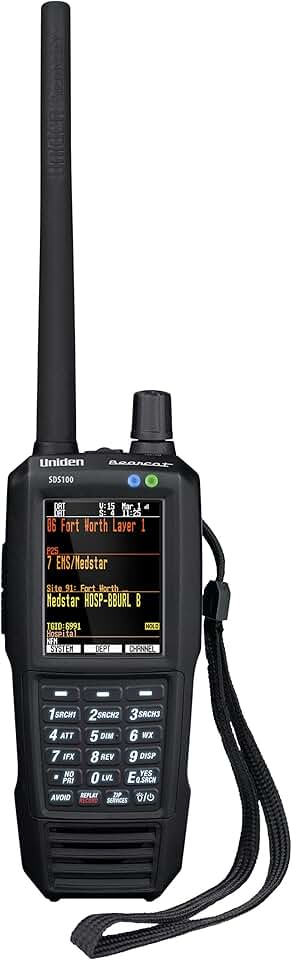
The Uniden SDS100 Scanner represents a significant leap forward in handheld radio scanning technology. Designed for enthusiasts and professionals alike, this device promises unparalleled performance, especially in challenging weak-signal and simulcast environments. Our in-depth review will explore every facet of this remarkable digital scanner, helping you decide if it’s the right investment for your monitoring needs.
Quick Summary: Uniden SDS100 Scanner
Rating: 4.4/5 Stars (based on 1284 reviews)
Price: $699.99 USD
Key Pros:
- Exceptional digital decoding, especially in simulcast.
- True I/Q receiver for superior weak-signal performance.
- Rugged, weather-resistant JIS4 construction.
- Full support for P25 Phase I/II, DMR, NXDN, and ProVoice.
Key Cons:
- High price point may be prohibitive for some users.
- Steep learning curve due to advanced features.
Table of Contents
Uniden SDS100 Scanner Overview
The Uniden SDS100 Scanner is not just another radio scanner; it’s a meticulously engineered device designed to tackle some of the most challenging aspects of modern radio monitoring. Its core strength lies in its True I/Q receiver technology, a revolutionary approach that significantly enhances digital decoding capabilities. This is particularly crucial in environments where traditional scanners struggle.
Many public safety agencies and commercial entities utilize complex trunked radio systems, often employing simulcast technology. Simulcast environments, where multiple transmitters broadcast the same signal on the same frequency, can create destructive interference for conventional scanners. The SDS100’s I/Q receiver is specifically built to overcome these issues, providing clear and reliable audio.
This handheld scanner is built for durability, featuring a rugged, weather-resistant JIS4 construction. This means it can withstand splashes of water and dusty conditions, making it an ideal companion for outdoor enthusiasts, storm chasers, and professionals who operate in less-than-ideal environments. Its robust build quality ensures longevity and consistent performance in demanding situations.
Beyond its robust exterior, the Uniden SDS100 boasts an intuitive, customizable display. Users can tailor the information presented on screen to their preferences, ensuring that critical data is always front and center. This level of customization enhances usability and helps users quickly adapt to different monitoring scenarios.
The SDS100 supports a wide array of digital radio formats, including P25 Phase I and II, DMR, NXDN, and ProVoice. This comprehensive compatibility makes it a versatile tool for monitoring a vast spectrum of communications, from local police and fire departments to commercial fleets and amateur radio operators. Its ability to decode multiple digital modes ensures future-proofing to a certain extent, as more agencies transition to these formats.
Uniden has a long-standing reputation for producing high-quality scanning equipment, and the SDS100 continues this legacy. It represents the pinnacle of their handheld scanner offerings, integrating advanced software-defined radio (SDR) principles into a portable form factor. This allows for greater flexibility and potential for future firmware enhancements.
The scanner also incorporates a powerful processor that handles complex digital signal processing with ease. This computational power is what enables its superior simulcast decoding and its ability to process multiple digital modes simultaneously. Users will notice a dramatic improvement in audio clarity and fewer dropped transmissions compared to older scanner models.
For those new to advanced scanning, the SDS100 might appear daunting at first. However, Uniden has designed the user interface to be as logical as possible, given the complexity of its underlying technology. With some dedication, users can unlock the full potential of this powerful monitoring device. Its detailed manual and online resources provide ample support for learning its intricacies.
The sheer depth of features packed into this compact device makes it a standout product in the market. From its precise GPS capabilities for location-based scanning to its Wi-Fi connectivity for remote control and updates, the Uniden SDS100 Scanner is engineered for modern monitoring needs. It truly offers a comprehensive solution for serious scanning enthusiasts.
Uniden SDS100 Scanner Key Features & Specs
The Uniden SDS100 Scanner is packed with innovative features that set it apart from its competitors. Understanding these key specifications is crucial for appreciating its capabilities and how it delivers its impressive performance. Each feature contributes to a superior scanning experience, especially in challenging environments.
True I/Q Receiver Technology
At the heart of the SDS100 is its revolutionary True I/Q receiver. Unlike traditional scanners that use a fixed filter, the I/Q receiver processes the entire radio spectrum in real-time. This allows the scanner to dynamically adapt to varying signal conditions, leading to significantly improved digital decoding.
This technology is particularly effective in simulcast systems, where signals from multiple towers can interfere with each other. The SDS100 can intelligently separate and process these signals, dramatically reducing audio distortion and dropped calls that plague other scanners in such areas. This results in crystal-clear audio, even from distant or weak transmissions.
Multi-Digital Mode Support
The Uniden SDS100 offers extensive compatibility with various digital communication formats. It supports P25 Phase I and Phase II, which are widely used by public safety agencies across North America. This ensures you can monitor police, fire, and emergency medical services in most regions.
Furthermore, it includes built-in support for Digital Mobile Radio (DMR), NXDN, and ProVoice. These modes are increasingly adopted by commercial businesses, utilities, and some public safety entities. Having these capabilities integrated means less need for additional software or expensive upgrades, making the SDS100 a versatile investment.
Rugged and Weather-Resistant Construction
Durability is a key aspect of the SDS100’s design. It features a JIS4 water resistance rating, meaning it can withstand splashes and light rain without damage. This makes it suitable for outdoor use, whether you’re a storm chaser, a hiker, or simply using it in inclement weather.
The robust casing protects internal components from dust, dirt, and minor impacts. This level of ruggedness ensures the scanner remains operational in demanding field conditions, providing peace of mind for users who rely on their equipment in critical situations. The build quality feels solid in hand, inspiring confidence.
Customizable Color Display
The SDS100 sports a large, customizable color display that is easy to read in various lighting conditions. Users can personalize the display’s color schemes, data fields, and backlighting. This allows for quick identification of important information and a more personalized user experience.
The vivid display enhances usability, making it easier to navigate menus, identify channels, and understand signal strength at a glance. This feature is particularly useful when scanning numerous channels or operating in dynamic environments where quick information retrieval is essential.
GPS Connectivity for Location-Based Scanning
Equipped with a built-in GPS receiver (or compatible with an external GPS for enhanced accuracy), the Uniden SDS100 Scanner can automatically select channels based on your current location. This feature is invaluable for users who travel frequently or monitor communications across large geographic areas.
As you move, the scanner can automatically enable or disable scan lists, ensuring you’re always monitoring relevant local transmissions. This eliminates the need for manual reprogramming when crossing county or state lines, streamlining the scanning process significantly. It’s a game-changer for mobile monitoring.
Wi-Fi Connectivity
The SDS100 includes Wi-Fi connectivity, opening up possibilities for remote control and firmware updates. Users can connect the scanner to a Wi-Fi network and control it from a computer or mobile device. This is ideal for fixed installations or for monitoring from a distance.
Wi-Fi also facilitates easier firmware updates, ensuring your scanner always has the latest features and bug fixes without needing a physical connection to a computer. This modern connectivity option adds significant convenience and expands the scanner’s utility beyond traditional handheld operation.
Enhanced Dynamic Memory and Database
The scanner features a vast internal database of frequencies and systems, which is regularly updated by Uniden. Its dynamic memory management allows users to store thousands of channels, talkgroups, and systems. This robust memory capacity ensures you can monitor a wide range of interests without running out of space.
The ability to organize channels into scan lists, favorites lists, and systems provides unparalleled flexibility in how you manage your monitoring targets. This structured approach helps keep your scanning organized and efficient, allowing you to quickly access the communications most important to you.
Pros & Cons
Evaluating any advanced piece of technology like the Uniden SDS100 Scanner requires a balanced look at its strengths and weaknesses. While its innovative features offer significant advantages, there are also considerations that potential buyers should be aware of. This section will detail the key pros and cons of this powerful digital handheld scanner.
Pros:
1. Unmatched Digital Decoding in Challenging Environments: The SDS100’s True I/Q receiver truly shines in simulcast and weak-signal areas. This is its most significant advantage, delivering clear, intelligible audio where other scanners produce garbled or dropped transmissions. For users in these problematic regions, this alone justifies the investment.
The advanced signal processing capabilities ensure that digital voice communications, which are notoriously difficult for conventional scanners, are decoded with exceptional accuracy. This means less frustration and more successful monitoring of critical public safety and commercial channels. It represents a significant leap in scanner performance.
2. Comprehensive Digital Mode Support: With built-in support for P25 Phase I/II, DMR, NXDN, and ProVoice, the SDS100 is highly versatile. This wide array of compatible digital modes means users are equipped to monitor almost any modern trunked or conventional digital system. It reduces the need for multiple devices or costly upgrades.
This broad compatibility ensures that as communication systems evolve, your scanner remains relevant and functional. It’s an excellent feature for those who need to monitor diverse agencies or commercial operations that utilize different digital standards. The scanner’s adaptability is a major selling point.
3. Rugged and Weather-Resistant Design: The JIS4 rating for water resistance and its robust construction make the SDS100 an ideal tool for field use. It can withstand splashes, rain, and dusty environments, ensuring reliability in outdoor or challenging conditions. This durability is essential for professionals and serious hobbyists.
Its sturdy build quality means it’s less prone to damage from accidental drops or harsh weather, providing peace of mind. This ruggedness extends the scanner’s utility beyond a desktop device, enabling truly mobile and outdoor monitoring experiences. It’s built to last and perform under pressure.
4. Customizable User Experience: The full-color display is highly customizable, allowing users to tailor information and appearance to their preferences. This includes color coding channels, adjusting backlight, and selecting data fields. Such personalization enhances usability and makes the scanner more efficient to operate.
The ability to quickly identify different types of transmissions or agencies through visual cues improves the overall monitoring experience. It helps users stay organized and react faster to incoming communications, especially when monitoring a large number of diverse channels. The user interface is powerful and flexible.
5. Advanced Location-Based Scanning with GPS: The integrated GPS functionality (or external GPS support) enables automatic location-based scanning. This means the scanner can activate or deactivate scan lists based on your geographical position, which is incredibly convenient for mobile users. It eliminates the need for manual adjustments.
Whether you’re traveling across states or simply moving between different counties, the SDS100 ensures you’re always listening to the most relevant local communications. This automated process saves time and greatly enhances the efficiency of mobile monitoring. It’s a truly smart feature for modern scanning.
Cons:
1. High Price Point: The Uniden SDS100 Scanner is a premium device, and its price reflects its advanced technology and capabilities. At approximately $700, it is significantly more expensive than many other handheld scanners on the market. This high cost can be a barrier for casual hobbyists or those on a tight budget.
While the performance justifies the cost for many, it’s an investment that requires serious consideration. Potential buyers need to weigh the benefits of its superior decoding and features against their budget constraints. It’s definitely not an entry-level scanner in terms of price.
2. Steep Learning Curve: Due to its advanced features and complex programming options, the SDS100 has a steeper learning curve compared to simpler scanners. New users may find the initial setup and customization process challenging, requiring time and dedication to master all its functionalities.
While the rewards of mastering the scanner are significant, the initial hurdle can be daunting. Accessing all its powerful features requires a willingness to delve into the manual and online resources. It’s not a plug-and-play device for absolute beginners, though Uniden provides extensive support.
3. Battery Life Considerations: While the SDS100 uses a rechargeable lithium-ion battery, its powerful processor and display can consume power relatively quickly, especially with heavy use. Users may find themselves needing to recharge more frequently than with less feature-rich scanners. Carrying spare batteries or a portable power bank is advisable for extended field operations.
Optimizing settings like backlight brightness and scan speed can help extend battery life, but intensive use will still drain it faster. This is a common trade-off for high-performance portable electronics, but it’s an important factor for users planning long periods away from a power source.
Who Should Buy the Uniden SDS100 Scanner?
The Uniden SDS100 Scanner is a specialized piece of equipment, and while it offers top-tier performance, it’s not necessarily for everyone. Its advanced features and price point make it particularly suitable for specific user groups. Understanding who benefits most from this scanner can help potential buyers make an informed decision.
Public Safety Enthusiasts and Volunteers
Individuals who are deeply interested in monitoring local police, fire, and EMS communications will find the SDS100 invaluable. Its exceptional ability to decode P25 Phase I/II, especially in simulcast areas, means they can reliably hear critical transmissions that other scanners might miss or garble. This clarity is paramount for staying informed about local emergencies and public safety operations.
For volunteer emergency responders, community watch members, or those who simply want to stay connected with local events, the SDS100 offers a reliable window into public safety communications. Its rugged design also means it can be taken on scene or used in various conditions without worry.
Storm Chasers and Weather Spotters
The weather-resistant JIS4 construction and superior reception make the SDS100 an ideal tool for storm chasers and weather spotters. Monitoring emergency services, amateur radio nets, and weather-related communications is crucial during severe weather events. The scanner’s ability to perform in challenging environments is a major asset.
Its GPS functionality, allowing for location-based scanning, is also highly beneficial for mobile operations. As storm chasers move through different counties, the scanner can automatically adapt to local frequencies, ensuring continuous monitoring of vital information. This feature significantly enhances situational awareness.
Radio Hobbyists and Advanced Scanners
Experienced radio hobbyists who are looking for the absolute best in digital scanning performance will appreciate the SDS100. Its True I/Q technology and multi-digital mode support provide a comprehensive platform for exploring the vast world of radio communications. From trunked systems to conventional digital channels, it handles it all with aplomb.
For those who enjoy delving into the technical aspects of scanning, the SDS100 offers deep customization and advanced features to explore. Its potential for firmware updates and remote control via Wi-Fi also appeals to users who want a future-proof and flexible device. It’s a scanner that grows with your expertise.
Professionals Requiring Reliable Monitoring
Certain professionals, such as private investigators, security personnel, or even some journalists, may require a highly reliable and versatile scanner. The SDS100’s ability to monitor various digital formats, combined with its robust build, makes it a valuable tool for gathering information in the field. Its discretion and performance are key.
The clarity of digital voice decoding ensures that important details are not missed, which is critical in professional applications. While not a covert device, its handheld form factor and reliable operation make it a strong contender for professional monitoring needs where legal and ethical guidelines are followed. For more details on various radio systems, consider consulting resources like Wikipedia’s page on Trunked Radio Systems.
Travelers and Mobile Users
Anyone who frequently travels and wants to monitor local communications will benefit from the SDS100’s GPS-enabled location-based scanning. This feature eliminates the hassle of manually updating frequencies as you move, making it incredibly convenient for road trips or professional travel. It simplifies the scanning process significantly.
The scanner automatically adjusts to the relevant systems in your current area, providing continuous, localized monitoring. This hands-free operation is a huge advantage for drivers or those who need to focus on other tasks while keeping an ear on local activity. It ensures you’re always tuned into what matters most in your immediate vicinity.
In essence, if you are serious about radio monitoring, especially in areas with complex digital or simulcast systems, and you value performance, durability, and advanced features, the Uniden SDS100 Scanner is an investment worth considering. It is designed for those who demand the best and are willing to learn its intricacies to unlock its full potential.
However, if you’re a casual listener who only needs to monitor basic analog channels or simple digital systems, a less expensive and less complex scanner might be more appropriate. The SDS100 is built for advanced users and challenging environments, delivering a premium experience for its target audience. It’s a tool for dedicated enthusiasts.
FAQ about Uniden SDS100 Scanner
Here are some frequently asked questions about the Uniden SDS100 Scanner, providing more detailed insights into its operation, capabilities, and common concerns.
Q1: What is True I/Q receiver technology, and why is it important for the SDS100?
A1: True I/Q receiver technology is a sophisticated method of signal processing that allows the SDS100 to capture and digitize the raw radio signal more comprehensively than traditional scanners. It processes both the in-phase (I) and quadrature (Q) components of the signal, which provides a complete picture of the radio wave. This is critical for accurately decoding complex digital modulations, especially in challenging environments like simulcast systems.
In simulcast, multiple transmitters broadcast the same signal, often causing destructive interference for conventional scanners. The SDS100’s I/Q receiver can intelligently analyze these interfering signals and reconstruct the original digital audio with remarkable clarity, virtually eliminating the garbling or dropped transmissions common in such areas. This makes it an essential feature for reliable digital monitoring today.
Q2: Can the Uniden SDS100 Scanner monitor all types of digital radio systems?
A2: The SDS100 supports a very wide range of common digital radio systems, including P25 Phase I and Phase II, DMR (Digital Mobile Radio), NXDN, and ProVoice. This covers the vast majority of public safety, commercial, and utility digital communications in use today. However, it cannot monitor proprietary or highly encrypted systems for which decoding algorithms are not publicly available or legally permissible.
For example, certain highly secure federal or military communications, or some specific proprietary digital voice modes not listed, would not be decodable. Always check the specific digital modes used in your area and compare them against the SDS100’s capabilities to ensure compatibility. For general consumer use, its coverage is extensive.
Q3: Is the SDS100 difficult to program for a beginner?
A3: The Uniden SDS100 Scanner is an advanced device, and its initial programming and setup can present a learning curve for beginners. It comes pre-loaded with a comprehensive North American radio database, which simplifies basic usage if you’re in a common area. However, to fully customize and optimize its performance, particularly for specific local systems or unique interests, users will need to invest time in learning its programming software (Sentinel) and menu structure.
Uniden provides detailed manuals and there are numerous online communities and video tutorials available to assist new users. While it’s not a ‘plug-and-play’ device in the simplest sense, the effort put into learning it is often rewarded with unparalleled monitoring capabilities. Patience and a willingness to learn are key for new users.
Q4: What is the battery life like on the Uniden SDS100 Scanner, and what type of battery does it use?
A4: The SDS100 uses a custom 3.7V, 7100 mAh Lithium-Ion battery pack (BT-955). Battery life varies significantly depending on usage, such as backlight brightness, scan speed, and whether GPS or Wi-Fi are active. Under typical conditions with moderate backlight and scanning, users can expect several hours of operation, often ranging from 4 to 8 hours.
Intensive use, such as continuous scanning with maximum backlight and active GPS, will drain the battery faster. For extended field operations, it is highly recommended to carry a spare battery pack or a portable USB power bank. The scanner can also operate while connected to external USB power, allowing for continuous use during charging.
Q5: Can the SDS100 receive analog signals as well as digital?
A5: Yes, absolutely. The Uniden SDS100 Scanner is fully capable of receiving and decoding traditional analog FM/AM signals, in addition to its advanced digital capabilities. It supports conventional analog channels, analog trunked systems, and various modulation types. This dual capability ensures that users can monitor both legacy and modern communication systems with a single device.
Many areas still utilize a mix of analog and digital systems, and the SDS100 seamlessly handles both. This versatility makes it a comprehensive tool for any scanning enthusiast, ensuring you don’t miss out on any transmissions due to format incompatibility. It’s designed to be a complete monitoring solution.
Q6: Does the SDS100 require any paid upgrades for digital modes like DMR or NXDN?
A6: No, the Uniden SDS100 Scanner comes with built-in support for all its advertised digital modes, including P25 Phase I/II, DMR, NXDN, and ProVoice, right out of the box. Unlike some previous Uniden models or competing scanners that required paid upgrades or licenses for certain digital formats, the SDS100 includes these capabilities as standard features.
This means that once you purchase the SDS100, you have access to its full suite of digital decoding capabilities without any additional costs for software keys or firmware unlocks. This makes the initial investment more straightforward and ensures full functionality from day one. You can visit the Uniden official website for more product details.
Q7: How does the Wi-Fi feature work on the SDS100?
A7: The Wi-Fi feature on the Uniden SDS100 Scanner allows for remote control and easier firmware updates. When connected to a Wi-Fi network, users can access the scanner’s web interface from a computer or mobile device on the same network. This enables remote control of scanning functions, channel selection, and other settings without physically interacting with the scanner.
For firmware updates, the Wi-Fi connectivity streamlines the process, allowing the scanner to download and install updates directly over the air, eliminating the need to connect it to a computer via USB. This adds a layer of convenience and ensures the scanner stays up-to-date with the latest features and performance enhancements. It’s a modern convenience for a powerful device.
Q8: Is the SDS100 suitable for mobile use in a vehicle?
A8: Yes, the Uniden SDS100 Scanner is exceptionally well-suited for mobile use in a vehicle. Its compact, handheld design makes it easy to place or mount, and its GPS functionality is a major asset for mobile operations. With GPS enabled, the scanner can automatically load relevant scan lists based on your current location, eliminating manual adjustments as you drive.
The clear, customizable display is easy to read at a glance, and its robust construction can handle the bumps and vibrations of vehicle travel. When combined with an external antenna for improved reception, the SDS100 becomes a powerful and convenient mobile monitoring solution. Its ability to run while connected to USB power ensures continuous operation on long trips.
Final Verdict
The Uniden SDS100 Scanner stands as a monumental achievement in handheld radio scanning technology. It delivers on its promise of superior digital performance, particularly in the notoriously challenging weak-signal and simulcast environments that have historically plagued other scanners. For serious enthusiasts and professionals, this scanner is a game-changer, offering clarity and reliability that is simply unmatched.
Its comprehensive support for multiple digital modes, coupled with a rugged, weather-resistant build, makes it an incredibly versatile and durable tool. While the initial investment is significant and the learning curve can be steep, the capabilities and performance you gain are well worth the effort for those who demand the absolute best in radio monitoring. The customizable display and GPS functionality further enhance its utility.
If you’re in an area with complex digital or simulcast systems, or if you simply want the most advanced and reliable handheld scanner available, the Uniden SDS100 Scanner is an outstanding choice. It’s a premium device that justifies its price through unparalleled performance and a rich feature set, ensuring you stay connected to the communications that matter most.