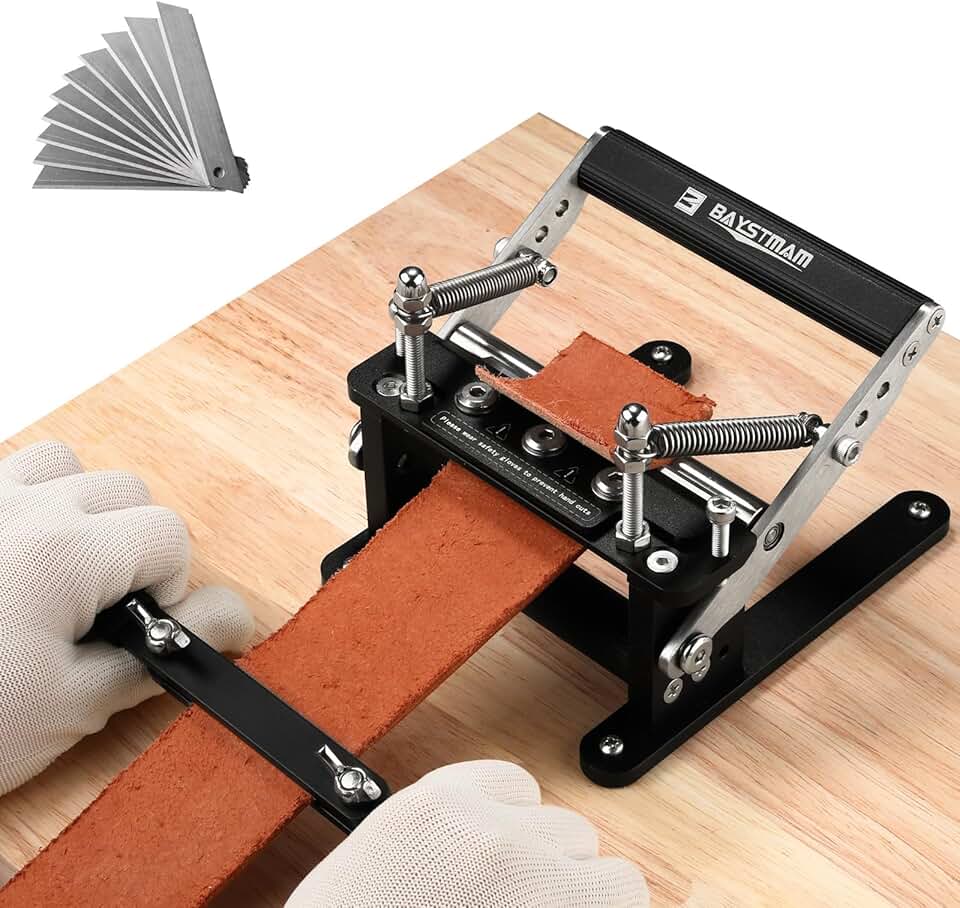
The Leather Skiver Splitter is an indispensable tool for anyone involved in leather crafting, from hobbyists to professional artisans. Achieving uniform leather thickness is crucial for high-quality finished products, and this specialized machine is designed to make that process efficient and precise.
Quick Summary
Rating: 4.2 out of 5 stars (81 reviews)
Price: $59.98 USD
Key Pros:
- Provides precise and consistent leather thinning.
- Durable aluminum construction ensures longevity.
- Easy to assemble and relatively straightforward to use.
Key Cons:
- Requires some practice to master for perfect results.
- Blades may need frequent replacement for heavy use.
Table of Contents
Leather Skiver Splitter Overview
The Leather Skiver Splitter is a specialized hand-operated machine designed for the precise thinning, or skiving, of leather. This process is essential in leathercraft to reduce the thickness of hides, allowing for cleaner seams, folds, and edges in various projects.
Unlike manual skiving knives, which require significant skill and practice to achieve consistent results, a mechanical skiver like this offers a more uniform and controlled approach. It helps in creating professional-looking finishes that are often difficult to achieve by hand alone.
The primary function of this Leather Skiver Splitter is to allow crafters to adjust the thickness of their leather pieces with greater accuracy. This is particularly useful when working on items that require multiple layers, such as wallets, belts, or bags, where excessive bulk can detract from the aesthetic and functionality.
Its robust aluminum construction suggests durability and stability during operation, which is crucial for precision work. The inclusion of a pulling handle further enhances control, enabling users to guide the leather smoothly through the blades.
This tool is not just about reducing thickness; it’s about refining the leather to suit specific design requirements. For instance, when creating intricate patterns or designs that involve folding, a perfectly skived edge ensures a crisp, clean fold without unsightly bulging.
The ability to consistently thin leather across long stretches is another significant advantage. Manual skiving often results in uneven thickness over extended lengths, leading to compromised structural integrity and a less polished appearance.
For those looking to elevate their leather crafting skills and produce more professional-grade items, investing in a dedicated Leather Skiver Splitter can be a game-changer. It streamlines a labor-intensive part of the crafting process, freeing up time to focus on other creative aspects.
Understanding the proper techniques for using a leather skiving machine is paramount to achieving the best results. It’s not simply a matter of feeding leather through; careful setup, blade maintenance, and practice are all part of the learning curve.
While the initial setup might require some attention to detail, the long-term benefits in terms of project quality and efficiency are substantial. This machine aims to simplify one of the more challenging aspects of leather work, making it accessible to a wider range of crafters.
For more general information on leather crafting tools and techniques, resources like Wikipedia’s Leather Craft page can provide a valuable starting point for beginners and experienced artisans alike.
The design of this particular Leather Skiver Splitter emphasizes ease of use combined with robust performance, making it a compelling option for those needing reliable leather thinning capabilities in their workshop.
Leather Skiver Splitter Key Features & Specs
The design and construction of the Leather Skiver Splitter are critical to its performance and utility for leather crafters. Let’s delve into its key features and specifications that make it a notable tool in the workshop.
One of the most prominent features is its durable aluminum construction. Aluminum is known for its strength-to-weight ratio, providing a sturdy and stable base for the skiving process without being excessively heavy. This robust material ensures the machine can withstand the rigors of repeated use.
The inclusion of a pulling handle is a significant ergonomic advantage. This handle allows users to exert consistent, controlled force when feeding leather through the machine. This control is vital for achieving uniform thickness and preventing the leather from slipping or bunching.
At the heart of the machine’s function are its precision blades. These blades are designed to cut through various leather types with accuracy, facilitating the thinning process. The sharpness and durability of these blades directly impact the quality of the skive.
The machine boasts an adjustable skiving thickness mechanism. This adjustability is paramount, as different projects and leather types require varying degrees of thickness. Users can fine-tune the setting to achieve the exact desired result, from subtle thinning to more aggressive material removal.
Its compact design means it doesn’t take up excessive workspace, which is a consideration for many home-based crafters. Despite its size, it offers the performance typically associated with larger, more industrial skiving machines.
The machine is generally supplied with a set of blades, ensuring that users can begin their projects almost immediately after assembly. The ease of blade replacement is also a critical factor, as blades will dull over time and require changing for optimal performance.
While specific dimensions are not provided in the basic product description, the visual representation suggests a size that is manageable for a workbench. Its manual operation means no reliance on power outlets, offering flexibility in workshop setup.
The mechanism often involves a roller system that guides the leather smoothly across the blade. This consistent feeding mechanism is what allows for the impressive uniformity in thickness that manual skiving struggles to achieve.
For optimal results, the Leather Skiver Splitter is typically designed to be mounted securely to a workbench. This stability prevents movement during operation, which could otherwise lead to inaccurate skives and potential safety hazards.
The materials chosen for its construction, particularly the aluminum, contribute to its longevity and resistance to corrosion. This makes it a reliable tool for long-term use in a crafting environment where materials like leather can sometimes introduce moisture.
Understanding these features helps crafters appreciate the engineering behind the Leather Skiver Splitter and how it translates into practical benefits for their leather working projects. It’s a tool built for precision and durability.
Pros & Cons
Every tool has its strengths and weaknesses, and the Leather Skiver Splitter is no exception. Understanding these can help potential buyers make an informed decision about whether it’s the right addition to their leather crafting toolkit.
Pros of the Leather Skiver Splitter:
- Exceptional Precision and Consistency: The machine excels at providing highly uniform leather thickness. This level of consistency is incredibly difficult to achieve with hand skiving tools, especially over longer pieces of leather or when needing very thin edges for delicate work. The adjustable mechanism ensures repeatable results.
- Durable Aluminum Construction: The use of aluminum for the main body ensures the machine is robust and built to last. This material resists rust and corrosion, contributing to a longer lifespan even in a workshop environment. Its solidity provides a stable platform for precision work.
- Improved Efficiency: For crafters who frequently need to skive leather, this machine dramatically speeds up the process compared to manual methods. What might take minutes or even hours by hand can be done in a fraction of the time with consistent quality. This efficiency is invaluable for production work.
- Professional Finish: By allowing for clean, even skives, the machine helps achieve a higher standard of finish on leather goods. This translates to neater seams, smoother folds, and a generally more polished, high-end appearance in finished products like wallets, bags, and belts.
- Ergonomic Pulling Handle: The integrated pulling handle provides excellent leverage and control. This design feature reduces fatigue during extended use and allows for a smooth, continuous feed of the leather, which is essential for uniform skiving.
- Versatility for Various Projects: The adjustable thickness allows the machine to be used for a wide range of leather projects, from thinning edges for small accessories to preparing larger pieces for complex constructions. It adapts to different leather weights and types.
- Reduced Learning Curve Compared to Manual Skiving: While there is still a learning curve, mastering a mechanical skiver is generally quicker and less frustrating than developing the advanced hand skills required for expert manual skiving. It offers a more forgiving entry point to precise leather thinning.
\
Cons of the Leather Skiver Splitter:
- Initial Learning Curve for Optimal Use: While easier than manual skiving, achieving perfect results with the machine still requires practice. Users need to learn how to set the thickness correctly, maintain blade sharpness, and apply consistent pulling force. Initial attempts might not be flawless.
- Blade Maintenance and Replacement: The blades are consumable parts and will dull with use, especially when working with tougher leathers. This means periodic replacement, which adds to the ongoing cost and requires a supply of compatible blades. Dull blades can tear or chew the leather rather than skive it cleanly.
- Not Suitable for Extremely Small or Irregular Pieces: The machine is best suited for pieces of leather that can be fed through its mechanism smoothly. Extremely small, oddly shaped, or very stiff pieces might be challenging to skive effectively, requiring manual touch-ups or alternative methods.
- Potential for Inconsistent Results Without Proper Technique: If the leather is not fed evenly, or if the blade is not sharp, the skiving can still be uneven. The machine provides the mechanism, but the operator’s technique remains crucial for consistent, high-quality outcomes.
- Requires Workbench Mounting: For stability and safety, the machine needs to be securely mounted to a workbench. This might be an additional setup step for some users and requires dedicated space in the workshop.
\
Weighing these pros and cons helps to form a balanced perspective on the Leather Skiver Splitter. Its benefits in precision and efficiency are significant for dedicated crafters, but the need for practice and blade maintenance should be considered.
Who Should Buy the Leather Skiver Splitter?
The Leather Skiver Splitter is a specialized tool that caters to a specific segment of the leather crafting community. Identifying who can benefit most from this machine involves considering various skill levels, project types, and production needs.
Serious Hobbyists and Enthusiasts: For those who have moved beyond basic leather projects and are looking to elevate the quality and complexity of their work, this machine is an excellent investment. It allows them to achieve professional-level finishes that are often unattainable with simpler hand tools.
Hobbyists creating items like custom wallets, finely stitched bags, or intricate leather jewelry will find the precision skiving indispensable. It enables cleaner edges and seamless joins, making their handmade items look factory-made.
Small Business Owners and Artisans: If you sell your leather goods, consistency and quality are paramount. The Leather Skiver Splitter can significantly improve your production efficiency and the overall aesthetic appeal of your products, leading to higher customer satisfaction and repeat business.
Artisans who produce multiple units of the same design will especially appreciate the repeatable results this machine offers. It ensures that every item meets the same high standard, reinforcing brand quality.
Leather Crafters Working with Thicker Hides: Certain projects or leather types inherently involve thicker materials. Skiving these by hand can be physically demanding and time-consuming. This machine makes working with heavier leathers much more manageable and less fatiguing.
For instance, preparing bridle leather for belts or thick vegetable-tanned leather for custom cases becomes far more efficient and precise with a dedicated skiving machine.
Those Seeking Consistency and Precision: The primary benefit of a mechanical skiver is its ability to produce highly consistent results. If uneven skiving has been a persistent frustration in your projects, leading to bulky seams or lumpy edges, this machine offers a reliable solution.
It’s ideal for crafters who prioritize meticulous detail and a flawless finish in every piece they create, ensuring that every project reflects a high level of craftsmanship.
Individuals Looking to Save Time: While there’s an initial setup and learning curve, the Leather Skiver Splitter ultimately saves a considerable amount of time on projects that require extensive skiving. This is particularly true for larger projects or batch production.
Freeing up time from labor-intensive skiving allows crafters to dedicate more attention to other creative and intricate aspects of their work, improving overall productivity.
Workshops with Limited Space but High Standards: Given its relatively compact footprint compared to industrial skiving machines, this tool is suitable for home workshops or smaller studios where space is a premium. It offers professional capabilities without requiring a dedicated large area.
It allows crafters to maintain high standards of quality even within the constraints of a smaller workspace, making it a practical choice for many independent artisans.
Conversely, beginners who are just starting out and only doing very simple projects might find this tool an overinvestment initially. For occasional, minor skiving, a good quality hand skiving knife might suffice until their skills and project complexity grow.
However, for anyone serious about improving their leather crafting output and achieving consistent, professional results, the Leather Skiver Splitter presents a compelling and valuable addition to their tool arsenal.
FAQ about Leather Skiver Splitter
Here are some frequently asked questions regarding the Leather Skiver Splitter to help clarify its use, maintenance, and overall suitability for various leather crafting needs.
Q1: How does the Leather Skiver Splitter work?
A1: The Leather Skiver Splitter works by feeding a piece of leather between a roller and a sharp, stationary blade. The roller guides the leather, while the blade shaves off a consistent layer from its underside, reducing its thickness. The distance between the roller and the blade determines the final thickness.
Users typically adjust a knob or lever to set the desired skiving depth. Then, they pull the leather through the mechanism using the handle, ensuring a smooth and even feed to achieve uniform thickness across the entire piece.
Q2: Is this machine suitable for all types of leather?
A2: Generally, the Leather Skiver Splitter is effective for most common leather types, including vegetable-tanned, chrome-tanned, and bridle leather. However, very soft, stretchy, or extremely thin leathers might be more challenging to feed consistently and may require a very sharp blade and careful technique.
Exotic leathers with unusual textures or scales might also present difficulties. It’s always recommended to test on a scrap piece of the specific leather you plan to use before working on your main project.
Q3: How difficult is it to assemble and set up the Leather Skiver Splitter?
A3: Assembly is typically straightforward, often involving attaching the handle and securing the blade. The most crucial part of the setup is mounting the machine securely to a workbench. This stability is essential for safe and accurate operation.
Once mounted, calibrating the thickness setting and practicing on scrap leather will be necessary to get comfortable with its operation. Most users find the setup manageable with basic tools.
Q4: How often do the blades need to be replaced, and where can I find replacements?
A4: Blade replacement frequency depends heavily on usage and the type of leather being skived. Working with tough, thick leathers will dull blades faster than soft, thin ones. It’s advisable to replace blades as soon as you notice resistance or uneven cuts, typically after several hours of continuous use.
Replacement blades are usually specific to the machine’s design. It is best to check the product listing or manufacturer’s website for compatible blades. Often, generic utility knife blades or specific razor blades can be adapted, but ensure they fit securely and safely.
Q5: Can this machine skive the entire width of a large piece of leather?
A5: The Leather Skiver Splitter is designed for thinning specific sections or edges of leather, not typically for splitting an entire hide down its full width. Its throat width (the maximum width of leather it can accommodate) is limited.
It’s ideal for skiving strap ends, edges for folds, areas for joining multiple layers, or thinning down localized sections. For full-width splitting of large hides, industrial-grade band knife splitting machines are required, which are much larger and more expensive.
Q6: What maintenance does the Leather Skiver Splitter require?
A6: Regular maintenance is key to the longevity and performance of your Leather Skiver Splitter. This includes keeping the machine clean by removing leather dust and debris after each use. Lubricating moving parts, such as the roller mechanism, with a light machine oil can prevent friction and ensure smooth operation.
Periodically inspect the blade for sharpness and replace it when dull. Also, check all mounting screws and bolts to ensure they remain tight and secure, maintaining the machine’s stability and precision.
For more detailed information on maintaining leather tools, general guides on leathercraft tool care can be helpful, such as those found on reputable leather supply websites like Tandy Leather.
Q7: Can I use this for materials other than leather?
A7: While primarily designed for leather, some users might experiment with other dense, fibrous materials like heavy canvas or certain types of thick fabric. However, the machine’s effectiveness and blade life might vary significantly, and it’s not guaranteed to work well.
Using it on materials it wasn’t designed for could also void warranties or damage the blades and mechanism. It’s best to stick to its intended use for optimal results and tool preservation.
Final Verdict
The Leather Skiver Splitter stands out as an essential tool for any serious leather crafter looking to achieve professional-grade results. Its ability to provide consistent and precise leather thinning is a significant upgrade from traditional manual skiving methods, offering a level of uniformity that is hard to match by hand.
The robust aluminum construction promises durability and stability, ensuring this machine will be a long-term asset in your workshop. Its ergonomic pulling handle and adjustable thickness settings contribute to an efficient and user-friendly experience, making complex tasks more manageable.
While there is a moderate learning curve and a need for regular blade maintenance, the benefits in terms of improved project quality, efficiency, and professional finish far outweigh these considerations for dedicated artisans. It transforms challenging skiving tasks into a streamlined process.
For hobbyists transitioning to more intricate designs, small business owners focused on consistent product quality, or anyone frequently working with thicker leathers, the Leather Skiver Splitter represents an impressive value proposition. It’s an investment that pays dividends in the quality and professionalism of your finished leather goods.
Ultimately, if you’re committed to elevating your leather crafting projects and demand precision in every detail, this Leather Skiver Splitter is a highly recommended addition to your toolkit. It will empower you to create cleaner seams, sharper folds, and overall more refined leather products.