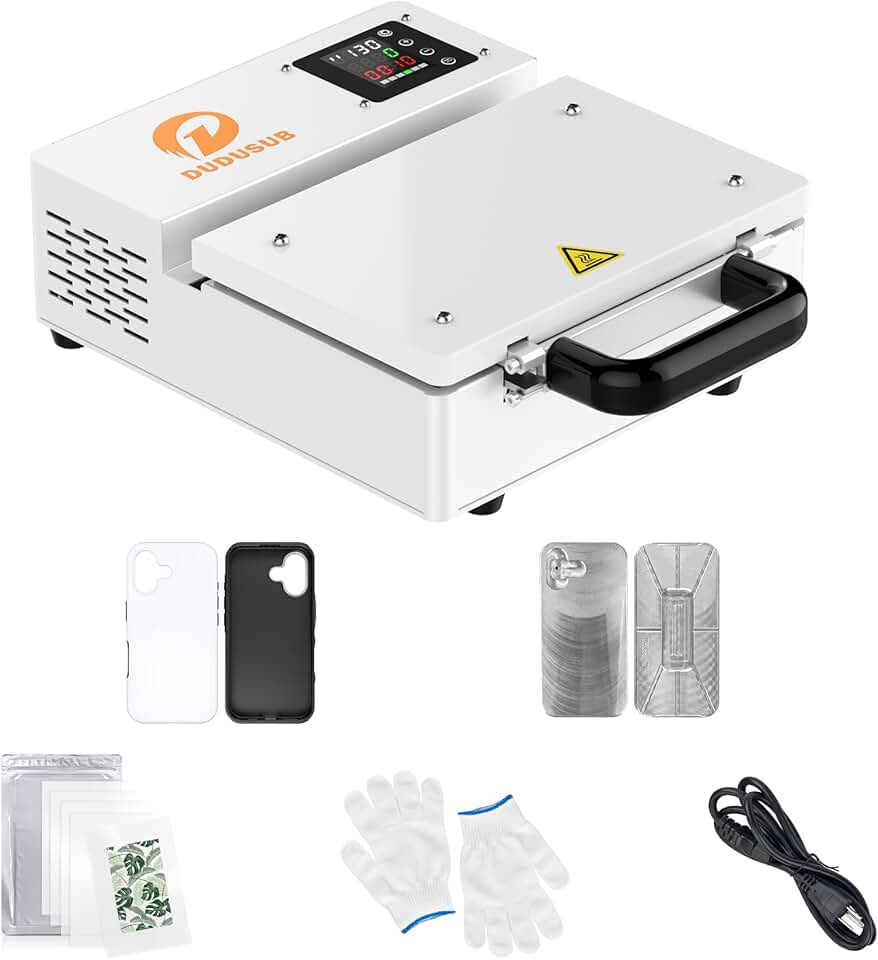
The Phone Case Heat Press machine promises to unlock a world of customization for phone cases, AirPods, and other small accessories. This 3D sublimation vacuum heat press aims to provide a compact solution for both hobbyists and small businesses looking to create personalized items. Our in-depth review will explore its capabilities, performance, and overall value in the competitive sublimation market.
Quick Summary: Phone Case Heat Press
- Rating: 3.3 out of 5 stars (Based on 6 reviews)
- Price: $269.99 USD
- Key Pros:
- Versatile 3D sublimation for various items, including phone cases, AirPods, and headphones.
- Compact design makes it suitable for home use or small business setups with limited space.
- Features digital controls for precise temperature and time settings, enhancing user control.
- Key Cons:
- Relatively low user rating of 3.3 stars suggests potential performance or reliability issues for some users.
- Limited number of reviews (only 6) makes it challenging to accurately assess long-term reliability and widespread user satisfaction.
Table of Contents
Phone Case Heat Press Overview
The Phone Case Heat Press machine is marketed as a versatile solution for 3D sublimation printing, specifically designed for small, curved objects like smartphone cases, earbud cases, and even small headphone covers. Unlike traditional flat heat presses, this unit utilizes vacuum technology in conjunction with heat to wrap sublimation paper around three-dimensional items. This process ensures a seamless, full-wrap print without visible seams or edges, which is crucial for high-quality custom accessories.
At its core, sublimation printing involves transferring an image from a special paper onto a substrate using heat and pressure. The ink turns directly from a solid into a gas, permeating the surface of the item before solidifying. For this to work effectively on curved surfaces, a vacuum is applied to ensure the sublimation paper adheres tightly to every contour of the object, preventing ghosting or incomplete transfers.
This particular model, often referred to as a mini 3D sublimation vacuum machine, aims to bring industrial-level customization capabilities to a more accessible price point and footprint. It’s an attractive option for individuals or small businesses who want to offer personalized products without investing in large, expensive industrial equipment. The promise of “DIY Customize” suggests ease of use for creative projects at home.
The machine’s white aesthetic gives it a clean and modern look, suitable for various workshop or home office environments. Its compact size is a significant advantage, allowing it to fit into smaller spaces where larger heat presses would be impractical. This makes it a potential game-changer for crafters, Etsy sellers, or anyone looking to add a unique touch to their personal gadgets or offer custom gifts.
However, the relatively low rating of 3.3 stars from a small number of reviews raises questions about its consistent performance and user satisfaction. While the concept of a compact 3D sublimation press is appealing, the execution and reliability are critical factors. Potential buyers need to consider whether its capabilities truly match its promises and if it can deliver professional-quality results consistently.
Understanding the nuances of 3D sublimation is key to successful operation. This machine is not a simple plug-and-play device; it requires specific sublimation blanks, inks, and a learning curve for optimal results. The complexity of achieving perfect transfers on curved surfaces means that patience and experimentation are often necessary, especially for newcomers to sublimation printing. For more information on the general principles of sublimation, Wikipedia offers a comprehensive overview of dye-sublimation.
The target market for such a device is broad, ranging from tech enthusiasts who want custom phone cases for their latest iPhone models to entrepreneurs building a niche business. Its ability to handle multiple items simultaneously, depending on their size, could be a productivity booster for small batch production. However, the machine’s overall capacity and speed would need to be evaluated against specific business needs.
Ultimately, the Phone Case Heat Press represents an intriguing entry into the DIY and small business customization market. Its potential for creating unique 3D sublimated products is clear, but its actual performance and user experience, as hinted by the review score, warrant a closer look. Our subsequent sections will delve deeper into its features, practical application, and whether it stands up to scrutiny.
Phone Case Heat Press Key Features & Specs
The Phone Case Heat Press machine is equipped with several features designed to facilitate 3D sublimation printing. Understanding these specifications is crucial for evaluating its suitability for various projects and ensuring successful operation. This section will break down the core components and capabilities that define this particular unit.
One of the primary features is its 3D Sublimation Vacuum Technology. This system combines heating elements with a powerful vacuum pump to create a sealed environment. The vacuum draws the sublimation paper tightly around the curved surfaces of blanks, ensuring consistent pressure and heat distribution for a flawless transfer. This is particularly important for items like phone cases that have complex edges and corners.
The machine includes Digital Temperature and Time Controls. Users can precisely set the desired temperature, typically ranging from ambient up to 200-220°C (392-428°F), and the printing time, usually in seconds. These digital controls are essential for achieving optimal transfer results, as different sublimation blanks and inks require specific heat and duration settings. An integrated display allows for easy monitoring and adjustment.
Broad Compatibility with Small Items is another significant selling point. While the product title specifically mentions iPhone cases, the machine is designed for a wider range of small sublimation blanks. This includes various smartphone models, cases for AirPods and other wireless earbuds, and even certain types of small headphone covers or other trinkets. Its internal capacity and mold options will dictate the exact range of compatible items.
The machine boasts a Compact and Tabletop Design. Its dimensions are typically much smaller than industrial 3D sublimation ovens, making it ideal for home workshops, craft rooms, or small business offices. This portability and reduced footprint are advantages for users with limited space, allowing them to perform intricate customization without a dedicated large setup.
Regarding its power specifications, this type of machine generally operates on standard household electricity, often requiring a 110V or 220V power supply depending on the region. Its power consumption can vary, but it’s designed to be energy-efficient for its size. Users should always verify the specific power requirements to ensure compatibility with their electrical outlets and avoid overloading circuits.
The construction of the unit typically involves a durable metal housing with internal heating elements and a silicon membrane for the vacuum process. The quality of these components directly impacts the machine’s longevity and performance. A robust build ensures consistent heat and pressure over time, which is vital for repeated use and reliable results.
Ease of use is often highlighted as a feature, with a straightforward control panel and intuitive operation. However, the learning curve associated with 3D sublimation itself, including understanding temperature profiles for different materials and mastering the vacuum process, should not be underestimated. Proper alignment of the blank and sublimation paper is also critical for avoiding misprints.
While specific technical details like internal volume, exact temperature uniformity, and vacuum pressure might not be overtly advertised, they are crucial for professional results. The effectiveness of the vacuum pump in removing air and creating a tight seal is paramount for achieving full-wrap, high-definition transfers on non-flat surfaces. Any weakness in this area can lead to blurry or incomplete prints.
The machine’s overall design, including safety features like automatic shut-off or overheating protection, contributes to a safer and more user-friendly experience. While such details are not always prominent in generic product listings, they are important considerations for any heat-generating equipment. Users should always follow manufacturer guidelines for safe operation and maintenance.
In summary, the Phone Case Heat Press offers a package of features aimed at accessible 3D sublimation. Its digital controls, vacuum technology, and compact size position it as a strong contender for personal and small-scale commercial customization. However, the true test lies in how consistently these features translate into high-quality, reliable results for users of varying experience levels.
Pros & Cons
Evaluating any product requires a balanced look at its strengths and weaknesses. The Phone Case Heat Press machine is no exception, presenting a unique set of advantages and disadvantages that prospective buyers should consider. Its innovative approach to 3D sublimation comes with both promising capabilities and potential challenges.
Pros:
- Versatile 3D Sublimation for Various Items: This machine excels at handling curved and irregular surfaces, a significant advantage over flat presses. It’s designed to create full-wrap prints on phone cases, AirPods, and even small headphone covers, offering a seamless, professional finish. This versatility opens up many creative and business opportunities for personalized merchandise.
- Compact Design for Home or Small Business Use: Its relatively small footprint makes it an excellent choice for users with limited space. Unlike large industrial sublimation ovens, this tabletop unit can fit comfortably in a home office, craft room, or a small retail workshop. This portability enhances its appeal for hobbyists and budding entrepreneurs.
- Digital Controls for Temperature and Time: The inclusion of precise digital controls allows users to set and monitor both temperature and time accurately. This level of control is crucial for achieving consistent and high-quality sublimation transfers, as different blanks and designs require specific settings. It helps in preventing under-curing or over-curing of the prints.
- Cost-Effective Entry into 3D Sublimation: Compared to larger, more expensive industrial 3D sublimation equipment, this machine offers a more affordable entry point. It allows individuals and small businesses to experiment with or launch 3D sublimated product lines without a substantial initial investment. This makes advanced customization more accessible to a broader audience.
- Potential for Unique Product Offerings: The ability to produce fully sublimated 3D items allows for the creation of truly unique and eye-catching products. This can be a significant differentiator in a crowded market, enabling sellers to offer items that stand out from traditionally flat-pressed or stick-on designs.
Cons:
- Low User Rating Suggests Potential Performance Issues: With a 3.3-star rating from a small review pool, there’s an indication that some users have experienced difficulties or dissatisfaction. This could stem from inconsistent heating, vacuum issues, durability concerns, or a steep learning curve. A lower average rating often points to areas where the product might fall short of expectations.
- Limited Reviews Make Overall Reliability Hard to Gauge: The small number of reviews (only 6) makes it difficult to draw definitive conclusions about the machine’s long-term reliability or common issues. A larger sample size would provide more robust data on performance consistency, common failure points, and overall user satisfaction. Buyers are essentially taking a greater risk due to this lack of extensive feedback.
- Steep Learning Curve for 3D Sublimation: 3D sublimation, especially with a vacuum press, requires more technical skill and experimentation than flat pressing. Achieving perfect, ghost-free transfers on complex curves can be challenging, demanding precise temperature, time, and vacuum settings, along with proper blank preparation. New users might face a significant trial-and-error period.
- Dependency on Specific Blanks and Molds: To achieve optimal 3D sublimation, this machine often requires specific, heat-resistant sublimation blanks and sometimes custom molds to hold the item in place during the vacuum process. This can limit the range of items that can be customized and increase ongoing material costs. Generic items may not fit or sublimate correctly.
- Potential for Inconsistent Heat Distribution: Despite digital controls, smaller, less expensive 3D presses can sometimes suffer from uneven heat distribution, particularly in the corners or edges of the heating chamber. This can lead to patchy or faded prints in certain areas of the sublimated item, diminishing the quality of the final product.
Who Should Buy the Phone Case Heat Press?
Deciding if the Phone Case Heat Press is the right tool for you depends heavily on your specific needs, experience level, and budget. This machine caters to a particular niche within the customization and crafting community. It’s not a universal solution but rather a specialized piece of equipment designed for distinct applications.
Hobbyists and DIY Enthusiasts: If you’re a creative individual who loves personalizing gadgets for yourself, friends, or family, this heat press could be an exciting addition to your craft arsenal. It offers the ability to go beyond simple stickers or flat prints, allowing for truly unique, full-wrap designs on phone cases and other small accessories. The joy of creating custom, professional-looking items can be a significant draw.
Small Business Owners and Etsy Sellers: Entrepreneurs looking to start or expand a customization business, especially one focused on personalized tech accessories, might find this machine appealing. Its compact size and relatively lower initial cost make it a viable option for home-based businesses or those with limited startup capital. Offering 3D sublimated phone cases can differentiate your products in a competitive market.
Tech Accessory Customizers: Anyone specifically interested in customizing smartphone cases, AirPods cases, or small headphone covers will find this machine directly relevant. Its 3D sublimation capability is perfect for these items, where a seamless, edge-to-edge design is highly desirable. If your primary focus is these types of products, this press is purpose-built for that task.
Users Seeking an Entry-Level 3D Sublimation Solution: For those curious about 3D sublimation but unwilling to invest in large, industrial-grade equipment, this machine offers an accessible entry point. It allows for experimentation and learning the ropes of 3D printing without a substantial financial commitment. It’s a stepping stone for understanding the process before potentially scaling up.
However, there are also groups for whom this Phone Case Heat Press might not be the best fit. Individuals who are completely new to heat pressing or sublimation in general might find the learning curve for 3D sublimation to be steep. The intricacies of vacuum pressing, mold usage, and specific temperature profiles can be challenging for beginners.
Furthermore, if your primary goal is high-volume production or customizing a wide variety of large, flat items, a dedicated flatbed heat press or a larger industrial 3D sublimation oven would be more appropriate. This compact unit is best suited for small batches and specific item types, not for mass production across diverse product categories. For resources on general heat press usage, many online guides are available, such as those found on Heat Press Nation’s guide.
Those who prioritize absolute reliability and consistent, perfect results from the very first print might be wary of the 3.3-star rating. While a small sample size, it suggests that some users have encountered issues. If you require flawless performance with minimal troubleshooting, investing in a more established or higher-rated brand might be a safer bet, even if it means a higher upfront cost.
Additionally, if you are not prepared to invest time in learning the nuances of sublimation, including proper blank preparation, paper alignment, and troubleshooting common issues like ghosting or uneven prints, this machine could lead to frustration. 3D sublimation is an art as much as a science, requiring patience and attention to detail for optimal outcomes.
Ultimately, the Phone Case Heat Press is for the creative individual or small business owner who is willing to learn, experiment, and specifically wants to produce high-quality, full-wrap custom designs on small, curved tech accessories. It offers a unique capability at an accessible price point, but requires a commitment to mastering the 3D sublimation process for consistent success.
Consider your dedication to the craft and your specific product goals before making this investment. If you fit the profile of a dedicated customizer of small, curved items, and are prepared for a learning curve, this machine could be a valuable tool. Otherwise, a different type of heat press or customization method might better suit your needs.
The machine’s ability to handle various types of phone cases, from different iPhone models to Android devices (provided compatible blanks are available), makes it quite flexible within its niche. This adaptability for different phone brands is a strong point for businesses catering to a broad customer base. However, always ensure you can source the correct molds and blanks for your desired products.
For those looking to expand beyond just phone cases, the mention of AirPods and headphones suggests a broader potential for small gadget customization. This allows for a more diverse product catalog, which can be beneficial for small businesses. Diversification helps in reaching a wider audience and mitigating risks associated with single-product offerings.
In conclusion, the ideal buyer for the Phone Case Heat Press is someone with a clear vision for creating personalized 3D sublimated tech accessories, a willingness to engage with the learning process, and a need for a compact, cost-effective solution. It serves as a specialized tool for specific creative and entrepreneurial endeavors.
FAQ about Phone Case Heat Press
Many questions arise when considering a specialized piece of equipment like a Phone Case Heat Press. Here are answers to some common inquiries that prospective buyers might have, covering operation, compatibility, and maintenance.
Q1: What exactly is 3D sublimation and how does this machine achieve it?
A1: 3D sublimation is a printing process where an image is transferred onto a three-dimensional object, typically with curved or irregular surfaces, using heat and pressure. This machine achieves it by combining heating elements with a vacuum pump. The vacuum creates a tight seal around the object, pulling the sublimation paper firmly against its contours, allowing the ink to permeate the entire surface evenly.
Q2: What types of materials can I sublimate with this Phone Case Heat Press?
A2: This press is designed for sublimation blanks that are specifically formulated to accept sublimation ink and withstand the heat. Common materials include specially coated plastics (like those used for phone cases), ceramics, and certain metals. You must use blanks designed for 3D sublimation to ensure proper adhesion and vibrant color transfer.
Q3: Is it difficult to learn how to use this Phone Case Heat Press?
A3: While the digital controls are straightforward, mastering 3D sublimation on curved objects does have a learning curve. Achieving perfect, ghost-free prints requires careful attention to temperature, time, vacuum pressure, and precise alignment of the blank and sublimation paper. Expect some trial and error initially, especially if you’re new to sublimation.
Q4: What kind of designs can I create with this machine?
A4: You can create virtually any digital design, including photographs, intricate patterns, logos, and text. The key is to print your design onto sublimation paper using a sublimation printer and ink. The machine then transfers this design onto compatible blanks, offering full-wrap, vibrant, and durable results.
Q5: What are the typical temperature and time settings for phone cases?
A5: Specific settings vary depending on the blank material, sublimation ink, and desired finish. However, a common starting point for phone cases might be around 180-200°C (356-392°F) for 6-8 minutes. Always consult the blank manufacturer’s recommendations and perform test prints to optimize your settings for the best results.
Q6: Does this machine come with molds for specific phone models?
A6: Often, these machines are sold with a generic mold or require separate purchases of specific molds for different phone models or other items like AirPods. It is crucial to verify what molds are included or if they need to be acquired separately to match the items you intend to sublimate. Molds are essential for holding items securely during the vacuum process.
Q7: How do I maintain the Phone Case Heat Press for longevity?
A7: Regular maintenance includes keeping the heating chamber clean, especially the silicone membrane, which should be free of debris or ink residue. Ensure the vacuum pump inlet is clear. Periodically check electrical connections and follow the manufacturer’s cleaning guidelines. Proper care extends the machine’s lifespan and maintains print quality.
Q8: Can I use regular inkjet or laser printer paper for sublimation with this machine?
A8: No, you cannot use regular printer paper. Sublimation requires specialized sublimation paper, which is designed to release the ink as a gas under heat and pressure. You also need a dedicated sublimation printer loaded with sublimation inks. Regular inks and paper will not transfer or bond correctly to the sublimation blanks.
Final Verdict
The Phone Case Heat Press machine presents itself as an appealing option for individuals and small businesses venturing into the world of 3D sublimation. Its compact design, digital controls, and versatile application for small, curved items like phone cases and AirPods are undeniable advantages. For those with a specific niche in personalized tech accessories, it offers a direct path to creating unique, full-wrap designs that stand out.
However, the machine’s mediocre 3.3-star rating from a limited number of reviews casts a shadow of uncertainty over its consistent performance and long-term reliability. This suggests that while the concept is sound, the execution might not always meet user expectations. Prospective buyers should approach this product with realistic expectations and a willingness to troubleshoot and learn.
If you are a dedicated hobbyist or a small business owner prepared for a learning curve and committed to mastering 3D sublimation, this machine could be a valuable tool. Its affordable entry point into a specialized customization technique makes it attractive. It allows for creative exploration without the prohibitive cost of industrial equipment.
Conversely, if you require flawless results from day one, prioritize high-volume production, or are uncomfortable with technical experimentation, you might find this particular model challenging. The lack of extensive user feedback makes it a somewhat riskier investment compared to products with more established reputations and higher review counts.
In conclusion, the Phone Case Heat Press is a specialized piece of equipment that offers significant potential for creative customization. Its value proposition is strong for those who understand its limitations and are prepared to invest time in learning the nuances of 3D sublimation. For such users, it can unlock a new dimension of personalized product creation, despite its current average user sentiment.