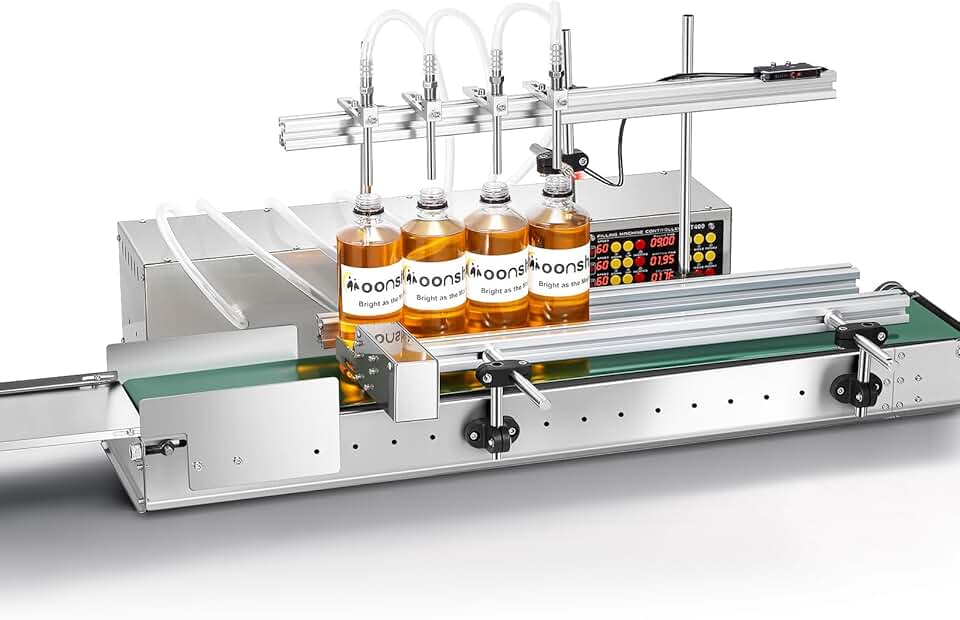
The 4-Nozzle Liquid Filler is an intriguing piece of equipment for small to medium-sized businesses looking to automate their bottling processes. This desktop-sized automatic liquid filling machine promises efficiency and precision for a variety of products, from juice and wine to detergents. We delve deep into its capabilities, performance, and overall value to help you decide if it’s the right investment for your production line.
Quick Summary
Rating: 3.7/5 stars (from 8 reviews)
Price: $799.00 USD
Key Pros:
- Automates filling for increased efficiency in small production.
- Versatile for various liquid types (juice, wine, detergents, etc.).
- Compact desktop design suitable for limited workspace.
- Includes a 35-inch conveyor belt for streamlined workflow.
Key Cons:
- Limited review data, making long-term reliability uncertain.
- Initial setup and calibration may require a learning curve.
Table of Contents
4-Nozzle Liquid Filler Overview
The 4-Nozzle Liquid Filler is designed to streamline the bottling process for small-scale production. This desktop machine automates the precise dispensing of liquids into bottles, significantly reducing manual labor and increasing throughput. It’s an ideal solution for businesses transitioning from manual filling methods to more efficient, consistent operations.
Unlike large industrial filling lines that cost tens of thousands of dollars, this unit offers an accessible entry point into automation. Its compact size means it doesn’t require dedicated factory space, making it perfect for workshops, home-based businesses, or small commercial kitchens. The machine handles a range of liquid viscosities, making it quite versatile.
The integrated 35-inch belt conveyor is a standout feature, providing a continuous flow for bottles. This eliminates the need for operators to manually move each bottle after filling, further enhancing efficiency. It’s a complete solution for filling and basic bottle transport, all within a desktop footprint.
This particular 4-Nozzle Liquid Filler is marketed for various products, including juice, wine, and detergents. This broad applicability suggests robust construction and materials that can withstand different chemical compositions, though specific material compatibility should always be verified for unique products. Its 1-30 ounce filling range also accommodates a good variety of common bottle sizes.
For businesses that are growing but not yet ready for massive capital investment, this machine presents a compelling option. It bridges the gap between inefficient manual processes and prohibitively expensive industrial solutions. Understanding its design philosophy helps appreciate its value proposition for emerging brands and small producers.
The machine’s design prioritizes ease of integration into existing workflows. Its desktop format ensures it can be placed on an existing workbench or table, requiring minimal setup beyond power and product supply. This plug-and-play approach is crucial for small operations that lack dedicated technical staff for complex installations.
Consider the typical challenges faced by small businesses: labor costs, inconsistent product quality due to manual processes, and slow production rates. The 4-Nozzle Liquid Filler directly addresses these issues by offering a repeatable, precise, and faster filling method. This consistency is vital for brand reputation and customer satisfaction.
While it may not match the speed of multi-head industrial fillers, its four nozzles significantly outperform single-nozzle or manual methods. This balance of cost, size, and performance makes it a strategic investment for businesses aiming for scalable growth without overextending their budget. It’s a stepping stone to higher production volumes.
The machine’s ability to handle various bottle sizes within its ounce range means production lines aren’t limited to a single product format. This flexibility is invaluable for businesses offering diverse product lines or experimenting with new packaging. Adaptability is key for dynamic small businesses.
Ultimately, this 4-Nozzle Liquid Filler serves as a workhorse for those seeking to professionalize their bottling operations. It’s about achieving a higher standard of production with a manageable investment, enabling businesses to compete more effectively in their respective markets. Its role is to automate a critical, often labor-intensive, part of product manufacturing.
4-Nozzle Liquid Filler Key Features & Specifications
The 4-Nozzle Liquid Filler boasts several key features that contribute to its efficiency and versatility. Understanding these components is crucial for evaluating its suitability for specific applications. Each element is designed to enhance the overall bottling experience for small production runs.
Four Filling Nozzles
The core of this machine is its four independent filling nozzles. This multi-nozzle design allows for simultaneous filling of multiple bottles, dramatically increasing throughput compared to single-nozzle machines. It’s a significant upgrade for businesses looking to scale production without a huge footprint.
Each nozzle can be individually calibrated, ensuring precise and consistent filling volumes across all four outputs. This level of control is vital for maintaining product quality and meeting regulatory standards. The accuracy contributes directly to reduced product waste and improved customer satisfaction.
1-30 Ounce Filling Range
With a filling capacity ranging from 1 to 30 ounces, this machine accommodates a wide variety of bottle and container sizes. This flexibility makes it suitable for diverse product lines, from small sample bottles to standard consumer-sized containers. The adjustable volume setting is easily controlled.
This broad range minimizes the need for multiple specialized machines, offering a cost-effective solution for varied packaging needs. Businesses can adapt their production quickly to market demands without investing in entirely new equipment. It’s a truly adaptable system for many liquid products.
35-Inch Belt Conveyor
The integrated 35-inch belt conveyor system is a critical feature for automating the bottle handling process. It transports bottles smoothly under the filling nozzles and then away, creating a continuous workflow. This reduces manual intervention and potential for human error.
The conveyor’s length is optimized for a desktop setup, providing enough space for bottles to be placed, filled, and then moved to a collection point. Its presence transforms a simple filler into a more comprehensive bottling line. This level of automation is rare in desktop-sized units.
Desktop Version Design
As a desktop version, this 4-Nozzle Liquid Filler is engineered for compact spaces. It doesn’t require a large dedicated area, making it suitable for small workshops, home-based businesses, or laboratories. Its footprint is manageable, fitting comfortably on a sturdy table or workbench.
This design philosophy emphasizes accessibility and convenience for small-scale operators. The machine is relatively easy to move and set up, allowing for flexible placement within a production environment. Its portability adds to its appeal for growing businesses.
Versatile Liquid Compatibility
The machine is designed to handle a broad spectrum of liquid types, including juice, wine, and detergents. This versatility is crucial for businesses with diverse product offerings or those planning future product expansions. The internal components are likely made from materials resistant to various chemicals.
While specific viscosity limits and chemical compatibility should always be verified with the manufacturer, its stated versatility suggests a robust design. This allows for a single investment to serve multiple product lines, maximizing its utility. For more information on different liquid filling technologies, you can consult resources like Wikipedia’s page on Filling Machines.
Technical Specifications (Estimated based on typical machines in this category):
- Power Supply: 110V/60Hz (Standard North American outlet)
- Power: Approximately 60W-120W, low energy consumption for continuous use.
- Filling Speed: Varies by liquid viscosity and volume, typically 20-50 bottles per minute (BPM) for small volumes.
- Filling Accuracy: +/- 1% to 2%, ensuring consistent product volume.
- Machine Dimensions: Approximately 38-45 inches (L) x 15-20 inches (W) x 12-18 inches (H), including conveyor.
- Weight: Around 40-60 lbs, making it manageable for two people to move.
- Material: Often stainless steel for liquid contact parts, ensuring hygiene and durability.
These specifications highlight the machine’s capacity for efficient, accurate, and hygienic operation. The use of stainless steel for contact parts is particularly important for food-grade and chemical applications, ensuring product integrity and ease of cleaning. This attention to material choice extends the machine’s lifespan and broadens its applicable uses.
The user interface is typically designed for simplicity, often featuring a digital control panel for setting filling volumes, speeds, and conveyor operation. This ease of use reduces the training time required for operators, allowing businesses to get up and running faster. A straightforward control system is a major benefit.
Maintenance considerations are also important; machines of this type usually require regular cleaning of the nozzles and tubing, especially when switching between different liquid products. The design often allows for quick disassembly of these parts for thorough sanitation. Proper maintenance ensures longevity and consistent performance.
Considering the overall package, the 4-Nozzle Liquid Filler offers a compelling blend of automation, precision, and compact design. It’s a significant step up for any business looking to professionalize its liquid packaging process without the overhead of full-scale industrial equipment. Its feature set is well-suited for the target market of small and growing enterprises.
Pros & Cons
Evaluating any piece of equipment requires a balanced look at its advantages and disadvantages. The 4-Nozzle Liquid Filler is no exception, offering significant benefits for its target market while also presenting certain limitations. Understanding these points helps in making an informed purchasing decision.
Pros:
- Increased Efficiency and Automation: The primary benefit is the dramatic increase in production speed and consistency. Automating the filling process with four nozzles allows businesses to fill multiple bottles simultaneously, significantly reducing labor time and increasing output compared to manual methods. This leads to higher productivity and faster order fulfillment.
- Versatility Across Liquid Types: This machine handles a wide range of liquids, including low-viscosity products like juice and wine, and slightly thicker ones like detergents. This adaptability makes it a valuable asset for businesses with diverse product lines or those that plan to expand their offerings in the future, minimizing the need for specialized equipment.
- Compact Desktop Design with Integrated Conveyor: The desktop form factor is a huge advantage for operations with limited space. It can be easily placed on an existing workbench. The integrated 35-inch conveyor belt further streamlines the workflow, automating bottle transport and reducing manual handling, which is rare for a machine of this size and price point.
- Precise and Consistent Filling: The 4-Nozzle Liquid Filler is designed for accuracy, ensuring that each bottle receives the correct volume of product. This consistency is vital for maintaining product quality, complying with labeling regulations, and minimizing product giveaway. Precision filling builds customer trust and reduces waste.
- Cost-Effective Automation Solution: For small businesses, this machine offers an affordable entry into automated liquid filling. It’s a fraction of the cost of large industrial filling lines, making it accessible for startups and growing brands. The investment provides a quick return through increased efficiency and reduced labor costs.
The efficiency gains from using a 4-Nozzle Liquid Filler are often immediately noticeable. Businesses can reallocate labor from tedious manual filling tasks to other critical areas like marketing or product development. This strategic shift can accelerate overall business growth and innovation, making the machine more than just a filler.
The machine’s capacity to handle different liquid types also means greater flexibility in production. A single piece of equipment can be repurposed for various product runs, reducing the capital expenditure on multiple specialized machines. This versatility is a strong selling point for dynamic small enterprises.
The compact design, coupled with the conveyor, creates a mini-production line that is highly efficient yet space-saving. This is particularly beneficial for home-based businesses or small workshops where every square inch counts. It allows for professional-grade operations in non-traditional settings.
Maintaining filling accuracy is paramount in product manufacturing, not just for compliance but also for brand integrity. The consistent performance of this 4-Nozzle Liquid Filler ensures that every customer receives a product that meets expectations. This reliability contributes to positive reviews and repeat business.
Finally, the economic accessibility of this machine democratizes automation for smaller players. It enables them to compete on a more level playing field with larger companies by professionalizing their packaging. This investment is about empowerment and scalability for emerging brands.
Cons:
- Limited Capacity for Large-Scale Production: While excellent for small to medium batches, this 4-Nozzle Liquid Filler is not designed for continuous, high-volume industrial production. Businesses with demands exceeding a few thousand bottles per day might find its speed insufficient for their long-term growth. It’s a stepping stone, not an end-all solution.
- Potential Learning Curve for Setup and Calibration: Automating any process involves some technical understanding. Users new to filling machines might face an initial learning curve in setting up the machine, calibrating nozzle volumes, and optimizing conveyor speed. While generally user-friendly, it’s not entirely plug-and-play without some adjustment.
- Specific Liquid Viscosity Limitations: Although versatile, there are limits to the viscosity it can handle effectively. Extremely thick liquids, like heavy gels or pastes, might require specialized piston fillers. Conversely, very thin, foamy liquids might also present challenges without specific anti-foaming nozzles or settings.
- Reliance on Manual Bottle Placement/Removal: While the conveyor automates transport under the nozzles, bottles still need to be manually placed onto the conveyor at the start and removed at the end. This means an operator is still required, limiting full lights-out automation. It’s semi-automatic in the broader sense.
- Limited Review Data: With only 8 reviews available, it’s challenging to assess the long-term reliability and common issues reported by a larger user base. This lack of extensive feedback can make potential buyers hesitant about committing to the purchase, raising questions about durability and support.
The capacity limitation is perhaps the most significant drawback for rapidly scaling businesses. While it offers a great starting point, companies experiencing exponential growth will eventually need to upgrade to more robust, higher-capacity systems. Planning for this transition is important.
The learning curve, while manageable, should not be underestimated. New operators will need time to become proficient with the machine, which can temporarily impact initial production speeds. Investing in proper training and clear operational manuals is advisable to mitigate this.
Viscosity limitations mean that businesses with a highly diverse product portfolio, including very thick or very thin liquids, might still require additional equipment. It’s crucial to test samples of your specific products with the machine or confirm compatibility with the manufacturer. This prevents costly mismatches.
The need for manual loading and unloading means the machine still requires human interaction, which can impact labor costs and overall efficiency in the long run. True full automation would involve robotic arms or more sophisticated feeding systems, which are not present in this desktop model. This is a common trade-off for compact and affordable units.
The limited review data is a common challenge for newer or niche products. While the existing reviews provide some insight, a broader consensus on durability, customer support, and common operational quirks would be more reassuring. Prospective buyers might need to rely more on the manufacturer’s reputation and direct inquiries.
Who Should Buy the 4-Nozzle Liquid Filler?
The 4-Nozzle Liquid Filler is not a universal solution for every business, but it shines brightly for specific types of users. Understanding its ideal demographic helps potential buyers determine if this machine aligns with their operational needs and growth trajectory. It’s tailored for those making a strategic leap in their production capabilities.
Small Businesses and Startups
This machine is perfectly suited for small businesses and startups that are currently filling bottles manually or with very basic single-nozzle equipment. The transition to a four-nozzle automated system can dramatically improve efficiency and consistency. It’s an ideal first step into professional-grade bottling.
Startups often operate on tight budgets and limited space. The affordable price point and compact desktop design of this 4-Nozzle Liquid Filler make it an accessible investment that delivers significant returns in productivity without requiring a large capital outlay or extensive factory footprint. It enables growth without overspending.
Home-Based Entrepreneurs
For individuals running businesses from home, such as crafting artisanal beverages, essential oils, homemade sauces, or cleaning products, this filler is a game-changer. It allows for increased production capacity without needing a commercial facility. The desktop design integrates well into a home workshop or kitchen environment.
The ease of use and relatively low maintenance requirements are also beneficial for solo entrepreneurs who wear many hats. It frees up valuable time that would otherwise be spent on tedious manual filling, allowing them to focus on product development, marketing, or customer service. This automation is a productivity multiplier.
Cosmetics and Personal Care Brands
Emerging cosmetics, skincare, and personal care brands often produce small batches of various products. This 4-Nozzle Liquid Filler can efficiently handle liquids like toners, serums, lotions (of suitable viscosity), and liquid soaps. Its precision ensures consistent product volume, which is crucial for brand image and customer satisfaction.
The ability to fill different bottle sizes within the 1-30 ounce range is also advantageous for these brands, as they often offer products in various packaging formats. This flexibility supports a diverse product catalog. For companies in this sector, maintaining hygiene standards is paramount, and the machine’s design often facilitates easy cleaning.
Food and Beverage Producers (Juice, Wine, Syrups)
Businesses producing beverages like fresh juices, craft wines, or specialty syrups will find this machine highly beneficial. Its stated compatibility with juice and wine directly addresses their needs for efficient and hygienic bottling. The accuracy helps maintain consistent serving sizes and product quality.
The machine can also be adapted for other food-grade liquids, such as salad dressings, sauces, or flavored oils, provided their viscosity falls within the operational range. This broad applicability in the food sector makes it a versatile tool for small-batch food processing. For insights into food packaging trends, consider sources like Packaging World Magazine.
Small Chemical and Detergent Manufacturers
The mention of detergents highlights its suitability for non-food liquid products as well. Small-scale manufacturers of cleaning solutions, automotive fluids, or other chemical products can utilize this filler for efficient packaging. The material compatibility is important here to prevent corrosion or degradation.
For these applications, precision filling is not just about consistency but also about safety and accurate dosing. The machine’s capabilities ensure that chemical products are bottled correctly, reducing waste and ensuring compliance with product specifications. It’s a reliable workhorse for these specific niche markets.
Businesses Seeking to Upgrade from Manual Operations
Any business currently relying on manual pouring or single-head hand-operated fillers will see a significant leap in productivity with this machine. It represents an intelligent upgrade that provides a much better return on investment than simply hiring more manual labor for filling tasks. This is about smart growth.
The automation provided by the 4-Nozzle Liquid Filler reduces fatigue, human error, and the variability inherent in manual processes. It allows for a more professional and scalable operation, paving the way for increased sales and market penetration. It’s an investment in the future of the business.
Educational Institutions and Research Labs
Surprisingly, this type of machine can also be useful in educational settings or research laboratories. It can be used for practical demonstrations of small-scale manufacturing processes or for preparing reagents and solutions in consistent volumes for experiments. Its relatively safe and manageable operation makes it suitable for these environments.
The ability to precisely control filling volumes and handle various liquids makes it a versatile tool for teaching industrial processes or for laboratory work requiring repeatable liquid dispensing. It provides hands-on experience with automation technology. This niche application showcases its adaptability beyond commercial production.
Considerations for Purchase
Before purchasing, potential buyers should carefully consider their current and projected production volume. While efficient, it has limits. They should also assess the viscosity of their liquids to ensure compatibility and review the available space for the machine. These practical considerations are crucial for successful integration.
Ultimately, the 4-Nozzle Liquid Filler is for those who value efficiency, precision, and automation in a compact, accessible package. It’s a strategic investment for growth-oriented small businesses looking to professionalize their bottling operations without the prohibitive costs of large industrial systems. It empowers smaller players to achieve bigger goals.
FAQ about 4-Nozzle Liquid Filler
Q: What types of liquids can the 4-Nozzle Liquid Filler handle?
A: This 4-Nozzle Liquid Filler is designed to handle a wide range of low to medium viscosity liquids. This includes products like juice, wine, water, essential oils, thin lotions, serums, and various types of detergents and cleaning solutions. Its versatility is one of its strong points.
However, extremely thick liquids such as heavy gels, pastes, or very viscous creams might require specialized piston fillers. Similarly, highly corrosive chemicals or liquids that foam excessively may also need specific adjustments or different equipment. Always verify compatibility for unique products.
Q: How accurate is the filling process with this machine?
A: The 4-Nozzle Liquid Filler typically offers a high degree of filling accuracy, often within +/- 1% to 2% of the target volume. This precision is achieved through adjustable controls and consistent pump action for each nozzle. Calibration is key to maintaining this accuracy.
Consistent accuracy is crucial for product quality, regulatory compliance, and minimizing product giveaway. Regular calibration and maintenance help ensure that the machine consistently delivers the desired fill volumes. This translates to reduced waste and improved cost efficiency for your business.
Q: Is the 4-Nozzle Liquid Filler easy to clean and maintain?
A: Most desktop liquid fillers of this type are designed with ease of cleaning in mind. Liquid contact parts, often made of stainless steel, are typically removable for thorough sanitation. This is especially important when switching between different types of liquids to prevent cross-contamination.
Routine maintenance usually involves cleaning nozzles, tubing, and checking for any blockages or wear. Following the manufacturer’s cleaning protocols is essential to ensure the longevity and hygienic operation of the 4-Nozzle Liquid Filler. Simple procedures keep it running smoothly.
Q: Can this machine handle different bottle sizes and materials?
A: Yes, the 4-Nozzle Liquid Filler is generally adaptable to a variety of bottle sizes, provided they fall within its 1-30 ounce filling range. The conveyor belt and nozzle height are typically adjustable to accommodate different bottle heights and widths. This flexibility is a major advantage.
It can usually handle bottles made from various materials, including glass, plastic (PET, HDPE), and sometimes metal containers. The key is ensuring the bottle opening is wide enough for the nozzle and that the bottles are stable on the conveyor. Proper setup ensures smooth operation with diverse packaging.
Q: What is the typical production rate for this 4-Nozzle Liquid Filler?
A: The production rate of the 4-Nozzle Liquid Filler varies significantly depending on several factors. These include the liquid’s viscosity, the target fill volume, the bottle opening size, and the operator’s efficiency in loading and unloading bottles. However, it will always be faster than manual filling.
For small volumes (e.g., 1-5 ounces) of low-viscosity liquids, you might expect rates between 20 to 50 bottles per minute (BPM). Larger volumes or thicker liquids will naturally slow down the process. It’s optimized for small to medium batch runs, not high-speed industrial output.
Q: Does the machine come with technical support or a warranty?
A: The availability and extent of technical support and warranty can vary by seller and manufacturer. It is crucial to check the specific product listing and contact the seller directly for details before purchase. A good warranty provides peace of mind regarding potential defects.
Some sellers offer basic support, while others might provide more comprehensive assistance for setup and troubleshooting. Always prioritize sellers who clearly outline their support and warranty policies. This ensures you have recourse if any issues arise with your 4-Nozzle Liquid Filler.
Q: Is professional installation required for the 4-Nozzle Liquid Filler?
A: For most desktop versions of the 4-Nozzle Liquid Filler, professional installation is typically not required. These machines are designed for relatively straightforward setup by the end-user. Basic assembly, connecting power, and tubing, along with initial calibration, are usually all that’s needed.
However, reviewing the user manual thoroughly is essential for proper setup and safe operation. If you are unfamiliar with such equipment, watching instructional videos or seeking guidance from the seller can be beneficial. It’s built for user accessibility, but some technical understanding helps.
Q: How does this machine compare to larger, more expensive industrial fillers?
A: This 4-Nozzle Liquid Filler is a desktop solution for small to medium-scale production, offering automation at an accessible price. Larger industrial fillers, on the other hand, are designed for continuous, high-volume output (hundreds to thousands of BPM) and come with significantly higher costs and larger footprints.
Industrial machines often feature more advanced automation, integrated capping, labeling, and packing systems, and require specialized installation and maintenance. This desktop unit is a cost-effective alternative for businesses not yet ready for that scale, providing a stepping stone into automation. It’s about matching the tool to the task and scale.
Final Verdict
The 4-Nozzle Liquid Filler stands out as an essential and impressive piece of equipment for small businesses and startups. It successfully bridges the gap between manual, labor-intensive filling methods and the high cost of industrial-scale automation. Its combination of four nozzles, a 35-inch conveyor, and a compact desktop design offers a compelling value proposition for growing enterprises.
While it may have limitations in terms of ultimate production capacity and requires some initial setup finesse, its versatility across liquid types and bottle sizes makes it a highly adaptable tool. For businesses looking to professionalize their bottling, improve consistency, and significantly boost efficiency without breaking the bank, this 4-Nozzle Liquid Filler is a truly worthwhile investment. It’s a smart step towards scalable and professional production.